Gartner forecasts worldwide AI spending will reach $2.59 trillion in 2026, a 47% jump over 2025. A growing share of that budget is moving from chatbots and copilots to autonomous AI agents: software that perceives context, reasons over data, plans multi-step actions, and executes end-to-end workflows across CRMs, ERPs, and legacy systems without continuous human input.
In such a scenario, choosing the right AI agent development company depends on more than finding a team that can connect an application to an LLM. Businesses need development partners that understand AI architecture, agentic workflows, RAG, LLM integration, APIs, enterprise software, data security, and production deployment.
The companies below represent different strengths within the AI agent development market. Some specialize in enterprise AI and automation, while others focus on conversational AI, generative AI products, data engineering, nearshore development, or specialized machine learning talent.
Important: This is a comparative list, not a universal ranking. The best AI agent development company for your business will depend on your use case, industry, budget, technical requirements, security needs, and the complexity of the systems you need to integrate.
But first, we will understand:
An AI agent development company designs, builds, and deploys autonomous software agents that can perceive context, reason over data, make decisions, and take actions across business systems with minimal human input. Unlike a basic chatbot that only answers questions, an AI agent can complete end-to-end workflows: qualifying a lead in your CRM, reconciling invoices in your ERP, triaging support tickets, scheduling logistics routes, or monitoring patient data and escalating anomalies.
A capable AI agent development partner typically combines:
Okay, let’s start the list:
Best for End-to-End AI Agent Development
Founded in 2012, Zealous System has grown into a 100+ member technology team serving more than 1,000 clients across four continents, with delivery offices in India, the USA, Australia, and Poland. The company is a Microsoft Gold Partner, is a Great Place to Work certified, and has verified client reviews across platforms such as Clutch and GoodFirms.
Zealous System combines AI and machine learning expertise with broader software engineering capabilities, making it relevant for businesses that need to build AI agents that operate within real-world business environments rather than as standalone chatbots. Its capabilities include custom AI agent development, agentic AI, autonomous AI agents, RAG-powered applications, generative AI, LLM integration, conversational AI, AI copilots, and AI workflow automation.
For businesses looking for a single technology partner that can take an AI agent from strategy and consulting through custom development, system integration, deployment, and long-term optimization, Zealous System is a strong option to consider.
Best Suited For: Startups and enterprises looking for a full-cycle AI agent development partner that can manage strategy, development, integration, deployment, and ongoing support.
Best for Custom AI Agents and Enterprise Workflow Integration
Established in 2008, Prismetric works with startups, SMBs, and enterprises that want to turn AI ideas into working business applications. The company reports 1,000+ clients, 1,500+ solutions delivered, a presence across 50+ countries, and a development team of more than 100 professionals. Its wider background in software and product engineering also gives it the technical foundation needed for AI projects that involve existing business systems.
Its AI agent development services focus on solving practical operational problems rather than building agents that work in isolation. Prismetric develops custom AI agents, autonomous systems, AI chatbots, multi-agent applications, RAG solutions, AI copilots, and workflow automation systems. It also connects these solutions with APIs, CRMs, ERPs, databases, cloud platforms, and other enterprise tools so agents can access information, trigger actions, and support multi-step processes.
Prismetric is worth considering when a project needs both AI expertise and conventional software engineering under one team. Businesses can work with the company across use-case planning, architecture, model and framework selection, development, integration, testing, production rollout, monitoring, and further improvements after launch.
Best Suited For: Startups, growing companies, and enterprises that need purpose-built AI agents connected to their existing applications, data, and operational workflows.
Custom Software and Agentic AI Development
Gleaming Systems is a custom software development company offering solutions across web and mobile development, cloud, eCommerce, AI, generative AI, chatbots, and other emerging technologies. Its AI capabilities are supported by experience across multiple industries, with the company highlighting 1,500+ completed projects and 500+ clients.
For businesses exploring AI agent development services, this broader engineering background can be valuable when agents need to integrate with existing software, business workflows, and enterprise systems rather than operate as standalone tools.
Best suited for: Businesses that want custom AI agent development alongside software engineering, system integration, and ongoing technology support.
SoluLab provides software engineering and emerging technology development services across areas including artificial intelligence, machine learning, blockchain, and enterprise software.
The company reports 10+ years in operation and hundreds of delivered projects, with client ratings above 4.5/5 on review platforms such as Clutch.
Its AI capabilities cover custom AI applications, LLM-powered solutions, intelligent automation, and AI agents. The company’s broader technology expertise can be useful for organizations that need AI development alongside other software engineering requirements.
For startups, this can be particularly relevant when an AI agent is part of a larger product that also requires web or mobile development, backend infrastructure, APIs, and cloud deployment.
Best suited for: Startups and enterprises looking for flexible AI agent development combined with broader product engineering capabilities.
Data Science and Custom AI Engineering
Founded in 2014 by Marat Karpeko, InData Labs is a data science and custom AI development company with a team of 100+ data scientists, ML engineers, and AI specialists. The company is also an AWS Partner, with experience across generative AI, AI agent development, LLM solutions, autonomous AI agents, NLP, predictive analytics, computer vision, OCR, and MLOps.
What makes InData Labs interesting for AI agent projects is its data-first approach. Many enterprise AI agents don’t fail because of the underlying AI model—they struggle because the data is fragmented, outdated, or difficult to access. InData Labs’ expertise in data science and machine learning can be valuable for businesses building AI agents for forecasting, recommendations, fraud detection, analytics, and document-intensive workflows.
Best suited for: Mid-sized and data-heavy organizations looking for a custom AI agent development company to build intelligent solutions around complex data, analytics, forecasting, and document workflows.
Best for AI Automation and Multi-Agent Systems
Founded in 2008, Intuz has delivered more than 1,700 projects across 14+ industries working with organizations ranging from Fortune 500 companies such as JLL and Bosch to startups. The company reports that more than 80% of its clients have continued working with it for three years or longer. Intuz is also ISO 9001 certified and identifies itself as a Microsoft and AWS Consulting Partner.
The company’s AI capabilities include custom AI agent development, multi-agent systems, LLM applications, generative AI, AI automation, and intelligent workflow development. This makes it relevant for businesses looking to move beyond basic conversational AI and explore agents that can perform tasks across multiple systems.
Best suited for: Companies exploring AI workflow automation, custom AI agents, and multi-agent systems.
Best for Nearshore AI Engineering Teams
Founded in 2016, Azumo began with Twitter as its first client and has grown into a nearshore technology company with a team of approximately 110 professionals. The company reports having delivered more than 100 AI projects for organizations including Meta, Discovery, Zynga, and UnitedHealth.
Azumo’s focus includes artificial intelligence, machine learning, data science, and custom software engineering. Its nearshore model can be attractive to North American companies that need additional AI engineering capacity while maintaining closer time-zone alignment and real-time collaboration.
Best suited for: US businesses seeking nearshore AI engineering, machine learning expertise, and flexible development teams.
Best for Large-Scale Enterprise AI Development
Founded in 2007, Innowise has grown to more than 3,500 IT professionals and reports delivering over 1,600 projects across more than 40 industries for 300+ clients. Its client portfolio includes organizations such as NTT DATA and Commercial Bank of Qatar, while the company reports a 93% client return rate.
Innowise offers capabilities across artificial intelligence, machine learning, data engineering, cloud computing, enterprise software, and digital transformation. Its scale can be particularly relevant for large organizations that need multiple engineering disciplines working together on complex AI initiatives.
Best suited for: Large enterprises and organizations managing complex AI transformation and software engineering programs.
Best for Data-Heavy Enterprise AI and AI Agent Projects
Founded in 2002, N-iX employs more than 2,400 engineers across 10 countries and has built a client portfolio that includes Fortune 500 companies such as Bosch, Siemens, eBay, and Inditex. Forbes Ukraine reported approximately ₴5 billion in revenue for the company in 2022, equivalent to roughly $135 million at the time.
N-iX combines software engineering, data engineering, cloud technologies, artificial intelligence, and machine learning, making its capabilities particularly relevant for enterprise AI projects where data infrastructure is as important as the AI model itself.
Best suited for: Enterprises building data-intensive AI agents and large-scale AI systems that require complex cloud and data infrastructure.
Best for Specialized AI and Machine Learning Expertise
Founded in 2019 by former Google and CapitalG executive Jaclyn Rice Nelson and Noah Gale, Tribe AI operates a referral-based network of more than 600 vetted AI engineers and product builders.
Rather than following a traditional software development agency model, Tribe AI focuses on connecting organizations with specialized AI and machine learning professionals. The company reports working with organizations including Google, Amazon, and Scale AI on enterprise AI initiatives spanning proof of concept through production.
This model can be particularly relevant for organizations working on technically complex AI challenges that require specialized machine learning expertise. For example, a business developing a highly customized AI system may benefit from access to experienced practitioners who can work on model development, AI strategy, machine learning infrastructure, or advanced AI applications.
Why consider Tribe AI: 600+ vetted AI engineers and product builders, a specialized AI talent model, and experience supporting enterprise AI programs from proof of concept to production.
Best suited for: Organizations with advanced or specialized AI and machine learning requirements that need access to experienced AI practitioners.
The cost of AI agent development in 2026 depends largely on the complexity of the agent, the number of systems it needs to integrate with, and the level of autonomy and security required. Here’s a simple breakdown:
These are designed to handle focused, single-task workflows, such as customer support, lead qualification, FAQ automation, or RAG-based knowledge retrieval. They typically involve limited integrations and straightforward workflows.
At this level, AI agents can manage multi-step workflows and connect with multiple business systems, including CRMs, ERPs, APIs, and internal databases. The additional integrations and decision-making capabilities make them suitable for automating more complex business processes.
Enterprise-grade solutions often involve multi-agent architectures, advanced orchestration, multiple AI models, extensive system integrations, custom evaluations, security, compliance, governance, and human-in-the-loop workflows.
Beyond development, businesses should also budget for ongoing AI agent costs, including LLM API usage, cloud infrastructure, monitoring, maintenance, security, and optimization. As a general benchmark, these ongoing expenses can add around 15–30% of the initial development cost annually, depending on usage and system complexity.
| Agent Type | Cost Range | Development Timeline |
|---|---|---|
| Simple AI Agent | $15,000 – $50,000 | 4–8 weeks |
| Intermediate AI Agent | $50,000 – $150,000 | 8–14 weeks |
| Complex & Enterprise AI Agent | $150,000 – $500,000+ | 3–6+ months |
| Annual Ongoing Costs | 15–30% of build cost | Continuous |
Our advice: When budgeting for an AI agent, look beyond the initial build price. Consider the total cost of ownership, including development, deployment, ongoing operations, and future improvements. The cheapest solution isn’t always the most cost-effective one if it can’t scale or deliver reliable results.
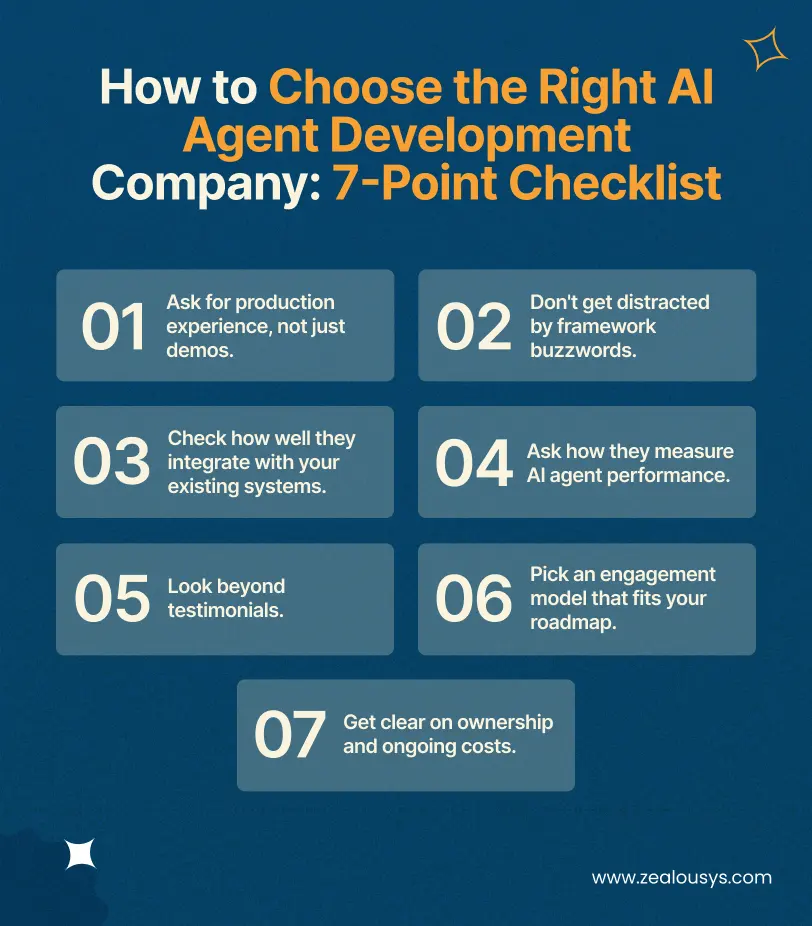
Choosing an AI agent development company isn’t about finding the vendor with the coolest demo. It’s about finding a partner who understands your business, knows where AI agents actually add value, and can take them from prototype to production. Here’s what I’d look for before signing a contract.
Anyone can build an impressive prototype. Ask to see AI agents they’ve deployed in real businesses and find out what happened after launch. How long has the agent been running? What broke? How did they fix it? Real-world experience matters more than a perfect demo.
LangGraph, CrewAI, AutoGen, Claude Agent SDK- these are all useful, but the tool isn’t the strategy. Ask why they’d choose a particular framework for your use case. A good AI agent development company should understand orchestration, RAG, memory, tool calling, model selection, and cost, and know when you don’t need a complex multi-agent system.
Your AI agent won’t live in a vacuum. It may need to connect with your CRM, ERP, EHR, APIs, databases, or internal tools. Ask how they’ll handle integrations, authentication, permissions, data governance, and failures. A smart AI agent that can’t work with your existing tech stack isn’t very useful.
Before you hire anyone, ask how they test and monitor their agents. How do they handle hallucinations, security risks, prompt injection, incorrect actions, and edge cases? Look for a partner with strong AI agent evaluation, guardrails, human-in-the-loop workflows, and monitoring.
Check independent reviews on platforms like Clutch, GoodFirms, and G2. Look for case studies relevant to your industry and, if possible, speak with past clients. You want evidence that the company can deliver, not just a great sales pitch.
Building one focused AI agent? A fixed-scope project may work. Planning a broader agentic AI transformation? You may need a dedicated team or long-term partner. Choose a company that can support you beyond the initial launch.
Make sure you know who owns the code, prompts, workflows, integrations, and data. Also understand the ongoing costs of LLM APIs, cloud infrastructure, monitoring, and maintenance. The development quote is only part of the total cost.
There is no one AI agent development company that is the best for every business. The right choice depends on what you want to build, the systems you need to connect with, your security and compliance needs, and whether you need a specialized AI team or a complete software development partner.
For custom AI agent development, Zealous System is a strong option for businesses looking for AI expertise along with software development and system integration capabilities. For enterprise AI and AI copilots, LeewayHertz is worth considering. For data-first AI agent projects, InData Labs may be a good fit.
Businesses looking for nearshore AI engineering can consider Azumo, while companies that need large-scale enterprise development may look at Innowise or N-iX. For specialized machine learning projects, Tribe AI offers access to experienced AI talent.
In the end, the best AI agent development company is one that understands your business, has experience with similar projects, can work with your existing systems, keeps your data secure, and can show how its AI solution will deliver real business value.
An AI agent development company builds AI-powered software agents that can understand context, reason through tasks, access business data, use external tools, and perform actions across business systems.
An AI agent development company typically handles AI strategy, agent architecture, LLM integration, RAG implementation, API integration, workflow automation, security, testing, deployment, and ongoing monitoring.
AI agent development typically costs $15,000–$50,000 for a simple workflow agent, $50,000–$150,000 for intermediate agents with multiple integrations, and $150,000–$500,000+ for complex enterprise multi-agent systems. The final cost depends on complexity, integrations, data, security, and ongoing infrastructure requirements.
A simple AI agent may take 4–8 weeks to develop. RAG-powered assistants can take 8–14 weeks, while complex enterprise AI agents and multi-agent systems may require 3–6 months or longer.
A chatbot primarily responds to user messages. An AI agent can understand a goal, reason through multiple steps, access tools and data, and take actions to complete a task.
There is no single best AI agent development company for every business. The right partner depends on your project requirements, industry, budget, technical complexity, security needs, and preferred delivery model.
Businesses should consider hiring an AI development company when they lack specialized AI engineering expertise, need to launch quickly, or require complex integrations. In-house development may make more sense when AI is a core part of the company’s long-term product strategy.
Common technologies include LangGraph, LangChain, CrewAI, AutoGen, OpenAI Agents SDK, Claude Agent SDK, LlamaIndex, and Pydantic AI. The appropriate framework depends on the architecture and requirements of the project.
AI agents can be secure enough for enterprise use when they are built with appropriate access controls, data protection, monitoring, audit logs, guardrails, and human approval mechanisms.
AI agents are being explored across healthcare, financial services, logistics, manufacturing, education, real estate, e-commerce, customer service, and other industries with complex or repetitive workflows.
RAG, or Retrieval-Augmented Generation, allows an AI system to retrieve relevant information from a company’s private knowledge base or database before generating a response. This can help ground AI agents in business-specific information.
A multi-agent system uses multiple specialized AI agents that collaborate on a larger task. For example, one agent might research information, another might analyze it, and a third might prepare a final response.
Agentic AI refers to AI systems that can operate toward a goal by reasoning, planning, using tools, and taking actions with varying levels of autonomy.
Our team is always eager to know what you are looking for. Drop them a Hi!

Nandini Pare is a CAPM® Certified Business Analyst at Zealous System, specializing in business analysis, Agile delivery, and helping organizations build technology solutions that solve real business challenges.


Comments