AI is no longer limited to simple automation. It is moving quickly toward systems that can think, decide, and act on their own. This shift from basic automation to autonomy is changing how businesses operate, especially for teams that rely on speed, accuracy, and real-time decision-making.
However, most traditional automation solutions still depend on fixed rules and predefined workflows. They handle repetitive tasks well, but they struggle when situations change or when decisions require context. This limitation often leads to bottlenecks, failed AI pilots, and missed opportunities for growth.
This is where agentic AI workflows come into the picture.
Agentic AI workflows combine the power of AI agents, real-time data, and intelligent decision-making to create systems that can plan, execute, and refine tasks with minimal human intervention. Instead of just following instructions, these workflows adapt, learn, and take actions based on changing conditions.
For CTOs, product managers, founders, and operations leaders, this opens up a new way to scale operations, reduce manual effort, and build smarter systems that drive real business outcomes.
In this guide, you will learn what agentic AI workflows are, how they work, where they are used, and how they can help your business move beyond automation into true autonomy.
Agentic AI workflows are intelligent systems that use AI agents to perform tasks, make decisions, and take actions autonomously without constant human input.
Unlike traditional automation, which follows fixed rules, agentic AI workflows analyze data, reason through problems, and adapt their actions based on real-time inputs. They sit at the autonomous end of a spectrum. That spectrum starts with rule-based scripting, runs through AI workflow automation where models make decisions inside a path someone designed in advance, and ends with systems that set their own path. These workflows combine large language models, tools, and decision-making logic to handle complex, multi-step processes.
In simple terms, agentic AI workflows do not just automate tasks. They think, decide, and act.
Think of traditional automation like a checklist.
You follow predefined steps one by one, and you cannot deviate from the process. If something unexpected happens, the system stops or requires human input.
Now, think of agentic AI workflows as a skilled project manager.
The manager understands the goal, analyzes the situation, makes decisions, assigns tasks, and adapts when challenges arise. Instead of waiting for instructions, the manager takes initiative and keeps everything moving forward.
This is exactly how agentic AI workflows operate in business environments.
They manage complex workflows, coordinate multiple systems, and make intelligent decisions in real time. This capability helps businesses reduce manual work, improve efficiency, and reach real automation at scale.
Agentic AI workflows operate as intelligent systems that can analyze, decide, and act independently without constant human intervention. Unlike traditional automation, these workflows use AI agent workflows to handle complex, multi-step tasks with real-time decision-making.
To understand how agentic AI workflows function in real-world scenarios, let’s break down the process step by step.
Every agentic workflow starts with an input. The system collects data from various sources such as user requests, APIs, databases, or real-time events.
For example, a logistics company feeds shipment data, delivery timelines, and route conditions into an autonomous AI workflow. The system immediately understands the context and prepares for the next step.
The AI agent processes the input using advanced models and contextual understanding. It identifies patterns, evaluates conditions, and determines possible approaches.
This step makes agentic workflows powerful. Instead of following fixed rules, the system dynamically reasons based on the situation. This capability helps businesses move beyond basic automation into true decision intelligence.
After analyzing the data, the AI agent selects the most effective course of action. It compares multiple options and chooses the one that aligns with predefined goals such as cost reduction, efficiency, or speed.
For instance, in a FinTech use case, the system evaluates transaction data and decides whether to flag a transaction as risky. This decision happens instantly without manual review.
Once the system makes a decision, it takes action by interacting with tools, systems, or APIs. It can send notifications, update databases, trigger workflows, or initiate processes.
In a SaaS environment, an AI agent can automatically resolve support tickets, assign priorities, and respond to users without human involvement.
Agentic AI workflows do not stop after execution. The system continuously monitors outcomes and collects feedback. It uses this information to refine future decisions and improve performance over time.
This feedback loop allows AI agent workflows to become more accurate, efficient, and aligned with business goals.
To understand how agentic AI workflows function in real-world business scenarios, you need to look at the core components that power them. These components work together to create autonomous AI workflows that can analyze, decide, and act without constant human input.
If you are a CTO, product manager, or founder evaluating agentic AI systems, this section will give you a clear picture of how these systems actually work.
The Large Language Model acts as the central intelligence in AI agent workflows. It processes inputs, understands context, and makes decisions based on data.
The LLM analyzes user queries, business rules, and past interactions to generate meaningful outputs. It does not just follow instructions. It reasons through problems and selects the best possible action.
For example, in a customer support workflow, the LLM can understand a query, identify intent, and decide whether to respond, escalate, or trigger another system.
Agentic systems connect with external tools and APIs to perform real-world actions. These integrations allow the AI agent to move beyond thinking and actually execute tasks.
The system can call APIs to:
This is what makes agentic workflows different from traditional automation. Instead of stopping at analysis, the system takes action.
Memory allows the system to store and recall information across interactions. It helps the AI agent maintain context, learn from past actions, and improve decision-making over time.
There are two types of memory in most agentic AI workflows:
With memory, the system avoids repeating mistakes and delivers more personalized and accurate outcomes.
The planning module breaks down complex tasks into smaller, manageable steps. It defines how the AI agent should approach a problem and what actions it should take.
For example, if the goal is to automate a supply chain process, the planner will:
This step-by-step reasoning is what enables autonomous AI workflows to handle multi-step business processes effectively.
The execution layer carries out the decisions made by the system. It interacts with tools, executes API calls, and completes tasks in real time.
This layer ensures that every decision leads to an actual outcome, whether that means sending an email, updating a database, or generating a report.
For businesses dealing with manual workflows and failed AI pilots, this is where the real value appears. The system does not just suggest actions. It completes them.
Businesses have used automation for years to speed up repetitive tasks, but today’s demands require more than rule-based systems. This is where agentic AI workflows stand out. They move beyond simple automation and bring intelligent decision-making into business processes.
| Feature | Agentic AI Workflows | Traditional Automation |
|---|---|---|
| Decision Making | AI-driven and autonomous | Rule-based and fixed |
| Flexibility | Adapts to changing inputs | Limited to predefined logic |
| Learning Capability | Improves over time using data | No learning capability |
| Use Cases | Complex, multi-step workflows | Repetitive, simple tasks |
| Business Value | Drives insights and better decisions | Reduces manual effort only |
For example, rule-based automation can process invoices in a fixed format. An agentic workflow can read varying formats, detect anomalies, and decide the next action without being told how. Our full comparison of agentic AI vs traditional automation covers where each approach holds up.
Agentic AI workflows are changing how businesses operate by moving beyond simple automation into intelligent, decision-driven systems. Instead of following fixed rules, these workflows use AI agents to analyze data, make decisions, and take actions in real time.
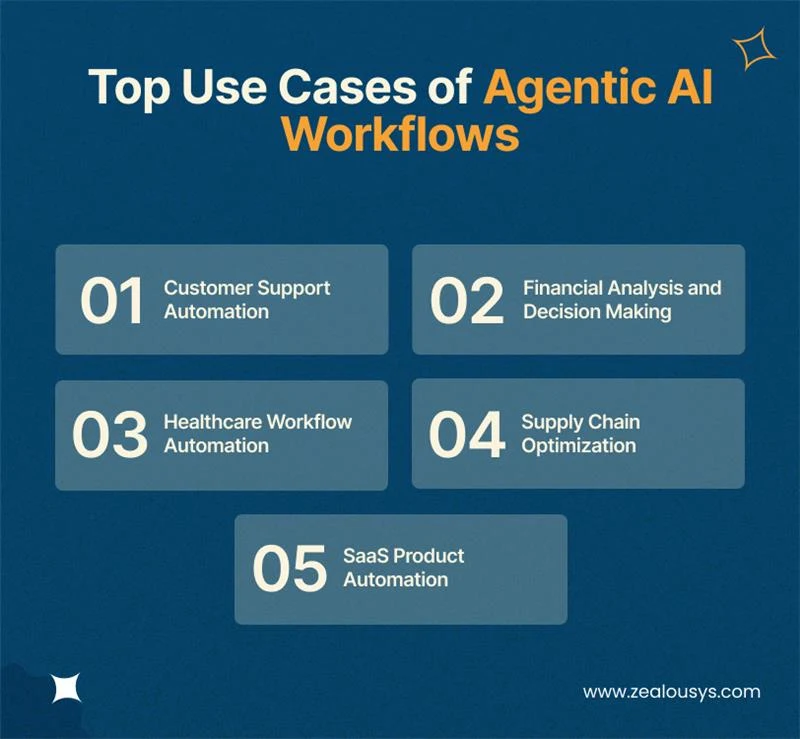
Here are some of the most impactful use cases of agentic AI workflows across industries.
Businesses use agentic AI workflows to deliver faster and more personalized customer support. AI agents understand customer queries, decide the best response, and take action without human intervention.
For example, an eCommerce company can use AI agent workflows to handle support tickets. The system reads the query, checks order status, processes refunds if needed, and updates the customer instantly.
This approach reduces response time, improves customer satisfaction, and lowers support costs. It also shows how agentic workflows go beyond chatbots by making decisions instead of just responding.
Financial teams use agentic AI workflows to automate complex analysis and improve decision-making. AI agents collect financial data, evaluate risks, and generate insights in real time.
For instance, a FinTech company can build agentic AI workflows to monitor transactions and detect fraud. The system analyzes patterns, flags suspicious activity, and can even block transactions automatically.
This helps businesses reduce risk, improve compliance, and make faster financial decisions with high accuracy.
Healthcare providers use autonomous AI workflows to simplify operations and improve patient care. AI agents manage data, assist in diagnosis, and automate administrative tasks.
For example, a hospital can use agentic AI workflows to manage patient intake. The system collects patient information, prioritizes cases based on urgency, and assigns doctors accordingly.
This reduces manual workload, improves efficiency, and ensures better patient outcomes through faster decision-making.
Supply chain operations benefit greatly from agentic AI workflows because they involve multiple variables and constant changes. AI agents analyze demand, track inventory, and make real-time decisions.
For example, a logistics company can use agentic AI workflows to plan delivery routes. The system evaluates traffic, weather, and delivery priorities, then adjusts routes automatically.
This reduces delays, lowers operational costs, and improves overall efficiency.
SaaS companies use agentic AI workflows to extend product functionality and automate internal processes. AI agents can manage onboarding, analyze user behavior, and trigger actions based on insights.
For instance, a SaaS platform can use custom AI agent development to automate user onboarding. The system tracks user actions, identifies drop-off points, and sends personalized guidance to improve engagement.
This helps companies increase user retention, improve product experience, and scale operations efficiently.
Businesses today do not just want automation. They want systems that can think, decide, and act in real time. That is exactly what agentic AI workflows deliver.
Unlike traditional automation, AI agent workflows combine reasoning, decision-making, and execution. This allows companies to move faster, reduce dependency on manual processes, and scale operations efficiently.
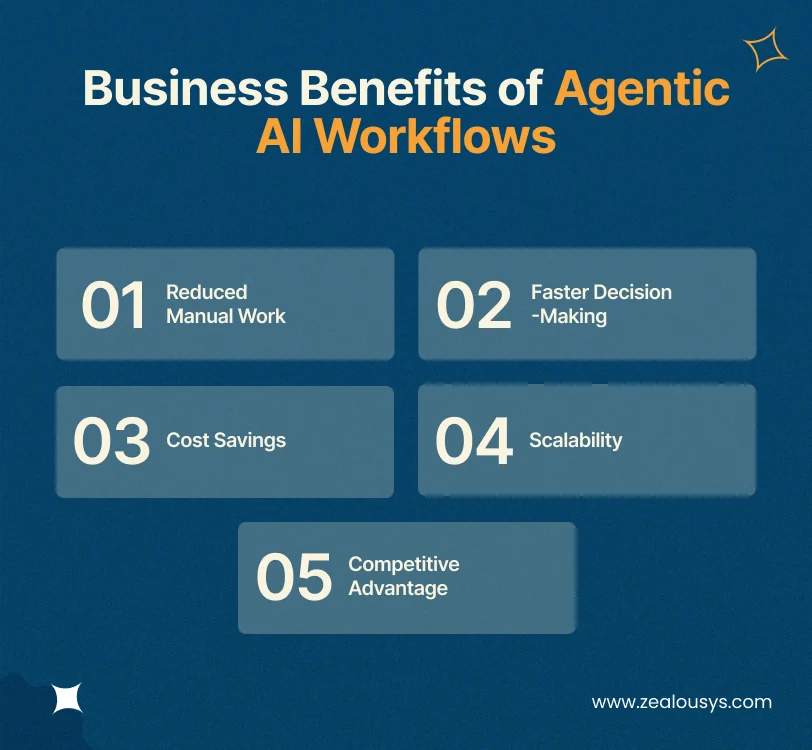
Let’s break down the key business benefits of agentic workflows and why they are becoming essential for modern organizations.
Teams often spend hours on repetitive and rule-based tasks. These tasks slow down productivity and increase the chances of human error.
Agentic AI workflows automate these processes end-to-end. They do not just follow instructions. They analyze inputs, make decisions, and take actions without constant human intervention.
For example, an AI agent can handle customer queries, process requests, and update systems automatically. This reduces workload for teams and allows them to focus on high-value tasks.
Speed matters in today’s competitive environment. Businesses need to make decisions quickly and accurately.
Autonomous AI workflows process large volumes of data in real time. They evaluate multiple scenarios and choose the best possible action instantly.
Instead of waiting for manual analysis, teams can rely on AI agent workflows to generate insights and execute decisions. This helps organizations respond faster to market changes and customer needs.
Manual operations, inefficiencies, and errors often increase operational costs. Businesses lose time, resources, and revenue due to slow processes.
Agentic AI workflows reduce these inefficiencies by automating complex workflows and minimizing errors. Companies can operate with leaner teams while maintaining high performance.
Over time, this leads to significant cost savings and better return on investment from AI initiatives.
As businesses grow, managing operations becomes more complex. Traditional systems struggle to handle increasing workloads.
Agentic workflows scale effortlessly. AI agents can manage multiple tasks, processes, and decisions simultaneously without increasing operational overhead.
Whether you handle 100 tasks or 10,000, autonomous AI workflows adapt to your needs and maintain consistent performance.
Companies that adopt agentic AI workflows gain a strong competitive edge. They move faster, operate smarter, and deliver better customer experiences.
By combining automation with intelligence, businesses can innovate faster and stay ahead of competitors. They can also launch new services, optimize operations, and respond to opportunities in real time.
In a world where speed and intelligence define success, AI agent workflows help businesses lead instead of follow.
Agentic AI workflows offer powerful automation and decision-making capabilities, but businesses often face a few challenges during implementation. If you understand these early, you can plan better and avoid costly mistakes. Gartner predicts that over 40% of agentic AI projects will be canceled by the end of 2027, citing escalating costs, unclear business value, and inadequate risk controls.
Agentic AI workflows rely heavily on data to make accurate decisions. If your data is incomplete, outdated, or inconsistent, the system will produce unreliable results.
Many organizations struggle because their data sits in silos or lacks proper structure. AI agents need clean, well-organized data to function effectively. Without it, even the most advanced AI agent workflows fail to deliver value.
To solve this, you should focus on data preparation, validation, and governance before building agentic systems.
Agentic AI workflows need to connect with multiple systems such as CRM, ERP, APIs, and third-party tools. This creates integration challenges, especially for enterprises with legacy systems.
Many businesses underestimate the effort required to integrate agentic AI workflows into existing infrastructure. Poor integration can lead to broken workflows, data inconsistencies, and delays.
You can overcome this by choosing the right architecture and working with experts who understand how to build scalable and well-integrated agentic AI workflows.
The cost of building agentic AI workflows depends on the level of complexity, customization, and scale. Businesses often worry about upfront investment, especially when they are unsure about ROI.
A full-scale system can require significant resources, including AI development, infrastructure, and ongoing optimization. However, jumping directly into large implementations increases risk.
A smarter approach is to start with an AI PoC, validate the idea, and then scale gradually. This reduces risk and ensures that your investment delivers measurable results.
Agentic AI systems make autonomous decisions, so reliability becomes critical. If the system produces incorrect outputs or behaves unpredictably, it can impact business operations.
This concern becomes even more important in industries like FinTech, healthcare, and logistics, where decisions must be accurate and timely.
To improve reliability, businesses should:
When you proactively handle these challenges, you get the full value from agentic AI workflows. You reduce risks, improve performance, and build systems that scale with your business.
For CTOs, product managers, and operations leaders, this means moving from experimentation to real, measurable impact with AI.
Explore the latest AI Agents Statistics 2026.
Not every business process needs advanced AI. But when your operations start slowing down due to complexity, manual decision-making, or disconnected systems, it’s a strong signal that you should consider agentic AI workflows.
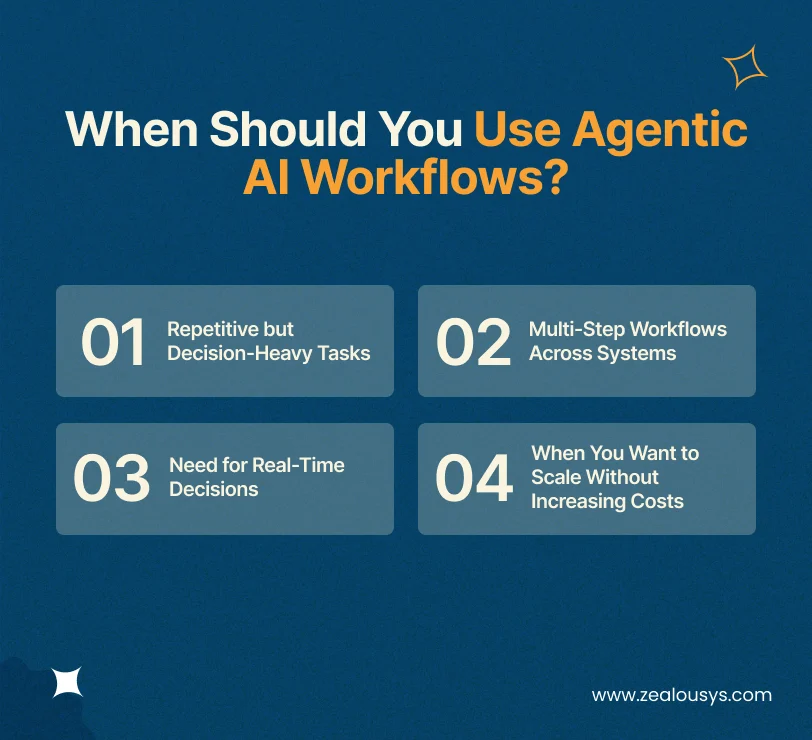
Let’s look at the situations where agentic workflows deliver the most value.
Many businesses automate repetitive tasks, but they still rely on humans to make decisions. This creates delays and limits scalability.
You should use AI agent workflows when your processes involve both repetition and decision-making.
For example, in finance or logistics, teams review data, make decisions, and take actions repeatedly. Instead of relying on manual effort, agentic AI workflows can analyze data, decide the next step, and execute actions automatically.
This approach helps you reduce workload, improve accuracy, and speed up operations.
Modern businesses run on multiple tools and platforms. Teams often switch between systems to complete a single workflow, which creates inefficiencies and errors.
You can solve this by implementing autonomous AI workflows that manage end-to-end processes.
For example, an agentic AI workflow can:
This level of orchestration makes agentic AI workflows far more powerful than traditional automation.
In fast-moving industries, delayed decisions can lead to lost opportunities and higher costs.
You should adopt agentic AI workflows when your business requires real-time responses based on dynamic data.
For example:
In these cases, AI agent workflows process data instantly, make decisions, and take action without waiting for human input.
This helps your business stay responsive, competitive, and efficient.
As your business grows, manual processes become harder to manage. Hiring more people increases costs but does not always improve efficiency.
You can use agentic AI development services to build scalable systems that handle complex workflows without adding operational overhead.
This gives you the ability to grow faster while keeping costs under control.
The cost of agentic AI workflows depends on how advanced your use case is, how many systems you want to integrate, and how intelligent you want your AI agents to be.
Most businesses do not start with a full-scale system. They begin with a small validation step and then expand based on results. This approach reduces risk and helps you invest with confidence.
Costs move through three stages: a proof of concept that validates feasibility on limited data, an MVP that solves one specific business problem with real integrations, and a full production system with multi-agent coordination, memory, and deeper enterprise integrations. Each stage carries its own budget range and timeline. Our full breakdown of the cost of agentic AI workflows covers the numbers for all three.
Here’s a complete guide explaining how to build an AI Agent from Scratch.
Adopting agentic AI workflows does not require a massive upfront investment. You can take a structured approach that reduces risk, validates your idea, and delivers measurable results faster. If you are a CTO, founder, product manager, or operations leader dealing with manual workflows or failed AI pilots, this approach helps you move forward with clarity.
You should always begin with a focused Proof of Concept. An AI PoC helps you test whether your agentic AI workflow can solve a real business problem before you commit to full-scale development.
Instead of trying to automate everything, you should select one high-impact use case. For example, you can automate customer support decisions, financial analysis, or internal workflow approvals.
During the PoC stage, your team:
This step helps you validate feasibility, estimate ROI, and avoid costly mistakes. It also gives stakeholders confidence in your AI initiative.
The success of autonomous AI workflows depends heavily on the technology you choose. You should select tools and frameworks that support scalability, flexibility, and integration with your existing systems.
A typical agentic AI architecture includes:
You should avoid overcomplicating your stack in the early stage. Instead, you should focus on building a reliable and scalable foundation that supports your business goals.
If you choose the right tech stack early, you reduce development time and improve long-term performance.
Building AI agent workflows requires expertise in AI, data engineering, system integration, and business logic. Most companies struggle when they try to manage everything in-house without the right experience.
You should work with an experienced team that understands how to:
A strong development partner helps you move faster, avoid common pitfalls, and turn your idea into a production-ready solution.
Agentic AI workflows are changing how businesses approach automation and decision-making. Instead of relying on rigid, rule-based systems, companies can now use intelligent AI agents that analyze data, adapt to new situations, and take meaningful actions in real time.
This shift allows organizations to move beyond simple task automation and build systems that think, plan, and execute with minimal human intervention. From improving operational efficiency to enabling faster and smarter decisions, agentic AI workflows offer a clear competitive advantage.
However, successful implementation requires the right strategy, the right technology stack, and a clear understanding of business goals. Many companies start with a focused use case, validate it through a proof of concept, and then scale gradually based on results.
If you are exploring ways to automate complex workflows, reduce manual effort, and get real value from AI, agentic AI workflows can be a powerful next step.
Agentic AI workflows are intelligent systems that use AI agents to automate tasks, make decisions, and execute actions without constant human input. Unlike traditional automation, these workflows adapt to changing data, analyze situations in real time, and take the next best action.
Businesses use agentic AI workflows to simplify operations, reduce manual work, and improve decision-making across complex processes. These workflows combine large language models, tools, and data to create autonomous AI systems that act with purpose and context.
Agentic systems follow a structured workflow that includes input, reasoning, decision-making, and execution. The system receives input data, processes it using AI models, and decides the best action based on defined goals.
These systems use multiple AI agents, APIs, and memory to handle tasks dynamically. Each agent performs a specific role, such as analyzing data, generating responses, or triggering actions. The system continuously learns from feedback and improves performance over time.
This approach allows businesses to build agentic AI workflows that handle multi-step processes with minimal human intervention.
Many industries use agentic AI workflows to improve efficiency and automate decision-heavy processes.
Any business that handles complex workflows and large volumes of data can benefit from agentic AI solutions.
The cost of agentic AI workflows depends on the complexity of the use case, the level of customization, and the scale of deployment. Simple agentic workflows can start with a small investment, especially during the proof of concept stage.
More advanced systems that involve custom AI agent development, integrations, and large-scale automation require higher investment. However, businesses often achieve strong returns by reducing operational costs, improving efficiency, and scaling faster.
Many companies start small, validate their AI Agent Business Ideas, and then scale their agentic AI workflows based on results.
Our team is always eager to know what you are looking for. Drop them a Hi!

Ruchir Shah is Technology Head at Zealous System with hands-on expertise in AI/ML, Microsoft Azure, .NET, Node.js, Python, React, and Angular. He leads enterprise software development, champions digital transformation, and mentors developers building the future of intelligent apps.




Comments