AI agents sound powerful… but what do they actually cost?
Many businesses hear about agentic AI workflows and assume they are either extremely expensive or surprisingly cheap. The reality sits somewhere in between. The confusion usually starts when people compare simple AI tools with fully customized AI workflows. A chatbot subscription might cost a few dollars per month, but a multi-agent system that integrates with your CRM, automates decisions, and runs operations can cost significantly more.
You might also see different pricing models across vendors. Some platforms charge per user, while others charge based on API usage, tokens, or workflow execution. This makes it difficult for CTOs, founders, and product leaders to estimate the actual cost of AI automation for their business.
In this guide, you will get a clear and practical breakdown of the agentic AI workflow cost. You will understand what drives pricing, how much you can expect to invest, and where hidden costs often appear. We will also look at real cost ranges and help you connect those numbers with actual business value and ROI.
By the end, you will not just know the cost of agentic AI. You will know how to plan, control, and justify your AI investment with confidence.
Agentic AI workflows are systems where AI agents don’t just follow instructions. They make decisions and take actions on their own. These workflows combine AI models, data, and tools to complete tasks from start to finish without constant human input.
In simple terms, an agentic AI workflow acts like a smart digital worker. It understands a goal, figures out the steps, and executes them in real time. This guide covers cost only. For architecture, use cases, and how these systems actually run, see our guide to agentic AI workflows.
An AI agent:
Instead of waiting for step-by-step instructions, the agent actively drives the workflow forward.
1. Customer Support AI Agent
A customer support AI agent can:
Instead of routing tickets manually, the AI handles the entire interaction.
This reduces response time and lowers overall support costs for the business.
2. Sales Outreach Automation Agent
A sales AI agent can:
Instead of relying on static campaigns, the AI continuously improves outreach performance.
This directly impacts conversion rates while keeping the cost down over time.
Check out the latest AI Agents Statistics 2026.
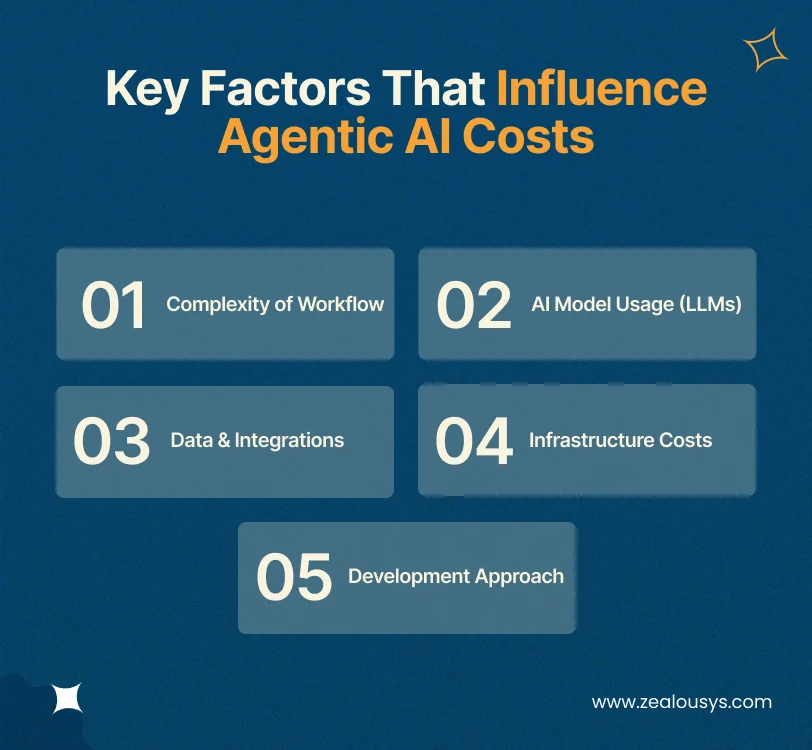
When businesses evaluate agentic AI workflow cost, they often expect a fixed number. In reality, several moving parts shape the final pricing. If you understand these factors early, you can plan better, avoid surprises, and build a cost-efficient AI workflow.
Let’s break this down in a simple way.
The complexity of your workflow directly impacts what you spend.
If you build a simple workflow, you keep costs low. For example, a single AI agent that answers customer queries or summarizes emails requires fewer resources and minimal coordination.
If you design a multi-agent system, costs increase quickly. In this setup, multiple AI agents collaborate, make decisions, and pass tasks between each other. This setup needs more logic, more testing, and more computing power.
As complexity grows, your AI workflow pricing increases because:
In short, simple workflows cost less, while advanced agentic systems deliver more value but require higher investment.
AI model usage is one of the biggest cost drivers.
Most businesses rely on large language models, and these models charge based on usage. You pay per token, which means you pay for every input and output processed.
If your workflow handles a high volume of requests, your LLM cost per request adds up quickly.
For example:
If you choose advanced models for every task, you drive up your bill unnecessarily.
Smart businesses control this by:
The more efficiently you use AI models, the better you control your overall costs.
Your data ecosystem directly affects your AI implementation cost.
Agentic AI workflows rarely work in isolation. They connect with systems like CRMs, ERPs, and third-party tools through APIs.
If you integrate multiple systems, you increase:
For example:
You also need clean and structured data. If your data is messy, you spend extra time and money preparing it.
Strong integrations increase value, but they also raise the overall cost.
Infrastructure is what your workflows actually run on.
You need reliable systems to run agentic workflows at scale. These systems include cloud platforms, databases, and vector databases for handling embeddings and search.
Your infrastructure cost depends on:
If your workflow runs continuously or handles large datasets, your costs increase.
For example:
Efficient infrastructure planning helps you control long-term costs and avoid overspending.
Your development approach significantly shapes your agentic AI workflow cost.
If you use no-code or low-code tools, you reduce initial costs and launch faster. These tools work well for simple use cases and quick experiments.
However, these tools often limit flexibility. As your needs grow, you may face constraints or higher subscription costs.
If you choose custom AI development, you invest more upfront. In return, you gain:
Many businesses prefer custom solutions when they want long-term ROI and automation built for their process.
No-code saves time in the short term, while custom development delivers better cost efficiency at scale. The wider build-versus-buy decision, including where no-code genuinely is the right answer, is covered in our guide to AI workflow automation.
Understanding the agentic AI workflow cost becomes much easier when you break it into clear parts. Let’s walk through each cost area in a simple, practical way so you can estimate what your business might actually spend.
You will spend most of your budget on building the actual AI workflow.
Your AI workflow pricing depends on how complex your use case is. A simple automation with one AI agent costs much less than a multi-agent system that handles decision-making across tools.
For example, a basic support chatbot may cost around $5K–$15K. A fully agentic AI workflow that connects CRM, email, and internal tools can easily go beyond $50K or more.
If you choose custom development, you get better flexibility and long-term ROI. If you use no-code tools, you reduce upfront cost but may face limitations later.
You pay for AI models based on usage. Most platforms charge per token or per API request.
Every time your AI agent processes a task, it consumes tokens. More conversations, more automation, and more complexity directly increase your monthly bill.
For example, a customer support AI agent that handles thousands of queries daily will generate higher costs than a low-usage internal tool.
You can cut this cost by choosing the right model, reducing unnecessary prompts, and caching responses where possible.
Your AI agents need to connect with your existing systems like CRM, ERP, or internal dashboards.
You will spend on APIs, middleware, and data pipelines to make everything work smoothly. This part plays a big role in your overall AI implementation cost.
Simple integrations cost less. Complex workflows that involve multiple systems, real-time data syncing, or custom APIs increase the cost.
Strong integrations make your agentic AI workflows more powerful, so this investment directly improves efficiency and automation quality.
You should always plan for ongoing costs after deployment.
Your AI workflows need regular monitoring, updates, and performance tuning. As your usage grows, your infrastructure and model usage costs will also increase.
You may also need retraining, prompt optimization, and system upgrades to keep everything accurate and efficient.
Many businesses ignore this part, but it directly impacts the long-term cost of agentic AI and its ROI.
Most businesses do not build the full system at once. They validate, then expand. The ranges in the previous section cover a full build; the stages below show how that spend typically breaks across a project.
| Stage | Typical Cost | Timeline | What You Get | Best For |
|---|---|---|---|---|
| Proof of Concept | $5,000 – $20,000 | 2 – 6 weeks | Core logic on limited data, plus a feasibility signal | Validating before committing real budget |
| MVP | $25,000 – $50,000 | 2 – 4 months | Real integrations, one business problem solved end to end | Teams needing measurable results quickly |
| Production | $50,000 and above | 4 – 9 months | Multi-agent coordination, memory, deeper enterprise integrations | Scaling across teams or business units |
You start with a Proof of Concept to validate your idea before making a large investment.
In this stage, teams build a small version of the agentic AI workflow using limited data and core logic. This helps you test whether your AI agents can automate decisions and improve outcomes.
You use a PoC to:
This stage works best for startups and enterprises that want to experiment with autonomous AI workflows without committing to full development.
Once your PoC shows positive results, you move to an MVP.
At this stage, you build a functional version of your AI agent workflows with real integrations, better accuracy, and limited production readiness. You focus on solving a specific business problem, such as customer support automation or workflow decision-making.
An MVP allows you to:
This stage suits CTOs and product teams who want agentic workflows that deliver measurable value quickly.
After validating your MVP, you scale your system across teams, processes, or business units.
In this stage, you extend your agentic AI architecture with capabilities such as multi-agent coordination, memory, continuous learning, and deeper integrations with enterprise systems.
Scaling includes:
Enterprises and SaaS companies invest at this stage to build fully autonomous systems that hold up over the long term.
When businesses explore agentic AI workflow costs, they often feel confused because pricing is not one-size-fits-all. Different models exist, and each model fits different business needs, budgets, and scalability goals. Let’s break this down in a simple and practical way so you can understand what works best for you.
In this model, you pay a fixed monthly or yearly fee to use an AI platform.
Businesses usually choose this option when they want a quick start without heavy development. Many AI automation tools offer pre-built agentic workflows for tasks like customer support, content generation, or internal automation.
How it works:
Best for:
Limitation:
You get less flexibility because you rely on the platform’s capabilities.
This model charges you based on how much you use the AI. It is one of the most common pricing models in agentic AI workflows.
You pay for:
How it works:
Every time your AI agent processes a request, it consumes tokens. Your total AI agent cost depends on usage volume.
Best for:
Key advantage:
You only pay for what you use, which makes this model cost-efficient at an early stage.
Challenge:
Costs can increase quickly if you scale without optimization.
In this model, you build agentic AI workflows from scratch based on your business needs.
You pay for:
How it works:
A development team builds a solution around your exact use case, which is what custom AI agent development covers. This approach gives you full control over cost and performance.
Best for:
Cost range:
Custom agentic AI development cost can vary from moderate to high depending on complexity.
Key advantage:
You get flexibility, scalability, and long-term ROI.
Many businesses now combine pricing models to balance cost and performance.
How it works:
Example:
A company may use a SaaS chatbot for basic queries but use custom AI agents with API pricing for complex decision-making workflows.
Best for:
Key advantage:
You avoid overpaying while still building powerful AI software.
Let’s break down the cost of agentic AI workflows with practical, easy-to-understand examples. This will help you estimate your AI workflow pricing based on real business use cases. The figures below are ongoing monthly running costs. They sit on top of the one-time development cost covered above, not inside it.
Estimated Monthly Cost
A customer support AI agent handles queries, resolves tickets, and integrates with your CRM. Many businesses use this type of AI automation to reduce support workload and response time.
Here is a simple cost breakdown:
Estimated total cost: $1,500 – $5,000/month
This type of agentic AI workflow works best for startups and SaaS companies that handle high support volume. The system reduces manual effort and improves response time instantly.
Cost vs ROI
An AI sales agent automates lead qualification, follow-ups, and outreach. It connects with tools like email platforms and CRMs to run the whole sequence end to end.
Here is the cost breakdown:
Estimated total cost: $2,000 – $7,000/month
Now let’s look at ROI:
Many businesses see 2x to 5x ROI within a few months.
This makes the spend look more like an investment than an expense.
HR / Finance Use Case
An internal AI agent automates repetitive tasks like payroll processing, invoice handling, employee onboarding, and report generation. This type of AI workflow improves efficiency across operations.
Here is the cost breakdown:
Estimated total cost: $1,500 – $4,500/month
This AI implementation cost stays lower because internal workflows often run in controlled environments. The system reduces human errors and saves operational time.
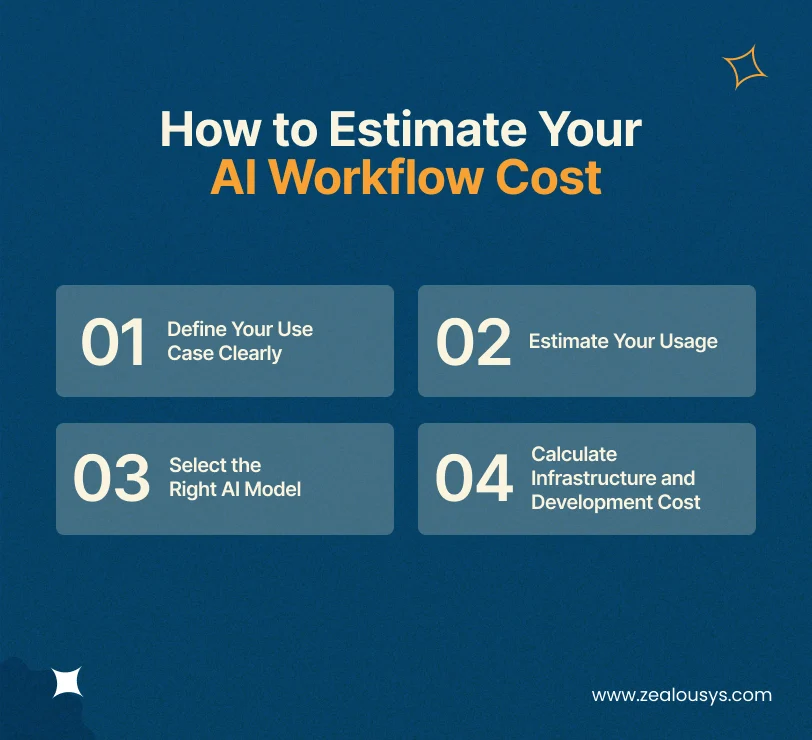
If you plan to invest in agentic AI workflows, you should start with a clear cost estimation approach. You do not need complex calculations. You just need to break things down step by step and align them with your business goals.
Let’s simplify it.
Start by identifying exactly what you want your AI workflow to do.
When you define your use case clearly, you avoid unnecessary features and control your AI workflow cost from the beginning.
For example, a simple support chatbot costs much less than a multi-agent system that handles sales, follow-ups, and analytics.
Next, you should estimate how often your AI system will run.
Ask yourself:
Most agentic AI pricing models depend on usage, especially when you use LLMs (Large Language Models).
For example:
When you estimate usage early, you avoid surprises in your monthly bill.
Now, choose the model that fits your use case and budget.
Not every workflow needs the most advanced or expensive model.
You can choose:
If you pick the wrong model, your costs can increase quickly without adding real value.
Finally, calculate the total cost beyond just AI model usage.
You should include:
Many businesses underestimate this part. However, infrastructure and development often make up a large portion of the AI implementation cost.
Agentic AI sounds powerful, but most business leaders ask one simple question: does it actually deliver value for the cost?
The short answer is yes if you apply it in the right place with the right approach.
Let’s break this down from an ROI perspective so you can make a confident decision.
When you invest in agentic AI workflows, you don’t just automate tasks. You improve how decisions and actions happen across your business.
Here’s where the real return comes from:
1. You reduce operational costs
Agentic AI handles repetitive workflows like support queries, data processing, and internal coordination. You save on manual effort and reduce dependency on large teams.
2. You increase team productivity
Your team focuses on strategic work while AI agents handle execution. This shift improves output without increasing headcount.
3. You speed up decision-making
AI agents analyze data and act in real time. You don’t wait for manual inputs, which helps you respond faster to customers and market changes.
4. You scale without proportional cost increases
Traditional systems require more people as you grow. Agentic AI workflows scale with usage, not headcount, which improves long-term margins.
5. You improve customer experience
AI agents respond instantly, personalize interactions, and stay consistent. This leads to better engagement and higher retention.
Agentic AI is a poor investment when your process runs at low volume, when the rules genuinely do not change, or when your data sits scattered across systems that disagree with each other. In those cases, a rules-based automation costs a fraction as much and fails less often. The honest test is whether the decisions in your workflow actually require judgment.
The agentic AI workflow cost depends on your use case, scale, and complexity. A simple AI automation can cost a few hundred dollars per month. A custom multi-agent system can cost anywhere from $5,000 to $100,000+ for development. You also pay ongoing costs for AI models, infrastructure, and maintenance. Businesses usually choose between low-cost tools and fully custom builds, depending on their goals.
You calculate AI workflow costs by combining a few key components. You estimate development cost based on complexity and features. You calculate LLM cost per request using token or API usage. You add infrastructure costs like cloud hosting and databases. You include integration costs for tools like CRM or ERP. You also consider ongoing costs like monitoring, updates, and scaling. This full breakdown gives you a realistic AI workflow cost estimate.
Agentic AI does not have to be expensive for startups. Startups can begin with small use cases and scale gradually. Many teams use APIs and lightweight models to control costs. Basic automation can stay within a few hundred dollars per month. Startups that invest wisely often see faster returns. The key is to avoid overbuilding and focus on high-impact workflows first.
AI agents deliver strong ROI when they automate repetitive work and improve decision-making. Businesses reduce manual effort and save operational costs. Teams also improve speed and accuracy across workflows. For example, an AI support agent can reduce support costs and handle more queries. Many companies recover their cost of agentic AI within months when they apply it to the right use case.
GPT-based automation cost depends on usage and model selection. You pay per token or per request when you use APIs. Small workflows can cost a few dollars to a few hundred dollars per month. High-volume enterprise workflows can scale to thousands per month. You can cut costs by using smaller models, caching responses, and designing efficient prompts.
Many businesses overlook hidden costs when they plan AI projects. You may spend extra on data preparation and cleaning. You may need prompt engineering and continuous tuning. You also pay for scaling infrastructure as usage grows. Security, compliance, and monitoring add to the cost. Vendor lock-in can also increase long-term AI implementation cost. A clear AI workflow cost breakdown helps you avoid surprises and plan better.
The cost of agentic AI workflows depends on your use case, scale, and architecture choices. You cannot apply a fixed price because every business builds AI workflows differently. A simple automation use case costs much less than a complex multi-agent system that handles decision-making across teams.
You should start with a clear goal and define what you want your AI workflow to achieve. When you align your business needs with the right level of AI complexity, you avoid unnecessary costs. Many businesses overspend because they adopt powerful models or build advanced systems without a real need.
You can control your AI workflow cost by choosing the right pricing model, controlling API usage, and selecting the right infrastructure. When you plan carefully, you turn agentic AI into a cost-effective investment instead of an expensive experiment.
The right partner helps you avoid overbuilding and optimize AI costs from day one. A skilled team guides you in selecting the right tools, designing efficient workflows, and scaling only when needed. This approach ensures that your AI investment delivers real business value while keeping costs under control.
Our team is always eager to know what you are looking for. Drop them a Hi!

Ruchir Shah is Technology Head at Zealous System with hands-on expertise in AI/ML, Microsoft Azure, .NET, Node.js, Python, React, and Angular. He leads enterprise software development, champions digital transformation, and mentors developers building the future of intelligent apps.


Comments