
AI sales agent development cost in 2026 sits between $15,000 and $250,000 for a custom build. That is a wide band, and the reason it is wide has almost nothing to do with which development partner you pick. It comes down to how much autonomy you give the agent, how many systems it has to talk to, and whether it needs to speak out loud.
Most cost articles stop at a table of ranges. That is not much help when you are putting a number in front of a CFO. So this breakdown goes further: what each layer of the build costs, what you pay every month after launch, and how the math compares to hiring SDRs.
A quick note on why this matters now. Gartner forecasts that 40% of enterprise applications will include task-specific AI agents by the end of 2026, up from under 5% in 2025. Gartner also expects more than 40% of agentic AI projects to be shelved by the end of 2027, largely because of unclear business value and rising costs. The teams that succeed are the ones who budget honestly at the start.
| Tier | Cost | Timeline |
|---|---|---|
| MVP, Single Channel | $15,000 to $35,000 | 6 to 10 weeks |
| Growth, Multi-Channel | $40,000 to $90,000 | 3 to 5 months |
| Enterprise | $100,000 to $250,000+ | 6 to 12 months |
Two things to keep in mind before you anchor on any of these numbers. The build cost is not the total cost, since running an agent carries a monthly bill and an annual maintenance line. And these ranges apply to custom development, which is not automatically the right choice. We cover both below.
One channel, usually email or web chat, with lead scoring and a single CRM integration. This is the right starting point for most companies. The agent handles one repetitive task well rather than several tasks poorly, and you get live performance data within two months instead of speculating for six.
Email, chat, and LinkedIn, with retrieval over your product content, two-way CRM sync, meeting booking, and an analytics dashboard. This is where most funded B2B companies land. The agent becomes a working part of the pipeline rather than an experiment, and the reporting layer is good enough for sales leadership to trust it.
Voice plus omnichannel, multi-agent orchestration, custom evaluation suites, compliance controls, SSO, and audit logging. Cost here is driven less by features than by governance. Enterprise buyers pay for provability: every action logged, every decision traceable, every escalation path documented.
An AI sales agent carries out sales tasks end to end rather than assisting a human with them. It researches an account, drafts and sends the outreach, reads the reply, decides what to do next, and writes the outcome back to your CRM.
That last part separates an agent from a chatbot. A chatbot answers. An agent acts, using function calling to trigger real API calls that book meetings or update deal stages.
A working agent has five layers:
For a fuller comparison of where agents sit relative to chatbots and raw LLMs, see Chatbots vs LLMs vs AI Agents.
The figures below reflect a mid-tier, multi-channel build. Scale down for an MVP and up for enterprise scope.
$3,000 to $8,000
Two to three weeks of mapping your sales process, defining what the agent may decide alone, and choosing the model and orchestration approach. The output is a technical spec and a firm estimate, not a slide deck. Teams that skip this phase reliably pay for it later in rework, because the expensive mistakes in agent projects are architectural rather than cosmetic.
$8,000 to $18,000
Prompt architecture, memory handling, model routing, and fallback behavior when the model returns something unusable. The engineering effort here is less about calling an API and more about consistency. Getting a good response once is trivial. Getting an acceptable response across ten thousand unpredictable conversations is the actual work, and it is why this line item is larger than most buyers expect.
$6,000 to $15,000
Ingesting your content, chunking it sensibly, building the retrieval pipeline, and tuning it so the agent surfaces the right case study rather than a vaguely related one. Cost climbs with the volume and messiness of your source material. Well-organized documentation sits at the bottom of the range. Content scattered across Notion, PDFs, and three generations of sales decks sits at the top.
$5,000 to $14,000 per system
Salesforce and HubSpot both have mature APIs, so the work is rarely about connectivity. It is about field mapping, deduplication, sync conflict rules, and deciding what the agent is permitted to overwrite. Custom or legacy CRMs push this to the top of the range because there is no documented sandbox to test against. If you are also weighing a CRM rebuild, our guide to custom CRM software development covers that decision.
$12,000 to $30,000 on top of a text build
AI voice sales agent development cost is the largest single add-on in an agent project. You are adding speech-to-text, text-to-speech, and telephony through providers like Twilio, Vapi, or ElevenLabs, then fighting for latency. A voice agent that takes two seconds to respond feels broken, so a large share of this budget goes into shaving response time rather than adding features. Voice also brings TCPA and call recording consent obligations in the US, which adds legal review. For voice agents in a live deployment context, see our breakdown of AI voice agents for restaurants.
$6,000 to $14,000
Conversation review, pipeline attribution, and the ability for a sales manager to see what the agent said and why. This is not a vanity feature. Sales teams do not delegate to systems they cannot inspect, and an agent your reps quietly work around is a write-off regardless of how well it performs. Underinvest here and adoption stalls in the first month.
$5,000 to $12,000
Building a test suite of real scenarios, adversarial prompts, and edge cases, then setting thresholds for hallucination control and escalation. This is the line item buyers cut first and regret fastest. Without an evaluation suite you have no way to tell whether a prompt change improved the agent or quietly broke it, so every future update becomes a gamble.
$3,000 to $7,000
Environments, CI/CD pipelines, monitoring, logging, and rollback paths. Agents need more deployment discipline than standard applications because their behavior can shift without a code change. A model version update or a provider-side change can alter output overnight, so you need the ability to detect the drift and roll back quickly.
| Component | Cost Range | Share of a Mid-Tier Build |
|---|---|---|
| Discovery and Architecture | $3,000 to $8,000 | 8% |
| Conversation Engine and LLM Integration | $8,000 to $18,000 | 22% |
| Knowledge Layer and Vector Database | $6,000 to $15,000 | 17% |
| CRM Integration (Per System) | $5,000 to $14,000 | 15% |
| Dashboard and Analytics | $6,000 to $14,000 | 15% |
| QA, Evaluations, and Guardrails | $5,000 to $12,000 | 14% |
| Deployment and DevOps | $3,000 to $7,000 | 9% |
| Voice Capability (Optional) | $12,000 to $30,000 | Added on top |
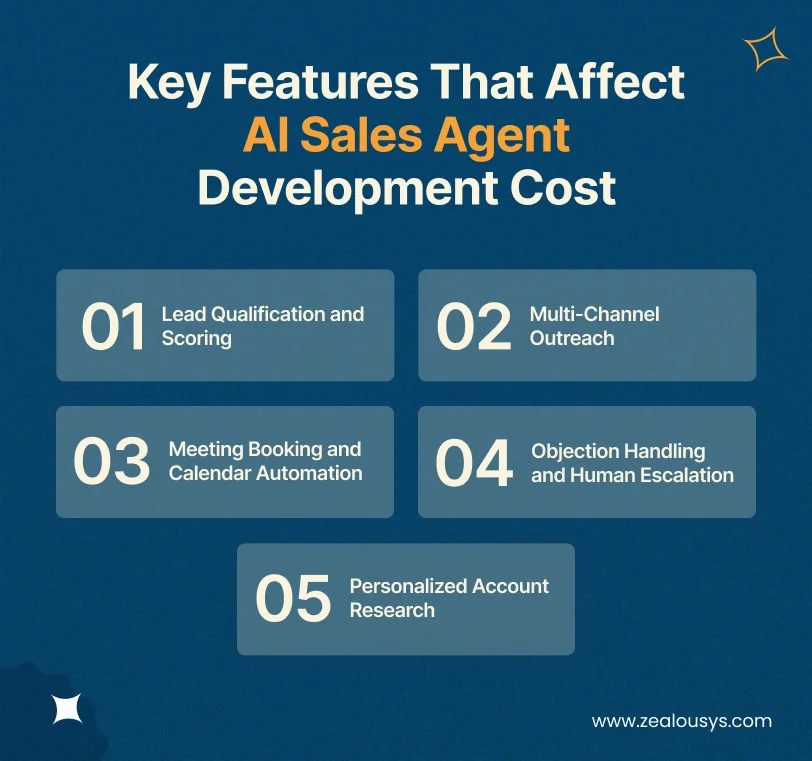
These figures sit inside the component budget above, not on top of it. They show how a mid-tier build gets allocated across capabilities, so you can see which features to cut if the number comes back too high. Some are nearly free once the core exists. Others are projects in their own right.
$4,000 to $9,000
Usually the cheapest meaningful feature, because the logic is bounded and the output is structured rather than conversational.
$5,000 to $12,000 per additional channel
The second channel costs less than expected and the third costs more. Email and chat share most of the same conversation logic, while LinkedIn adds platform constraints and rate limits that need separate handling.
$5,000 to $11,000
Looks trivial and is not. Timezone handling, availability conflicts, rescheduling, and no-show follow-up account for most of the effort.
$6,000 to $13,000
Where quality separates agents. The agent has to recognize when it is out of its depth and hand off cleanly, with full context, rather than improvising an answer that a rep then has to walk back.
$7,000 to $16,000
The most expensive feature per unit of output, because every conversation triggers enrichment calls and heavier model usage. It also drives your monthly running bill more than any other capability.
An assistive agent that drafts for human approval costs roughly half what a fully autonomous agent costs. Autonomy is expensive because every unsupervised action needs a guardrail, an audit trail, and a rollback path. Gartner has warned that treating agent governance as binary, either locked down or fully trusted, is the root cause of most enterprise agent failures.
Each channel adds infrastructure, testing surface, and failure modes. Text channels are additive. Voice is multiplicative.
Two clean integrations cost less than one messy one. A well-documented modern API takes a week. An undocumented internal system with no sandbox takes a month.
The most underestimated factor in the entire project. If your CRM has duplicate accounts, inconsistent stage definitions, and half-empty fields, the agent acts on bad data and your team loses faith in it within two weeks. Expect cleanup to add 15% to 30% to a project when the CRM has not been maintained.
Running one frontier model for every task is simple and expensive. A routing approach, where a small cheap model handles classification and intent detection while a stronger model handles reasoning and drafting, costs more to build and far less to run. On most projects the routing work pays for itself within three to four months.
GDPR for European prospects, TCPA and state consent rules for US voice outreach, SOC 2 if you sell into enterprise. Each adds engineering and documentation time. Compliance is not something you retrofit cheaply, so scope it in discovery rather than after your first enterprise security review.
$200 to $2,500 a month for a mid-volume text agent
Your model bill is driven by conversation volume, how much context you put into each prompt, and how long the responses run. Output tokens cost three to six times more than input tokens across major providers, so trimming response length saves more than trimming prompts.
Two levers matter. Prompt caching cuts repeated context costs sharply, and batch processing carries a 50% discount at most providers for anything that is not real time. Voice runs considerably higher because of per-minute speech processing.
One caution on forecasting: published model prices fell roughly 80% across the industry between 2025 and 2026 and change several times a year. Build your budget around token volume per conversation rather than today’s rate card.
$220 to $1,300 a month combined
Roughly $70 to $500 for the vector store depending on document volume and query rate, plus $150 to $800 for application hosting and infrastructure.
$100 to $400 a month
Conversation logging, tracing, and evaluation tooling. Skip this and you find out about a problem when a prospect complains rather than when it starts.
15% to 20% of build cost per year
Models get deprecated, APIs change, your product changes, and your objection library needs updating as the market shifts. An agent left untouched for a year quietly gets worse at its job.
Fixed price, retainer, or time and materials
Fixed price protects you on a tight spec and punishes you when requirements shift, which they usually do on a first agent build. A fixed-price discovery phase followed by a monthly retainer tends to be the most honest structure for both sides.
| Region | Hourly Rate | Notes |
|---|---|---|
| North America | $100 to $180 | Highest cost, strongest timezone overlap for US teams |
| UK and Western Europe | $80 to $140 | Strong AI engineering depth, GDPR fluency |
| Australia | $90 to $150 | Limited senior AI talent pool, longer lead times |
| Eastern Europe | $45 to $80 | Balanced cost and seniority |
| India | $25 to $50 | Deepest available capacity, largest cost saving |
The practical takeaway is that a $60,000 build in North America lands closer to $22,000 to $28,000 with a strong offshore team, including senior architecture oversight.
Whether that saving is real does not depend on the rate. It depends on whether the team has shipped production agents before, runs a working evaluation practice, and can hold a design conversation rather than only take instructions. Those are the questions worth asking before you hire AI developers for an agent build.
This is the decision worth getting right, and plenty of companies should buy.
Buy when your outbound motion is fairly standard, your product does not require deep technical explanation, you have fewer than 50 reps, and you want something running next month.
Platforms in this space charge roughly $1,000 to $5,000 per month depending on seat count and volume. Over three years, that is $36,000 to $180,000. Real money, but you carry no build risk, no maintenance burden, and no hiring requirement.
Build when any of the following applies:
There is a middle path worth naming. Several teams start on a platform to validate that AI outreach works in their market at all, then build custom once they know which parts actually matter. That sequencing costs slightly more in total and removes most of the risk.
The median US SDR base salary sits around $60,000, with on-target earnings near $85,000, according to compensation research from The Bridge Group and RepVue. Add employer taxes, benefits, tooling, and a share of management time, and the fully loaded cost of one SDR lands closer to $105,000 to $120,000 a year. Two SDRs run roughly $220,000.
Take a $60,000 mid-tier build, $1,500 a month in running costs, and $10,000 a year in maintenance.
| Year 1 | Year 2 | |
|---|---|---|
| Two SDRs (Fully Loaded) | $220,000 | $220,000 |
| AI Sales Agent | $88,000 | $28,000 |
The agent pays back inside the first year and then costs roughly an eighth as much annually.
That comparison is cleaner than reality, for three reasons. An agent does not replace an SDR one for one. It replaces the volume-heavy part of the role: sequencing, first-touch qualification, follow-up, and scheduling. Discovery calls and relationship building stay human.
Ramp is not instant either. Expect six to ten weeks after launch before output quality settles, because the evaluation loop needs live conversations to tune against.
And the real comparison is not agent versus human. Forrester research puts average B2B quota attainment at around 47%, meaning most reps never hit target. The realistic gain is a smaller human team working better-qualified pipeline.
The ROI of AI sales agents is easiest to defend when you measure cost per qualified meeting rather than headcount saved. Headcount math invites an argument about whether the agent truly replaced anyone. Cost per meeting is auditable, comparable to your existing numbers, and survives scrutiny in a budget review.
Pick the highest-volume repetitive task in your funnel, usually inbound lead qualification or follow-up on unresponsive leads, and ship that alone. Six weeks of live data teaches you more than six months of planning.
The highest-return preparation available, and you can do it internally at no vendor cost. Clean fields, consistent stage definitions, deduplicated accounts.
Building the routing layer early is considerably cheaper than retrofitting it after your first surprising invoice.
Custom integration work is justified for your proprietary systems. It is rarely justified for Salesforce, HubSpot, or Google Calendar.
Two to three weeks and a few thousand dollars to produce a technical spec and a firm estimate. It costs a fraction of the project and prevents the far more expensive outcome of building the wrong thing.
We build production AI agents rather than prototypes. That distinction shows up in the parts of a project invisible in a demo: evaluation suites, escalation logic, audit trails, and the guardrails that stop an autonomous system from making commitments your team has to undo.
Teams come to us either to build the agent outright or to extend an in-house team with AI agent development support. Both models start the same way, with a scoped discovery phase.
Our agent work spans regulated and data-heavy environments, including insurance claims and underwriting agents, AI-powered logistics platforms, and private LLM deployments for enterprises that cannot send data to third-party APIs.
We also publish our cost thinking openly rather than holding it for a sales call. For the wider view on agentic project economics beyond sales, see our breakdown of agentic AI workflow costs.
A single-channel MVP handling lead qualification or follow-up with one CRM integration runs $15,000 to $35,000 and takes six to ten weeks.
Budget $500 to $4,200 a month for a mid-volume text agent across model usage, vector database, hosting, and monitoring. Voice agents run higher because of per-minute speech processing. Add 15% to 20% of build cost annually for maintenance.
Six to ten weeks for an MVP, three to five months for a multi-channel build, and six to twelve months for enterprise scope with voice and compliance requirements.
Yes. Both have mature APIs and integration typically costs $5,000 to $14,000 per system. The work is mostly field mapping, sync rules, and deciding what the agent may write.
You need product documentation, pricing, and ideally your past sales conversations. You do not need to train a model from scratch. Most agents use retrieval over existing content rather than fine-tuning.
Over two years, usually yes. A $60,000 build with running costs comes in well under the fully loaded cost of two SDRs. Over twelve months alone the gap narrows, and an agent supplements a sales team rather than replacing it.
CRM data cleanup. Poor data quality routinely adds 15% to 30% to a project and is the most common reason agents underperform after launch.
AI sales agent costs become predictable once you settle three decisions: how autonomous the agent will be, how many channels it works across, and whether it speaks. Everything else is detail arranged around those three.
The projects that fail are rarely the ones that spent too little. They are the ones that budgeted for a build and forgot the run, or automated a sales process that was not working properly to begin with.
At Zealous System, we open agent engagements with a scoped discovery phase precisely so the number you plan around is the number you pay. If you are working through a 2026 budget and want a realistic estimate against your actual stack and sales motion, we are happy to look at it with you.
Our team is always eager to know what you are looking for. Drop them a Hi!

Mansi Prajapati is the Business Head at Zealous System. She works closely with founders, agencies, and businesses worldwide to understand their goals, challenges, and budgets before recommending the right technology solutions. With a strong focus on transparency, honest communication, and long-term partnerships, Mansi believes that building trust and delivering real business value will always matter more than simply closing a deal.




Comments