A company buys an AI platform, signs off on the pilot, and hands it to the operations team. Three months later, the tool still can’t read data from the 15-year-old ERP, and most staff have gone back to their old process. Companies hire a forward deployed engineer to fix exactly this. The FDE works inside the customer’s systems until the software is connected, trusted, and in daily use.
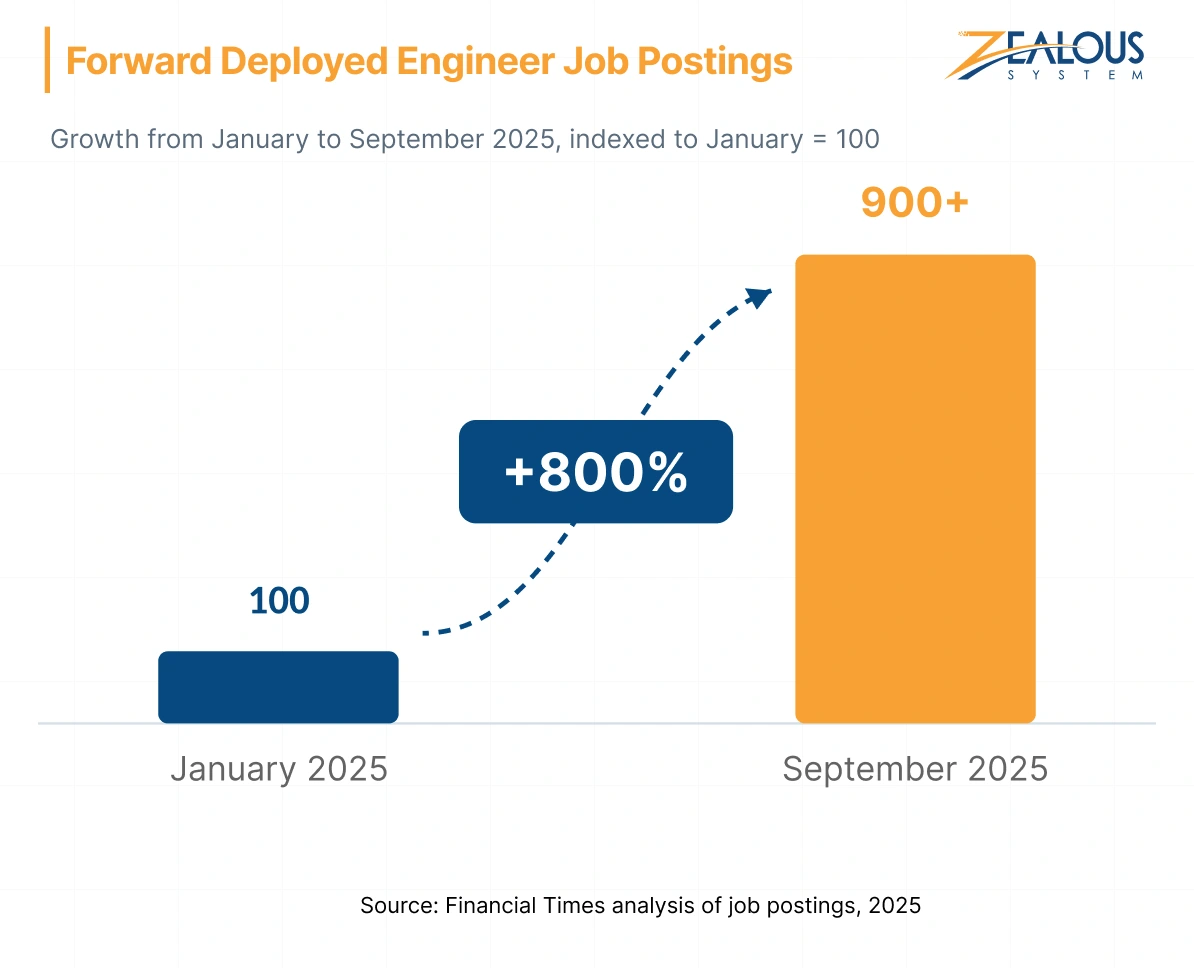
The role started at Palantir and stayed fairly niche for years. Generative AI changed that, because every company adopting LLMs needed engineers to connect models to its own data and tools. According to the Financial Times, job postings for forward deployed engineers rose more than 800% between January and September 2025.
Below, you’ll find what the job involves, the skills it demands, how it compares to similar roles, and when a business needs this kind of support.
A forward deployed engineer is a software engineer who deploys, customizes, and integrates a product inside a customer’s real environment. FDEs work directly with the customer rather than from a home office. FDEs write production code, and they also own the result. The software has to solve the customer’s problem once it’s live.
A useful way to separate the role from product engineering comes from Palantir’s model. A product engineer builds one capability that many customers use. An FDE builds many capabilities for one customer.
You’ll also see the title forward deployed software engineer (FDSE), which is Palantir’s original name for the position. Other companies post similar jobs as Applied AI Engineer, Deployment Engineer, or Forward Deployed AI Engineer.
The phrase borrows from military language, where forward-deployed units operate close to the action instead of from a central base. In software, it means engineers are based with the customer, on-site or inside the customer’s systems, and handle problems directly instead of through support tickets.
Palantir made the title well known, and the Palantir FDE model is still the reference point most employers borrow from. Its engineering blog explains that software engineers are called “Devs” and forward deployed software engineers are called “Deltas” internally. The “Delta” nickname dates back to when Palantir’s business development teams were named after letters of the NATO alphabet.
Demand for FDEs grew fastest once companies began deploying large language models. Putting an LLM into production use needs retrieval over company data, access controls, evaluations, cost limits, and connections to existing tools. Someone has to build all of that inside each customer’s stack.
That’s why AI companies now treat forward deployed engineering as a core function. In May 2026, OpenAI launched the OpenAI Deployment Company with a $4 billion investment. It also acquired consulting firm Tomoro, which brought in about 150 forward deployed engineers. Around the same time, Google Cloud began recruiting FDEs across several countries.
A forward deployed AI engineer does the same core job as a traditional FDE, with an extra layer of work: prompt design, RAG pipelines, model evaluation, and guardrails. For product leaders, it’s the same challenge you face when you integrate generative AI into your existing product, repeated for every customer.
Forward deployed engineer responsibilities shift with every customer, which is why many engineers find the role interesting. Still, most of the work falls into a few recurring areas. A typical forward deployed engineer job description will list most of the following.
Before writing any code, an FDE learns how the customer’s work actually gets done. That means sitting with operators, reading process documents, and asking why each step exists. This often changes the brief. A request for “an AI summary tool” can turn out to be a need to help claims adjusters find policy details faster, which calls for search and retrieval more than summaries.
Products rarely fit a customer’s environment out of the box. FDEs build connectors to CRMs, ERPs, internal APIs, and legacy databases. They also write custom applications on top of the core platform. Much of this is hands-on application integration and client integration work, done under security rules the FDE didn’t set.
FDEs install, configure, and secure software inside the customer’s cloud account, private network, or on-premise servers. Along the way, they deal with identity systems, firewall approvals, compliance reviews, and change boards. Getting access to a production environment can take longer than building the feature.
Customers want to see something working before they commit budget. A skilled FDE can turn a vague use case into a working prototype within days, using the customer’s real data. That prototype then becomes a tool for testing assumptions and deciding what deserves a production build.
Almost every deployment runs into data trouble. Records are duplicated across systems, fields mean different things in different departments, and the most useful information sits in PDFs or email threads. FDEs build pipelines to clean, map, and move that data. Some projects grow large enough to need dedicated data migration services.
An FDE might talk to developers in the morning and a VP of Operations in the afternoon. They explain trade-offs in plain language, manage expectations when timelines slip, and keep sponsors informed without burying them in detail. The trust built here often decides whether a pilot gets renewed.
FDEs see what breaks in the field before anyone at headquarters does. They report recurring customer needs, missing features, and fragile components back to the product team. When several customers ask for the same custom work, the product team can turn it into a standard feature.
What a forward deployed engineer does day-to-day depends on the deployment stage. During discovery, most of the week goes to meetings and workshops. During the build phase, the schedule looks much like a regular engineering job.
Here’s a realistic composite of a mid-deployment day for an FDE rolling out an AI document processing system at an insurance company:
| Time | What’s Happening |
|---|---|
| 8:30 AM | Review overnight pipeline runs and error logs in the customer’s environment |
| 9:30 AM | Stand-up with the customer’s IT team to unblock a pending API access request |
| 10:30 AM | Sit with a claims supervisor to see where the extraction model misreads handwritten forms |
| 1:00 PM | Write code: add fallback rules for low-confidence fields and update evaluation tests |
| 3:30 PM | Sync with the internal product team about a connector bug affecting other customers |
| 4:30 PM | Demo progress to the project sponsor and agree on next week’s priorities |
| 5:30 PM | Document the day’s changes so the customer’s team can maintain them later |
Some realities rarely make it into job listings. Travel can mean several days a week at a client site, and context switching is constant. FDEs are also judged on adoption, so they spend time training users and fixing workflow issues, not only writing code.
The skills required for forward deployed engineer roles span three areas. Most candidates are strong in one and passable in another. The engineers who do best in the role are solid in all three.
Forward deployed engineer skills start with shipping production code quickly inside unfamiliar systems. Requirements that show up across most job postings include:
FDEs spend a large part of their week with non-engineers. They explain why a feature will take three weeks, push back on unrealistic requests, and run workshops with people who have never written code. Written communication matters too, since handover notes outlast any meeting.
An FDE working in healthcare needs to understand clinical workflows and patient data rules. One working in logistics needs to know how dispatch and freight billing operate. Nobody expects industry expertise on day one. What matters is learning fast and tying each technical decision to a business result, such as hours saved or errors avoided.
The FDE title overlaps with several established roles, and some employers use the labels loosely. Here’s how they typically compare:
| Factor | Forward Deployed Engineer | Software Engineer | Solutions Engineer | Solutions Architect |
|---|---|---|---|---|
| Main Goal | Make the product deliver results for a specific customer | Build and maintain the core product | Win deals by proving technical fit | Design the overall system and approach |
| Customer Contact | Daily, often embedded | Low | High, mostly before the sale | Medium to high |
| Production Code | Heavy | Heavy | Light, mainly demos and POCs | Rare |
| Where the Work Happens | Customer site or customer environment | Internal product teams | Sales calls and demos | Design and planning sessions |
| Success Measured By | Adoption, results, renewals | Product quality and delivery | Deals closed | Sound architecture and project success |
Both roles write serious code, so the forward deployed engineer vs. software engineer question comes down to who they write it for. A software engineer builds features for many customers and works from a defined roadmap. An FDE builds for one customer at a time, handles messier requirements, and faces users directly.
The clearest forward deployed engineer vs. solutions engineer difference is timing. Solutions engineers usually work before the contract is signed. They run demos, answer technical questions, and build proofs of concept to help win the deal. FDEs typically come in after the signature and stay until the system runs in production. Some companies blur this line, so read each job description closely.
In forward deployed engineer vs. solutions architect terms, the split is how far each role goes. A solutions architect designs how a system should fit together and often hands implementation to other engineers. An FDE designs and builds. Senior FDEs do plenty of architecture work, but they stay accountable for writing and shipping the code themselves.
There’s no single route into this role. Most FDEs come from software engineering, data engineering, or technical consulting. If you’re planning the move, these steps close the most common gaps.
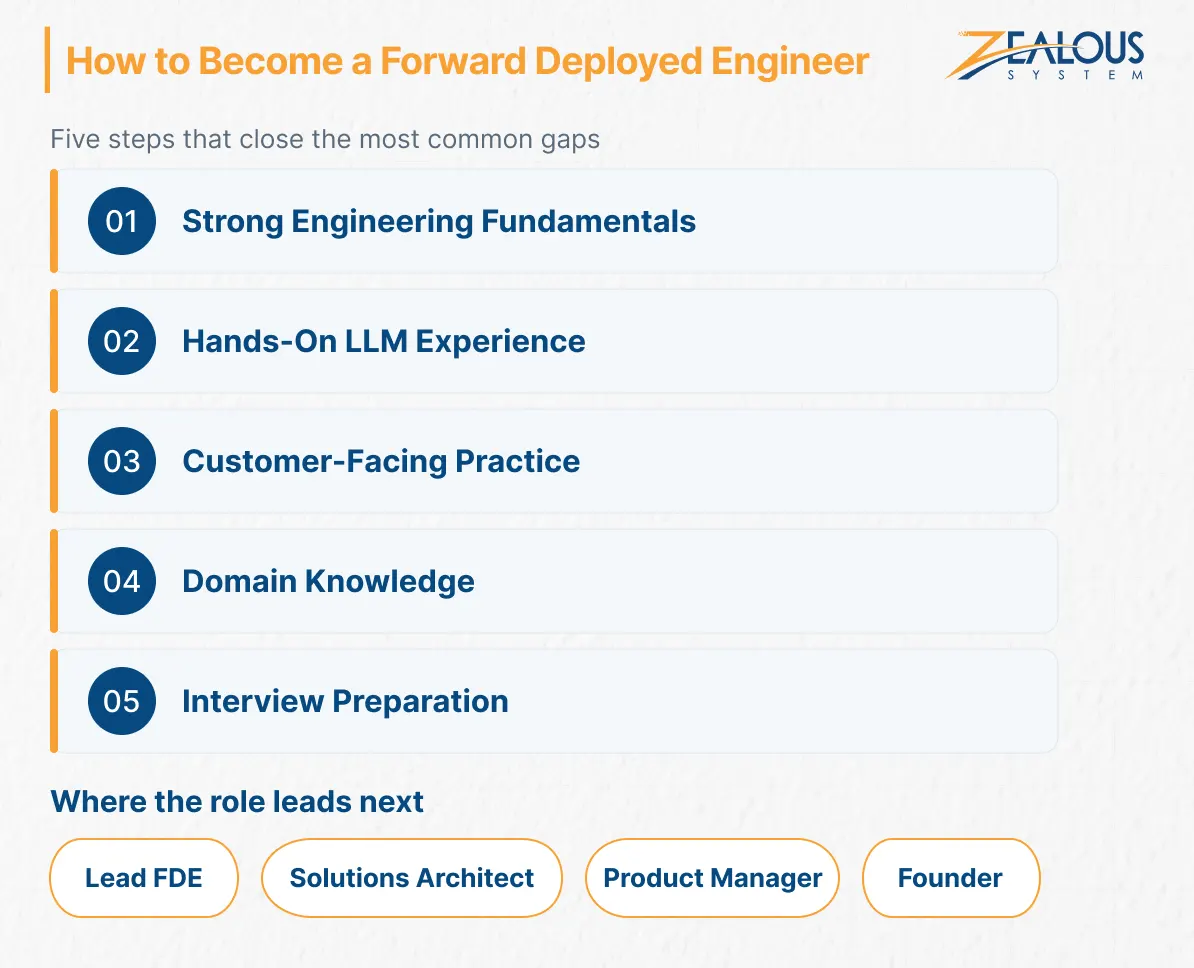
Employers expect production-grade code, not only scripts and notebooks. One OpenAI FDE listing, for example, asks for five or more years of engineering or technical deployment experience that includes customer-facing work. Get comfortable across the full stack, since FDEs rarely have a specialist nearby to hand tasks to.
Build something real with LLMs and deploy it. A RAG application over messy internal documents teaches you more about production AI systems than a polished chatbot demo does. Pay attention to the unglamorous parts: evaluation, latency, cost tracking, and what happens when the model is wrong.
You can start building this in your current job. Volunteer for customer escalations, join sales calls, lead requirement sessions with internal teams, or take on client projects. Interviewers want evidence that you can handle ambiguity and difficult conversations without losing momentum.
FDE interviews often combine coding rounds with case-style problems, such as scoping a solution for a vague business scenario. Practice talking through trade-offs out loud, and prepare stories about messy problems you owned end to end. When job hunting, also search for titles like Applied AI Engineer and Deployment Engineer.
Forward deployed engineer salary figures vary widely by company, location, and equity. At the time of writing, Levels.fyi reports a median total compensation of $206,000 for FDEs in the United States. The 25th percentile sits at $175K, while the 90th percentile reaches $350K.
Pay also differs sharply by employer. At Palantir, reported total compensation for the role ranges from $135K to $631K, with a median of about $254K. Frontier AI labs tend to pay more, although a large share often comes as equity. Keep in mind that these figures are self-reported and US-focused, so check local listings for other regions.
From here, common next steps include lead FDE, solutions architecture, product management, engineering management, or founding a company. Product management and founder roles are a natural fit, since FDEs see firsthand which problems customers will pay to solve.
Palantir still runs one of the largest FDE programs, but the list of employers has grown quickly. Companies hiring forward deployed engineers or closely related roles include:
For business leaders, the growth in FDE hiring shows where enterprise AI deployment budgets are really going: into connecting models with company data, systems, and processes.
In 2025, MIT’s Project NANDA studied enterprise generative AI pilots. About 95% of them showed no measurable impact on profit and loss. The researchers pointed to poor enterprise integration rather than weak models. Some analysts have questioned the study’s methodology, yet the pattern matches what many engineering teams see in practice.
The blockers tend to repeat:
Forward deployed engineering deals with those problems at the source. Engineers working inside your environment find data issues in the first week instead of the fourth month. They build against your real systems, bring security teams in early, and adjust the solution based on how people actually use it.
One example is an AI fraud alert triage agent built for a UK-based non-banking financial company (NBFC). Analysts were spending 15 to 20 minutes per alert pulling data from four different systems. The project began with discovery workshops alongside fraud, risk, and compliance teams. The AI then ran in shadow mode next to live operations before any automation went live, and rollout happened in phases, starting with low-risk alerts. Monthly alerts needing manual review dropped from over 12,000 to around 4,500.
Discovery workshops, shadow testing, and a phased rollout are the same steps an FDE would follow.
Building an internal FDE team makes sense when AI deployment is central to your product and you have a long runway. Recruiting takes time: the skill mix is scarce, AI labs compete for the same people, and new hires still need months to learn your systems.
A development partner is often faster for a defined initiative. You get engineers who have handled similar deployments, and team size can change as the project does. Many companies do both. They bring in AI integration services for the first production rollout, then hire AI developers to own the system long term.
| Factor | In-House FDE Team | AI Development Partner |
|---|---|---|
| Time to Start | Months of hiring and onboarding | Weeks |
| Cost Structure | Fixed salaries and benefits | Project-based or flexible team size |
| Knowledge Retention | Stays inside the company | Needs planned handover and documentation |
| Best Fit | AI is a core, long-term product capability | Specific initiatives or a first production rollout |
IT staff augmentation sits between the two, placing external engineers directly inside your team, which is similar to how FDEs work.
For engineers who enjoy variety and direct impact, yes. Pay is strong, demand has grown sharply, and the experience prepares you for product, architecture, or founder roles. It’s a weaker fit for people who prefer deep focus on a single codebase or want predictable schedules with little travel.
Yes. Writing production code is central to the job, and it’s what separates FDEs from consultants and most sales engineers. Coding time varies by deployment stage, with the most during build and integration.
Yes, it’s a fully technical engineering role. Employers usually hire FDEs with software engineering backgrounds and assess them through coding interviews. Customer-facing skills are assessed in addition to coding ability.
The challenges are different. Software engineers often go deeper into system design and scale. FDEs face more ambiguity, shifting requirements, customer pressure, and constant context switching. Engineers who find ambiguity draining usually find the FDE role tougher.
Most FDE roles are hybrid, with regular travel to customer sites. Government and defense roles may require full on-site work and security clearance, while others run mostly remotely inside a customer’s cloud environment. Check each listing for travel expectations.
A forward deployed engineer gets software running inside a customer’s business and keeps working until people use it. The job blends production engineering, data work, and customer relationships, and it suits people who care more about outcomes than tickets closed.
For engineers, it’s one of the best-paid and most in-demand paths in tech. For enterprises, it’s a reason to budget for integration, data, and adoption work at the start of an AI project.
As an AI software development company, Zealous System works with businesses to take AI from pilot to production, handling the data pipelines, integrations, and LLM deployment that sit between a good demo and daily use. Has an AI project in your organization stopped short of production? Our engineers can help you find what’s blocking it and plan the route forward.
Our team is always eager to know what you are looking for. Drop them a Hi!

Meet Prashant Suthar, a Sr. Software Developer at Zealous System. With a passion for building elegant code and solving complex problems, Prashant transforms ideas into digital solutions that drive business success.




Comments