Quick Overview:
A national contractor running four active projects can easily sit on 600 live Safe Work Method Statements at once. Every one of them is a legal document. Every one needs to match the actual site, the actual crew, and the actual plant on the ground that week.
Most of them do not.
They get copied from the last job, the site address gets swapped out, and the controls stay exactly as they were written three years ago. Safety managers know this. They just do not have the hours to fix it at that volume.
This is where an AI SWMS generator starts to look less like a novelty and more like infrastructure. Below, we walk through how an AI agent actually drafts an automated safe work method statement, what the architecture looks like underneath, where Australian compliance draws a hard line, and what a build of this kind costs and takes.
SWMS generation is the process of producing a Safe Work Method Statement: the document that sets out what high-risk work will happen, what hazards it creates, and what controls will keep people safe. It is prepared before work starts and kept available on site for inspection.
Under the model WHS Regulations, a SWMS is mandatory before any of the 18 defined high-risk construction work activities begin. The list sits at regulation 291 and covers work near live electrical conductors, trenching deeper than 1.5 metres, demolition of load-bearing elements, confined spaces, asbestos disturbance, tilt-up concrete, and work involving a risk of falling more than two metres, among others.
The document itself has four jobs under the regulations. It must identify the work as high-risk, specify the hazards, describe the control measures, and explain how those controls will be implemented, monitored, and reviewed. Practically speaking, most run to six pages or fewer.
Two details catch teams out. WorkSafe Tasmania notes that a principal contractor must obtain the SWMS before high-risk work begins, and workers cannot start until they have had the chance to read and understand it. If a notifiable incident occurs, that SWMS has to be kept for at least two years afterwards.
These three get used interchangeably on site, and they should not be.
The distinction matters for anyone building software. A JSA can be freely formatted. A SWMS cannot, because a regulator may ask to see it.
Construction remains one of the most dangerous industries in the country. Safe Work Australia’s Key Work Health and Safety Statistics 2025 recorded 37 construction fatalities in 2024, around 20% of all worker deaths that year, with falls from height responsible for 13% of fatal injuries nationally. Paperwork alone does not cause those numbers. But paperwork that nobody reads is a fair signal of a system under strain.
The failure mode regulators care about most is the generic SWMS. A document lifted from a previous job, lightly edited, and filed.
It passes a glance. It fails an audit, because the controls listed do not correspond to the hazards actually present. Same trade, same activity, different site: different weather exposure, different neighbouring works, different access constraints, different plant.
For a principal contractor, the workload is not writing SWMS. It is reading them. Every subcontractor submits their own before mobilising. On a large project, that is several hundred documents, each needing a check for missing controls, unsupported claims, expired licences, and activities that were never declared.
The reviewers are experienced HSEQ people doing repetitive comparison work, and the queue is where projects lose days. It is the same bottleneck we found when digitising deficiency tracking in a construction site inspection software build for a Canadian housing agency: the inspections were never the constraint; the paperwork behind them was.
A contractor working nationally is not managing one rulebook. Victoria runs its own list under regulation 322 of the Occupational Health and Safety Regulations 2017, with 19 categories and different terminology from the model laws. And South Australia moved on 1 July 2026, dropping its high-risk fall threshold from three metres to two under the Work Health and Safety (High Risk Construction Work) Amendment Regulations 2025, bringing it into line with the national model.
That single change was significant. SafeWork SA data showed 68% of construction falls between 2020 and 2022 sat in the two-to-three-metre band the old threshold excluded, and roughly 1,585 claims since 2016/17 had cost more than $64 million. Overnight, a large share of single-storey roof work in SA became high-risk construction work requiring a SWMS.
Now consider what that means operationally. Every affected template in a national library needed reviewing, and every SA site needed re-papering. Done by hand, that is weeks of work. Done properly, it is the exact task a retrieval-backed system handles well.
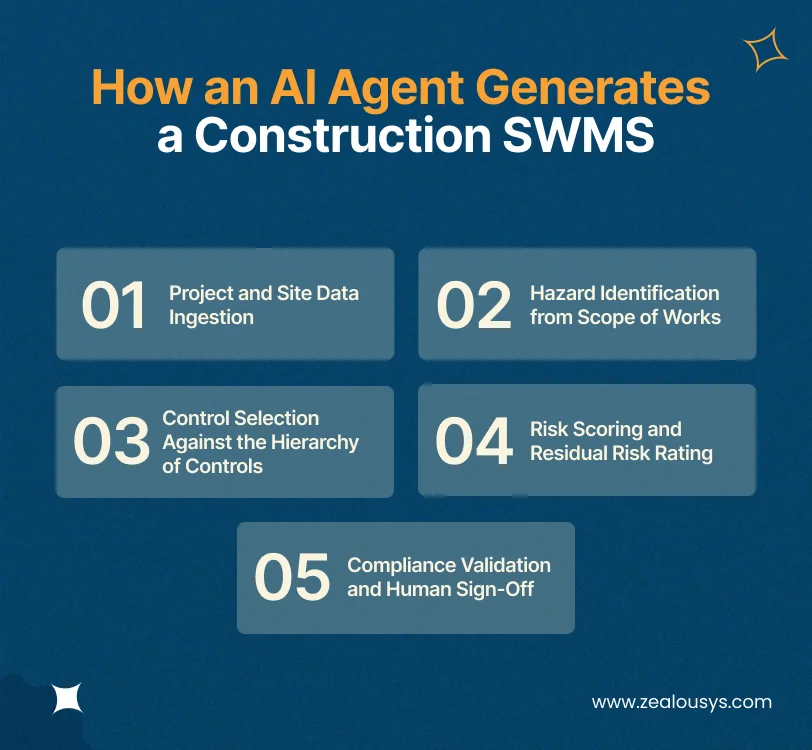
So, can AI write a SWMS? Yes, it can produce a complete, site-specific draft, and it can do it in minutes rather than hours. What it cannot do is approve one. Australian WHS law requires a competent person to review and sign off, and requires workers to be consulted before the work starts. The agent handles preparation, not accountability.
If you are working out how to automate SWMS generation, here is what happens between input and draft.
The agent pulls the context a safety adviser would gather manually. That means the scope of works, the plant and equipment register, safety data sheets for any substances on site, the site induction pack, subcontractor licences and competencies, and often photographs of the work area.
For AI risk assessment construction use cases, site photos matter more than people expect: an image of an unprotected penetration or a crowded laydown area surfaces hazards no scope document mentions. That input is what separates an AI construction risk assessment tool from a document generator. Extracting structure from mixed document formats is unglamorous machine learning development work, and it decides how good everything downstream can be.
The agent breaks the activity into discrete work steps, then maps hazards to each one. This is where cross-referencing against the 18 HRCW categories happens. A scope that reads “install roof sheeting on single-storey dwelling” needs to trigger the fall-from-height category, and in South Australia it now does at a lower threshold than it did last financial year.
Controls are chosen under an explicit constraint: the hierarchy of controls, as required by the WHS Regulations. The constraint is what makes the output defensible. An unconstrained model will happily suggest PPE and a toolbox talk for a fall risk, because that language appears constantly in its training data. A properly built agent cannot jump to PPE while elimination, substitution, or engineering controls remain available. It has to work down the hierarchy in order and justify why higher-order controls were ruled out.
Each hazard gets a pre-control rating and a residual rating after controls are applied. Use the client’s own risk matrix, not a generic five-by-five. Contractors calibrate their matrices differently, and a mismatch between the agent’s scoring and the organisation’s standard makes every output feel wrong to the people reviewing it.
A second pass checks the draft before any human sees it. Critically, this validation runs as a separate step from drafting. It flags missing mandatory fields, controls with no traceable source, regulation references that do not resolve, and activities mentioned in the scope but absent from the hazard list. Only then does the SWMS enter the review queue for a competent person, worker consultation, and signature.
Most software to automate SWMS still expects a person to supply the content. The real difference between these three is where the drafting effort sits.
| Static Templates | Digital SWMS Platform | AI SWMS Generator | |
|---|---|---|---|
| Site-Specificity | Manual editing, often skipped | Structured fields, still manually filled | Drafted from actual project data |
| Time per Document | 4 to 8 hours | 1 to 3 hours | 10 to 20 minutes plus review |
| Subcontractor Review | Fully manual | Manual, with workflow routing | Pre-screened, exceptions flagged |
| Regulatory Updates | Rewrite every template | Update master templates by hand | Re-retrieve against updated corpus |
| Auditability | Document version only | Field-level change log | Source traceable per control |
| Setup Effort | None | Low | Moderate, needs data preparation |
Not every feature carries equal weight. These are the ones that decide whether AI for construction safety compliance works on a live site or only in a demo.
Every generated document is grounded in that project’s data rather than a stored template, so the controls reflect conditions on that site on that day.
Incoming submissions are checked against the principal contractor’s requirements before reaching a human, with gaps, omissions, and undeclared activities flagged for attention. This is usually the highest-value feature for Tier 1 and Tier 2 contractors.
Controls are drawn from current WHS Regulations, Codes of Practice, and relevant Australian Standards, with the jurisdiction handled correctly for the site in question.
Every revision is logged with what changed, who approved it, and which source supported each control, satisfying both internal audit and a regulator’s request.
SWMS live where project documents already live. An AI tool for creating SWMS that requires a separate login will be ignored within a month, which makes application integration a scoping question rather than a phase-two nicety.
A construction safety AI agent is not a single model with a long prompt. It is a pipeline with distinct components, each doing a narrow job, which is what makes the output auditable.
Three separate indexes, not one. The regulatory corpus, the client’s approved SWMS library, and historical incident and near-miss data each carry different trust weightings. Blending them into a single index is the most common early mistake we see, because an approved internal control and a general industry practice then compete on equal footing during retrieval. They should not. The retrieval patterns are shared across most generative AI development projects that touch regulated content, whether the corpus is WHS law or something else entirely.
Separate agents for identifying hazards and selecting controls, rather than one model doing both. Splitting the two allows the control agent to be constrained by the hierarchy of controls independently, and makes it far easier to test where an error originated when output quality drops.
Compliance Validator and Hallucination Guardrails
A checking pass that never drafts, only verifies. Every citation must resolve to a real clause. Every control must trace to a retrieved source. Anything the validator cannot ground gets flagged rather than published. In a compliance document, a confidently invented regulation reference is worse than a blank field, because a blank field is obvious.
Confidence thresholds decide routing. High-confidence, low-complexity drafts go straight to a reviewer with a summary attached. Anything uncertain, novel, or high-consequence escalates with the uncertainty made explicit.
We used the same pattern when building an AI fraud alert triage agent for a UK lender: the agent enriched and prioritised every alert, but analysts kept the final call on anything uncertain. Manual review volume fell 62%, and because every recommendation arrived with a plain-language justification and a full audit log, the compliance team could defend it.
The parallel to SWMS is close. Same shape of problem: high volume, high stakes, regulated output, human accountability that cannot be delegated to software.
Whether an AI-generated SWMS is legally compliant in Australia depends entirely on how it is prepared and approved, not on whether software drafted it. It is the first question anyone evaluating an AI SWMS generator in Australia has to answer, and the answer is clearer than most people expect. The regulations do not say who, or what, produces the draft. They specify what the document must contain, who must be consulted, and who carries the duty.
The duty sits with the person conducting a business or undertaking carrying out the high-risk construction work. Each PCBU must manage risks so far as is reasonably practicable, including for contractors within their control. Software does not hold a duty and cannot absorb liability. Treat AI output as a draft prepared for a competent person, exactly as you would treat a graduate engineer’s first attempt.
A SWMS must be prepared in consultation with the workers who will carry out the work, and those workers must have the opportunity to read and understand it before starting.
No, AI does not replace worker consultation. Nothing in an automated workflow substitutes for that conversation. What a good agent does is make the conversation better, because the crew is reviewing a document that already reflects their actual site rather than a generic template they have learned to sign without reading.
Generic output is the precise failure regulators penalise, which makes grounding an engineering requirement rather than a quality preference. Every control the system proposes should be traceable to a source: a regulation, a Code of Practice, an approved internal control, or a documented site condition.
Incident records, worker details, and project documents carry privacy obligations. Many Australian contractors and government clients require data to stay onshore, which shapes hosting decisions and model selection early. Settle this in discovery, not after the pilot.
This article provides general information about software design and compliance considerations. It is not legal or work health and safety advice. Confirm your obligations with your WHS regulator or a qualified adviser.
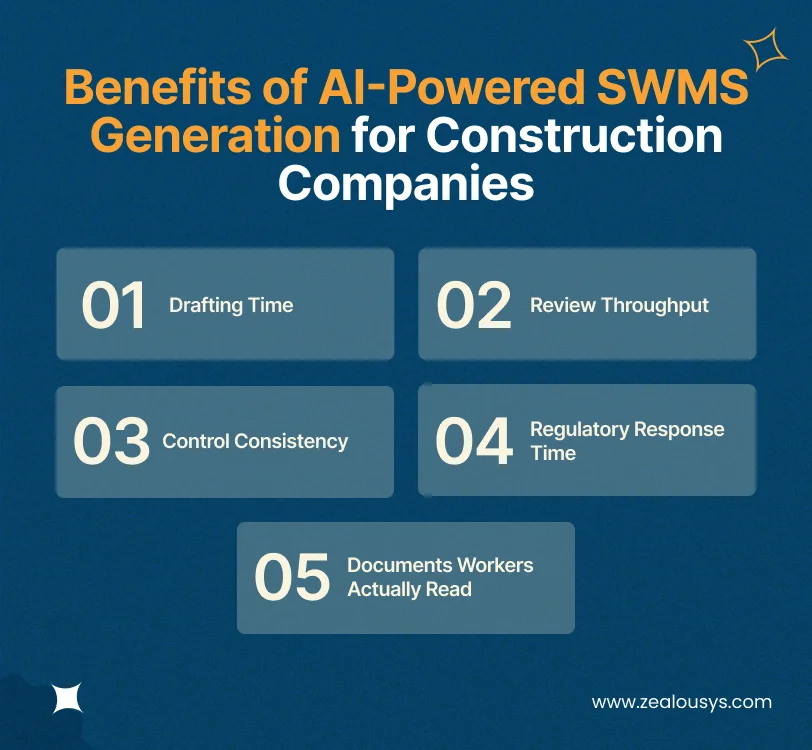
Construction risk assessment automation pays back in four measurable places, and one that is harder to count.
Preparation drops from hours to minutes plus review. The saving compounds across a portfolio rather than a project.
This is where the larger gain sits for principal contractors. Pre-screened submissions arrive with exceptions already flagged, so reviewers spend their time on genuine problems instead of confirming that the routine ones are fine.
The same activity produces the same standard of controls across every project and every subcontractor, which is close to impossible to achieve manually across a national portfolio. Contractors already running workforce management software will recognise the pattern, since competency and licence data feeds the same checks.
When a Code of Practice changes or a threshold moves, as SA’s did in July 2026, updating a retrieval corpus is a different order of task from rewriting a template library by hand.
This one is harder to measure and probably matters most. A SWMS that genuinely reflects the site is a document workers read. A generic one is a signature exercise.
Budget for an AI SWMS generator runs from USD $15,000 to $150,000, or roughly A$20,000 to A$210,000 and above, with the spread driven mostly by integration count and how clean the existing data is.
| Scope | Timeline | Budget (AUD) | Budget (USD) |
|---|---|---|---|
| Pilot/MVP | 8–14 weeks | A$20K–A$55K | US$15K–$40K |
| Production Platform | 4–6 months | A$55K–A$120K | US$40K–$85K |
| Enterprise Platform | 5–9 months | A$120K–A$210K+ | US$85K–$150K+ |
One high-risk activity, one jurisdiction, no external integrations. The point of a pilot is not a working product. It is an answer to one question: does retrieval over your actual SWMS library produce controls your safety team would sign? Working at height is the usual test case.
You get a functioning draft-and-review loop the team can react to, which is the same logic behind any MVP development decision, and enough evidence to scope the next stage honestly.
All 18 HRCW categories, one or two jurisdictions, subcontractor review workflow, and one or two integrations. This is where most Tier 2 contractors land. Coverage extends across the full HRCW list, the subcontractor review queue gets automated, and the agent connects to wherever project documents already live.
Add an evaluation harness and a phased rollout, and this tier does the actual work of removing manual hours from the business.
Multi-jurisdiction coverage, deep integrations, and data residency or hosting constraints. The extra cost here is rarely the AI. It comes from Victoria running a separate regulation with different terminology, from per-business-unit risk matrices, from single sign-on and role-based access across thousands of users, and from onshore hosting requirements common on government work.
ConTech vendors embedding SWMS generation as a product feature also sit at this tier, since they carry multi-tenant and white-label requirements a single contractor does not.
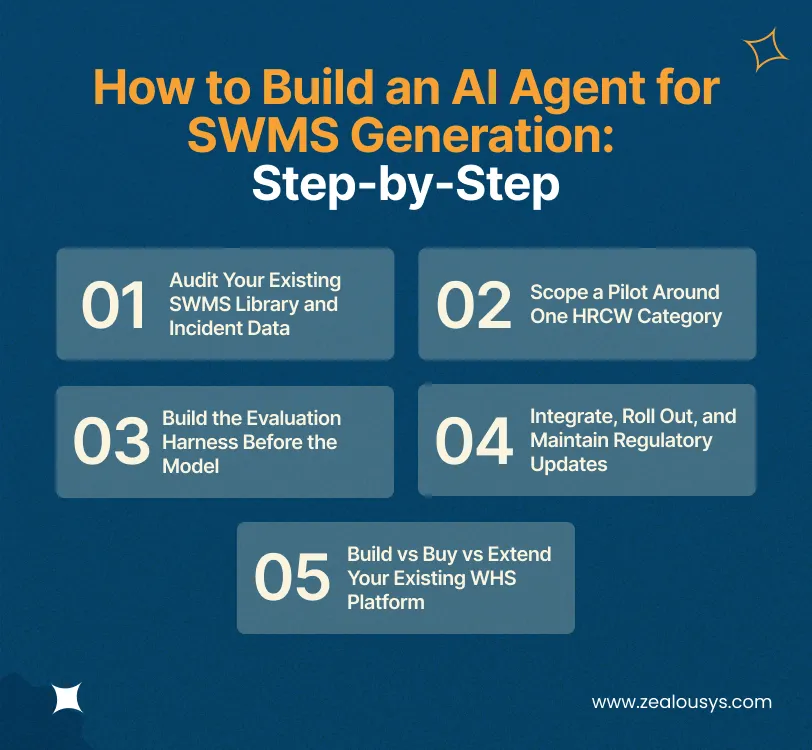
Start by finding out what you actually have. Most organisations discover duplicates, superseded versions, and documents referencing repealed clauses. This audit usually delivers value on its own, before any AI is involved, which is why it tends to sit inside an AI consulting engagement rather than a build.
Pick one activity with high volume and clear rules. Working at height is the usual choice, because it appears on nearly every site and the regulatory position is well documented. Resist the temptation to cover everything at once. A narrow pilot that works beats a broad one that half-works.
Assemble a test set of SWMS your safety team considers correct, and a set of known-bad examples, before writing generation code.
Without this, you cannot tell whether a prompt change improved anything. Teams that skip it end up tuning on vibes and shipping regressions.
Run the agent in shadow mode first, generating drafts alongside the existing manual process so the safety team can compare without risk. Expand automation only as accuracy holds.
Then plan for maintenance. Regulations move, as South Australia demonstrated. Someone owns keeping the corpus current, and that responsibility belongs in the build plan rather than discovered later.
Worth being straight about this. If your requirements are standard and your library is small, an off-the-shelf digital SWMS platform may be enough, and a custom AI SWMS generator would be poor value. If you already run a WHS platform, adding an agent layer over your existing data is usually cheaper than replacing it.
Custom SWMS software development earns its cost in three situations: you are a ConTech vendor, and this capability is your product; you operate at a volume where review labour is a material cost line; or your compliance requirements exceed what any general-purpose tool handles. Outside those, buy.
We at Zealous System build compliance-grade AI systems where the output has to survive an audit, not just read well. As an AI agent development company for construction, our work spans RAG pipelines over regulatory corpora, human-in-the-loop review workflows, and explainable decision engines. Teams come to us to build AI agents for compliance documents, where a wrong citation is a legal exposure rather than a support ticket.
High-risk work and documentation duties intersect the same way in adjacent sectors, which is how we came to build workforce management software for the Australian mining industry and compliance management software for regulated property portfolios. With a team in Victoria and delivery capability across four countries, clients treat us as a construction software development company in Australia rather than an offshore vendor, working in Australian time zones against Australian compliance requirements.
If you are weighing a build, our custom AI agent development services start with a two-week feasibility assessment against your existing SWMS library, which will tell you what your data can support and what it cannot. That is usually the most useful place to start.
Yes. An AI agent can produce a complete, site-specific SWMS draft in minutes using project scope, plant registers, safety data sheets, and site conditions. A competent person must still review and approve it, and workers must be consulted before the work begins.
It can be. The regulations govern content, consultation, and accountability rather than authorship. A SWMS drafted by AI, reviewed by a competent person, prepared in consultation with affected workers, and specific to the site meets the same test as one written by hand.
Typically USD $15,000 to $150,000, or about A$20,000 to A$210,000 and above. A single-activity pilot sits at the lower end; a multi-jurisdiction platform with integrations sits at the upper end.
A scoped pilot takes 8 to 14 weeks. A production platform runs 4 to 6 months, and an enterprise build with multi-jurisdiction coverage and deep integrations takes 5 to 9 months. Data readiness is the main variable.
No. Consultation with workers carrying out the high-risk construction work is a legal requirement and cannot be automated. AI improves the document those workers review; it does not replace the conversation.
A SWMS is legally required in Australia for 18 defined high-risk construction activities. A JSA is a task-based risk assessment method with no equivalent statutory trigger. RAMS is the UK and Irish equivalent, pairing a risk assessment with a method statement.
Yes, and for principal contractors this is often the strongest use case. The agent checks submissions against project requirements, flags missing controls and undeclared activities, and routes exceptions to reviewers.
All of them. Most jurisdictions apply the model WHS Regulations at regulation 291 with 18 categories. Victoria uses its own list at regulation 322 of the OHS Regulations 2017. South Australia aligned its fall threshold with the national two-metre standard on 1 July 2026.
Five things: drafts grounded in actual project data rather than templates, every control traceable to a named source, control selection constrained by the hierarchy of controls, mandatory human sign-off before issue, and integration with wherever your project documents already live. A tool missing traceability will not survive an audit.
Our team is always eager to know what you are looking for. Drop them a Hi!

Pranjal Mehta is the Managing Director of Zealous System, a leading software solutions provider. Having 10+ years of experience and clientele across the globe, he is always curious to stay ahead in the market by inculcating latest technologies and trends in Zealous.


Comments