Investment banking has always been a data-heavy business. Analysts spend hours reviewing financial statements, building models, researching companies, preparing pitch books, evaluating transactions and turning large amounts of information into recommendations for clients.
Artificial intelligence is changing how much of that work gets done.
The shift in 2026 is no longer simply about using AI to automate repetitive tasks. Generative AI and increasingly capable AI agents are beginning to influence how investment banks conduct research, analyse transactions, prepare documents, manage workflows and support decision-making.
McKinsey’s latest research on corporate and investment banking points to a significant change in the operating model. AI is expected to move some junior-level work away from basic analysis and work-product creation toward synthesizing information, generating differentiated insights and interacting more frequently with clients.
For finance professionals, this creates an important question: What skills will actually make someone employable in investment banking in 2026 and beyond?
The answer is not simply “learn AI.”
The strongest candidates will be professionals who can combine financial expertise, analytical thinking, technology awareness and the ability to use AI responsibly.
AI has been present in financial services for years through algorithmic trading, fraud detection, risk models, natural language processing and automated reporting. Generative AI has accelerated the transformation because it can work with unstructured information such as documents, emails, research reports and financial disclosures.
The World Economic Forum’s 2026 AI Playbook for Financial Services highlights the industry’s transition from AI experimentation toward scaled implementation. It also identifies workforce transformation, governance, data foundations and agentic AI as important parts of this transition.
Investment banking is particularly exposed because so much of its work involves information-intensive processes.
AI can increasingly assist with:
Deloitte has similarly identified significant potential for generative AI across investment banking, particularly in activities involving research, marketing, decision support, due diligence, valuation and document generation.
This does not mean that investment bankers are becoming obsolete.
It means the definition of a productive investment banker is changing.
For years, entry-level investment banking roles have involved a considerable amount of manual work.
An analyst might spend hours extracting information from financial statements, updating Excel models, searching through filings, preparing presentation slides or checking numbers across multiple documents.
AI can increasingly accelerate parts of these workflows.
That creates an interesting paradox for students and early-career professionals.
The work that traditionally helped junior professionals learn investment banking may become more automated. At the same time, employers will increasingly expect those professionals to understand the output produced by AI, challenge incorrect assumptions and turn information into meaningful financial conclusions.
This makes practical training more important, not less.
For students exploring an investment banking course in Mumbai, this shift is particularly relevant. Mumbai remains one of India’s most important financial centers, with opportunities across investment banking, equity research, corporate finance, financial analytics, asset management and related financial services.
The right training therefore needs to prepare students for the way finance work is actually being performed.
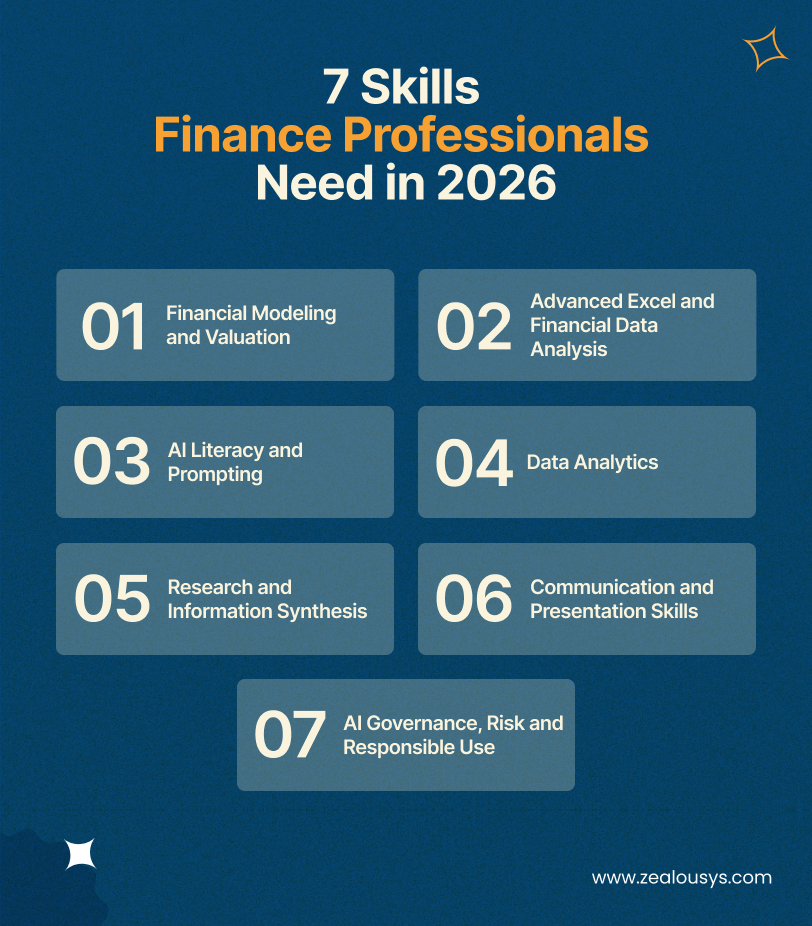
AI can help generate a financial model faster, but it cannot replace financial judgment.
A finance professional still needs to understand:
The difference is that AI can potentially reduce the time spent building the first version of a model, while the professional remains responsible for understanding whether the assumptions make sense.
A candidate who knows Excel but cannot explain why a company’s WACC changed will struggle.
A candidate who understands valuation and can use AI to accelerate the analytical process becomes considerably more useful.
This is why a financial modelling course can complement investment banking training, particularly for candidates targeting analyst-level finance positions.
Excel remains deeply embedded in investment banking.
AI is changing how professionals use it, but it has not eliminated the need for spreadsheet expertise.
Finance professionals should be comfortable with:
The future is therefore unlikely to be “Excel versus AI.”
It is more likely to be Excel plus AI plus financial judgment.
For someone comparing the best investment banking course, practical exposure to financial modeling and spreadsheet-based analysis should therefore be an important consideration.
Finance professionals do not necessarily need to become machine-learning engineers.
They do, however, need to understand how AI systems behave.
That includes knowing how to:
Someone who simply asks an AI chatbot to “analyze this company” is using AI.
Someone who gives the system a defined analytical framework, specifies the financial metrics required, validates the output against filings and then incorporates the results into a valuation is using AI professionally.
Investment banking increasingly intersects with data analytics.
Professionals may need to work with large datasets to identify market trends, analyze companies, compare financial performance or support transaction decisions.
Useful capabilities include:
The goal isn’t to become a full-time data scientist.
It is to become a finance professional who can understand and work with data.
This combination is also why an investment banking and financial analytics course in Mumbai can be relevant for students who want to develop both financial and analytical capabilities.
AI makes it easier to find information.
That makes the ability to evaluate and synthesize information more valuable.
Investment bankers need to distinguish between:
A strong analyst should be able to take information from annual reports, investor presentations, earnings releases, industry research and market data and turn it into a coherent investment or transaction perspective.
AI can accelerate this process, but professional judgment remains essential.
Investment banking is not purely an analytical profession.
Financial professionals must communicate complex ideas to clients, senior bankers, investors and internal teams.
That means candidates still need strong skills in:
As AI handles more routine analytical work, these human skills can become even more important.
One of the biggest mistakes finance professionals can make is assuming that faster automatically means better.
Financial institutions operate under strict expectations around confidentiality, compliance, accuracy, data protection and risk management.
Professionals working with AI need to understand:
Knowing when not to trust an AI output is itself becoming a professional skill.
The biggest change may not be the disappearance of investment banking jobs.
It may be the disappearance of certain types of investment banking work.
Routine tasks are increasingly exposed to automation, while roles requiring judgment, client interaction, complex analysis and decision-making remain difficult to automate completely.
This creates a new career hierarchy.
A candidate with only theoretical finance knowledge may struggle to differentiate themselves.
A candidate with finance knowledge, practical modelling experience and AI literacy has a stronger proposition.
And a candidate who can demonstrate these capabilities through actual projects has an even clearer advantage during recruitment.
This is where industry-focused investment banking education can make a meaningful difference.
Traditional finance education can teach concepts such as accounting, corporate finance and valuation.
But employers often need candidates who can apply those concepts.
A modern investment banking curriculum should therefore connect financial theory with practical assignments.
This practical shift is also happening alongside the broader digital transformation of financial services, where AI-enabled platforms, automation and fintech software development solutions are increasingly supporting modern financial workflows.
For example, students should have opportunities to work on:
For students looking for an investment banking training institute in Mumbai, these practical components can be more valuable than simply comparing course titles.
Boston Institute of Analytics’ Investment Banking & Financial Analytics program, for example, combines investment banking concepts with financial analytics and practical work. Its published course structure includes 200+ hours of learning and practical work, 50+ case studies and assignments, and exposure to 15+ tools and technologies.
The objective is to bridge the gap between what students learn and what they may encounter in professional finance roles.
For students considering an investment banking course with placement in Mumbai, the question is no longer only:
“What will I learn?”
It is also:
“Can I demonstrate these skills to an employer?”
This is where placement-oriented training becomes important.
An investment banking course with placement assistance should ideally address the entire transition from classroom to workplace.
That includes:
Financial modeling, valuation, accounting, Excel and financial analytics.
Case studies and projects that simulate real investment banking assignments.
Resume development, interview preparation and professional communication.
Guidance from professionals who understand actual finance workflows.
Opportunities to apply knowledge in a professional environment.
Access to relevant corporate networks and recruitment opportunities.
Boston Institute of Analytics provides career assistance for its investment banking program, including resume building, interview preparation and career counselling. Its published program structure includes a 4-month certification, a 6-month diploma with a 2-month guaranteed internship, and a 10-month master diploma with 6 months of guaranteed on-job training.
Importantly, placement support should not be confused with a guaranteed job for every learner. Actual hiring outcomes depend on factors such as individual performance, interview readiness, experience, location and market conditions.
The real value of a strong placement ecosystem is that it helps candidates become more employable and better prepared for the recruitment process.
As investment banking becomes increasingly technology-driven, finance education also needs to evolve. Students looking for an investment banking course in Mumbai increasingly need training that combines traditional finance with financial analytics, AI tools and practical exposure.
This is where Boston Institute of Analytics (BIA) positions its Investment Banking & Financial Analytics program differently. The program combines investment banking fundamentals with financial modelling, valuation, M&A, equity research, financial analytics and emerging technologies. Its curriculum includes 200+ hours of learning and practicals, 50+ case studies and assignments, 15+ tools and technologies, and hands-on capstone projects.
The technology component is particularly relevant as AI becomes part of everyday finance workflows. BIA’s program incorporates Generative AI, prompt engineering, Python and business intelligence tools, giving learners exposure to technologies that complement traditional investment banking skills.
For students specifically comparing the best investment banking course in Mumbai, practical exposure is an important factor. BIA’s Mumbai programs emphasize real-world financial modelling projects, case studies, live learning sessions and industry-oriented training rather than focusing exclusively on theoretical finance concepts.
For many students, choosing an investment banking course with placement ultimately comes down to one question: Will the program help me become employable?
Boston Institute of Analytics has a dedicated career-support structure around its Investment Banking & Financial Analytics program. Its published offerings include resume building, interview preparation, one-to-one career mentorship, job interview preparation and access to partner companies.
BIA also publishes multiple learning paths. The program includes a 4-month Investment Banking Certification, a 6-month Investment Banking Diploma with a 2-month internship, and a 10-month Master Diploma with 6 months of job training.
This distinction is important. Placement assistance is not the same as promising every learner a job. Hiring depends on individual performance, skills, interview performance, experience and market conditions. What a placement-oriented program can do is provide structured preparation, practical experience and employer connectivity that can improve a candidate’s readiness for the recruitment process.
For aspiring finance professionals in Mumbai, that combination of investment banking + financial analytics + AI + practical projects + career support is becoming increasingly relevant.
Imagine two candidates applying for the same financial analyst or investment banking position.
Candidate A has completed a finance degree and understands accounting concepts.
Candidate B has similar academic knowledge but can also:
Build a three-statement model
The second candidate gives the employer more evidence of workplace readiness.
This is increasingly important because AI itself is raising the productivity expectations placed on employees.
The World Economic Forum’s Future of Jobs Report 2025 found that 86% of employers globally expect AI and information-processing technologies to transform their businesses by 2030. In financial services, the expected exposure is even higher, at 97%.
The message for aspiring finance professionals is straightforward:
Do not learn AI separately from finance. Learn how AI can make you better at finance.
Finance students and professionals can use a simple four-stage framework.
Start with accounting, financial statements, corporate finance, markets and investment banking fundamentals.
Learn Excel, financial modeling, valuation, financial analysis and presentation techniques.
Learn how to work with data, use AI tools effectively, automate repetitive workflows and validate AI-generated outputs.
Build a portfolio of practical projects.
For example, instead of simply stating “I know valuation,” demonstrate a completed valuation of a publicly listed company.
Instead of saying “I understand M&A,” build an acquisition case study.
Instead of saying “I know AI,” demonstrate an AI-assisted research workflow while explaining how you verified the information.
This evidence can make a significant difference during interviews.
Mumbai’s finance ecosystem makes it an attractive location for people pursuing investment banking and financial analytics careers. But the growing number of finance programs also makes it important for students to evaluate training providers carefully.
When comparing an investment banking institute in Mumbai, consider:
These questions provide a better basis for choosing a program than simply looking at course duration or certification titles.
For learners specifically searching for the best investment banking institute, the strongest option should ultimately be the one that helps connect technical knowledge with demonstrable workplace skills.
AI is not removing the need for investment bankers.
It is changing what investment banking expertise looks like.
The investment banker of the future will likely spend less time performing repetitive information-processing tasks and more time interpreting information, developing recommendations, managing AI-enabled workflows and communicating with clients.
For students, this creates both pressure and opportunity.
The pressure is that simply having a finance qualification may no longer be enough to stand out.
The opportunity is that professionals who combine finance expertise with analytics, technology and communication skills can become considerably more valuable.
This is why choosing an investment banking course should involve looking beyond the syllabus. Practical projects, industry exposure, career mentoring, internships and placement support can matter just as much as classroom instruction.
As AI continues to reshape financial services, the professionals most likely to succeed will be those who can do something technology alone cannot: understand the numbers, question the assumptions, make sound judgments and turn complex financial information into decisions that businesses can act on.
The transformation of investment banking is not really an AI-versus-human story.
It is a story about AI-enabled finance professionals.
Financial modelling, valuation, accounting and market knowledge remain essential. But they increasingly need to be combined with AI literacy, data analytics, critical thinking, communication and practical experience.
For anyone planning a career in Mumbai’s financial sector, this makes the choice of training increasingly important. A good investment banking course with placement in Mumbai should not simply teach concepts. It should help candidates develop practical skills, create evidence of those skills and prepare for the expectations of modern finance employers.
The future of investment banking will belong to professionals who know how to use technology without losing sight of the fundamentals of finance.
AI may change the tools.
But financial judgment will remain the skill that makes those tools valuable.
Our team is always eager to know what you are looking for. Drop them a Hi!

Nandini Pare is a CAPM® Certified Business Analyst at Zealous System, specializing in business analysis, Agile delivery, and helping organizations build technology solutions that solve real business challenges.


Comments