
Here is the short answer: automotive software development cost in the UAE typically ranges from $20,000 to $250,000+ (AED 73,000 to AED 918,000+). A basic car rental booking app sits at the lower end. A full dealer management system or a connected fleet platform with telematics hardware integration sits at the higher end.
But a range that wide raises more questions than it answers. Why does one fleet management platform cost AED 150,000 while another crosses AED 500,000? What are you actually paying for at each stage? And where can you cut costs without cutting corners?
That is exactly what this guide covers. You will find realistic cost brackets for every major automotive software type, the factors that push budgets up or down, hidden expenses most vendors never mention upfront, and practical ways to keep your project within budget.
If you only have thirty seconds, this table gives you the honest picture:
| Project Complexity | Estimated Cost (USD) | Estimated Cost (AED) | Typical Timeline |
|---|---|---|---|
| Simple (MVP, Single Platform, Core Features) | $20,000 – $50,000 | AED 73,000 – 184,000 | 2 – 4 months |
| Medium (Cross-Platform, Integrations, Admin Panel) | $50,000 – $120,000 | AED 184,000 – 440,000 | 4 – 8 months |
| Enterprise (Multi-Module, IoT/Telematics, Compliance) | $120,000 – $250,000+ | AED 440,000 – 918,000+ | 8 – 14 months |
These ranges come from our own experience scoping and delivering automotive projects, and they assume you work with a development partner rather than building an in-house team from scratch. We compare both models later in this article, because the difference in total cost is bigger than most decision-makers expect.
One more thing before we go deeper: these are typical ranges, not quotes. Your actual number depends on your feature list, integrations, and the engagement model you choose. Treat everything below as a planning tool, then get a detailed estimate for your specific scope.
The UAE is not digitizing its automotive sector quietly. It is doing it at policy level, with deadlines attached.
Dubai’s Autonomous Transportation Strategy aims to convert 25% of all transportation trips in the city to autonomous mode by 2030, a target the government expects to cut traffic accidents and losses by 12% and save 396 million hours in travel time every year. Abu Dhabi, meanwhile, plans to install around 70,000 EV charging points by 2030 through the E2GO joint venture between ADNOC Distribution and TAQA.
The commercial side is moving just as fast. Mordor Intelligence values the UAE car rental market at USD 0.61 billion in 2025 and projects it to reach USD 1.33 billion by 2031, growing at 13.89% annually, driven by tourism, corporate travel, and rapid digitalization of booking and fleet operations.
What does this mean for you? Every dealership, rental operator, and fleet business in the Emirates is now competing on software, not just on inventory or price. Customers book cars from their phones. Fleet managers expect live GPS data, not weekly spreadsheets. Regulators expect digital records. The businesses investing in custom automotive software solutions today are the ones positioned to win contracts, customers, and market share over the next five years.
This is where budgets get real. Different automotive solutions carry very different price tags because their complexity varies enormously. The ranges below reflect what we typically estimate for each solution type when scoping projects for UAE businesses.
Estimated cost: $30,000 – $90,000 (AED 110,000 – 330,000)
A rental app needs booking flows, real-time vehicle availability, payment gateway integration, digital KYC (Emirates ID verification), and an admin dashboard. Car rental app development cost in the UAE rises when you add dynamic pricing, chauffeur options, subscription rentals, or integration with insurance providers. Given how competitive the UAE rental market is, the user experience often decides whether customers book with you or the app next door.
Estimated cost: $40,000 – $120,000 (AED 147,000 – 440,000)
Fleet management software development cost depends heavily on scope: these platforms combine live vehicle tracking, route history, driver behavior monitoring, fuel analytics, and maintenance scheduling. The biggest cost variable is hardware, since integrating with GPS trackers and OBD devices requires additional engineering work compared to a software-only product. If you want to understand the tracking layer in detail, this breakdown of GPS app development for tracking devices explains what goes into it.
Estimated cost: $60,000 – $150,000 (AED 220,000 – 550,000)
A DMS is essentially the operating system of a dealership: inventory, sales pipeline, customer records, service scheduling, finance, and reporting in one place. Dealer management system development cost runs higher than customer-facing apps because a DMS has more modules, more user roles, and more business logic to get right. Dealerships replacing legacy desktop systems should also budget for data migration, which we cover in the hidden costs section.
Estimated cost: $25,000 – $70,000 (AED 92,000 – 257,000)
These apps digitize inspection checklists, photo documentation, service history, and reminders. They are among the more affordable automotive solutions to build, which makes them a popular starting point for garages and inspection businesses testing digital workflows for the first time.
Estimated cost: $40,000 – $120,000 (AED 147,000 – 440,000)
Buy-and-sell platforms for cars, parts, or even number plates need seller onboarding, listing management, search and filters, secure payments, and often a subscription or commission model. Car marketplace app development cost runs higher than single-purpose apps because you are effectively building three products: the buyer experience, the seller experience, and the admin layer that governs both.
Estimated cost: $35,000 – $100,000 (AED 128,000 – 367,000)
With the UAE’s aggressive charging infrastructure targets, EV charging app development in the UAE is one of the fastest-growing categories. Core features include station discovery maps, real-time availability, charging session management, and payments. Integration with OCPP-compliant charging hardware and utility billing systems adds to the engineering effort.
Estimated cost: $60,000 – $180,000 (AED 220,000 – 660,000)
Connected vehicle platforms process live sensor data, run diagnostics, and often include predictive maintenance features. Connected car app development sits at the expensive end because it involves IoT hardware communication, real-time data pipelines, and serious cloud infrastructure. For a sense of what is possible here, these IoT use cases in the automotive industry show how connected data is being applied across the sector.
Estimated cost: $80,000 – $200,000+ (AED 294,000 – 734,000+)
For distributors, importers, and large dealer groups, an ERP ties together procurement, inventory, warehousing, sales, and accounting. Automotive ERP development cost is the largest investment on this list, but it also carries the broadest operational impact. This guide to automotive ERP software development goes deeper into modules and planning.
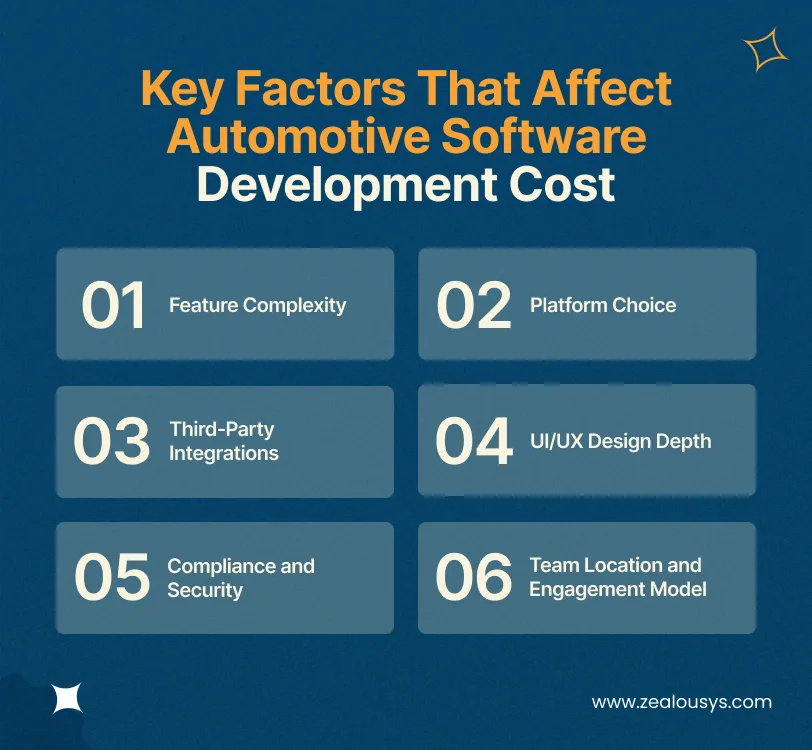
Two companies can ask for “a fleet management app” and receive quotes that differ by AED 300,000. Neither quote is wrong. The difference lies in these factors.
The single biggest cost driver. A booking form is cheap. Real-time GPS streaming, AI-based route suggestions, and predictive maintenance are not. Every feature you add multiplies design, development, and testing hours.
Native iOS plus native Android means two codebases and nearly double the cost. Cross-platform frameworks like Flutter or React Native deliver both platforms from one codebase, typically saving 30 to 40% on development effort. For most UAE automotive businesses, cross-platform is the sensible default unless you have a specific performance reason to go native.
Payment gateways (Telr, PayTabs, Stripe), mapping services, SMS providers, telematics hardware, insurance APIs, and government systems each add integration work. Integrations with RTA or other government platforms deserve special attention: they involve approval processes and documentation requirements that extend timelines, not just budgets.
A functional interface and a polished, conversion-focused one are different investments. Customer-facing apps in competitive segments like car rental justify heavier design spend. Internal tools usually do not.
The UAE Federal Personal Data Protection Law (PDPL) applies to customer data your software collects. Payment features bring PCI-DSS requirements. Building compliance in from the start is far cheaper than retrofitting it after launch.
The cost to build an automotive app in Dubai with a local agency differs sharply from offshore delivery. UAE-based agencies typically charge $50 to $150 per hour. Established offshore teams in India or Eastern Europe deliver comparable quality at $25 to $50 per hour. Over a 2,000-hour project, that gap alone can swing your budget by $100,000 or more.
Knowing where the money goes helps you question estimates intelligently. A typical automotive software budget splits roughly like this:
| Stage | Share of Budget | What Happens |
|---|---|---|
| Discovery & Planning | 5 – 10% | Requirements, technical architecture, scope documentation |
| UI/UX Design | 10 – 15% | Wireframes, user flows, visual design, prototypes |
| Development | 50 – 60% | Frontend, backend, integrations, APIs |
| Testing & QA | 15 – 20% | Functional, security, performance, and device testing |
| Deployment | ~5% | App store submission, server setup, go-live |
Notice that development itself is only a little over half the budget. Teams that quote suspiciously low often get there by shrinking discovery and QA, and both shortcuts cost you later: vague requirements cause expensive mid-project changes, and weak testing causes post-launch firefighting.
One line item deliberately missing from this table is maintenance, because it is not a launch cost. It is an ongoing one. Plan for 15 to 20% of your initial build cost per year to cover updates, bug fixes, OS compatibility, and small improvements.
Once you know your budget range, the next question is who builds it. This is how the three models compare in the UAE context.
| Factor | In-House Team | Freelancers | Development Partner |
|---|---|---|---|
| Upfront Cost | Very high (salaries, visas, office) | Low | Moderate |
| Annual Cost Example | AED 1M+ for a 4-person team | Varies widely | Project-based |
| Speed to Start | 3 – 6 months of hiring | Fast | 2 – 4 weeks |
| Accountability | Full control | Fragmented | Contractual, single point of contact |
| Best For | Software-first companies | Small fixes and additions | Full product builds |
Building in-house makes sense if software is your core business. For dealerships, rental operators, and fleet companies, it rarely does: a senior developer in Dubai costs AED 25,000 to 40,000 per month before visa, insurance, and workspace costs, and to hire automotive software developers in-house you need four to six specialists covering design, frontend, backend, QA, and DevOps.
Freelancers work for small, well-defined tasks. For a full product, coordinating five independent freelancers usually costs more in delays and rework than it saves in rates.
Hiring an automotive software development company in the UAE gives you a complete, managed team at project-based pricing. If you go this route, evaluate candidates on automotive experience specifically, not just general portfolios. This comparison of top automotive software companies is a useful starting point for shortlisting.
Here is a shift worth understanding before you sign any contract in 2026: how a team builds software now matters as much as where they are located.
Development teams that have properly integrated AI into their workflow are structurally cheaper than those that have not. Not because of discounts, but because of how the work itself changes:
The practical effect: a project that needed eight months of traditional development can often ship in five to six, and the saved time converts directly into saved budget. When you evaluate vendors, ask them specifically how AI fits into their delivery process. The answer tells you a lot about what your dirham actually buys.
The quote you receive is rarely the full amount you will spend. These are the expenses that surprise first-time buyers:
None of these should scare you off. They should simply appear in your business case from day one, so your total cost of ownership is a known number rather than a series of surprises.
You can meaningfully cut costs without producing a worse product. Four levers matter most.
Launch with the 30% of features that deliver 80% of the value, validate with real users, then invest in the rest based on evidence instead of assumptions. Most successful automotive platforms in the region started this way.
Paying for one or two weeks of discovery feels like an extra expense. It is the opposite. Clear scope documentation prevents the mid-project changes that inflate budgets more than any hourly rate ever will.
Unless you have a hard technical requirement for native performance, one Flutter or React Native codebase serving both iOS and Android saves roughly a third of development cost and keeps future maintenance cheaper too.
The rate difference between UAE-based and offshore teams is real, but only valuable when paired with structured communication, sprint demos, and a single accountable project lead. Rate savings without governance usually evaporate into rework.
Everything you have read above comes from how we actually scope and build automotive software at Zealous System. We have spent over a decade in the transport and automotive space, and the cost ranges in this guide are the same ones we work through with clients every week.
Some of that work you can see for yourself. When a client needed engine chip data turned into something usable, we built an IoT-based vehicle tracking and traffic surveillance system with a real-time dashboard, live maps, automated reports, and dual-channel alerts, replacing hours of manual data processing per machine. For another client, we developed a number plate trading marketplace with subscription-based seller onboarding, secure payments, and structured search, taking an unorganized offline market fully digital.
We are an AI-powered software development company, which in practice means AI runs through our entire delivery process: requirement analysis, code generation, review, and testing. That is how we keep timelines shorter and budgets leaner than traditional development models. We are headquartered in India with a global presence across the UAE’s key partner markets, so our clients get senior engineering talent at rates that make their project budgets go considerably further.
If you are budgeting an automotive software project, share your requirements with us. We will send back a detailed, stage-wise estimate for your specific scope, with no obligation attached, so you can plan with real numbers instead of ranges.
A car rental app in the UAE typically costs $30,000 to $90,000 (AED 110,000 to 330,000). A basic MVP with booking, payments, and an admin panel sits at the lower end. Dynamic pricing, KYC verification, insurance integrations, and subscription rentals push costs toward the upper end.
Feature complexity, platform choice (native vs. cross-platform), the number of third-party and hardware integrations, compliance requirements, and your development team’s location and delivery model. Of these, feature complexity and team location create the widest cost swings.
Simple apps take 2 to 4 months. Mid-complexity platforms take 4 to 8 months. Enterprise systems like a full DMS or telematics platform take 8 to 14 months. In our delivery experience, AI-assisted workflows shorten these timelines by roughly a quarter to a third.
Usually, yes. An in-house team of four to six specialists in the UAE costs upwards of AED 1 million per year in salaries alone, before visas and infrastructure. Outsourcing to an experienced partner converts that into project-based pricing and removes hiring risk, though you should verify automotive domain experience before committing.
Plan for 15 to 20% of your initial development cost per year. This covers maintenance, bug fixes, OS updates, and minor improvements, plus separate monthly costs for cloud hosting and third-party API subscriptions.
Yes. Integrations with platforms like RTA services are common in rental, fleet, and inspection software. Budget additional time for approval processes and documentation, and confirm your development partner has handled regulated integrations before.
Our team is always eager to know what you are looking for. Drop them a Hi!

Nandini Pare is a CAPM® Certified Business Analyst at Zealous System, specializing in business analysis, Agile delivery, and helping organizations build technology solutions that solve real business challenges.


Comments