
Every mobile app project begins with a decision that quietly shapes everything after it. Do you build natively for each platform, or do you write one codebase that runs on both iOS and Android? It sounds like a technical question. But at its core, it is a business decision.
The wrong choice at this stage does not just slow you down. It can inflate your budget, limit your product’s capabilities, and create technical debt that is painful to unwind later. Depending on complexity and approach, mobile app development typically ranges from around $15,000 for a basic cross-platform build to $120,000 and beyond for high-complexity native applications. Cross-platform can cost 30 to 40 percent less than native for the same scope, but that saving is not the whole story. Performance trade-offs, platform access limitations, and long-term maintenance costs all factor in.
The right choice puts you on a path where your tech stack works with your goals, not against them. This guide is for startup founders evaluating their first app build, CTOs comparing frameworks for a new product line, and product managers trying to understand what they are actually signing up for when someone says “let’s go cross-platform.”
Whether you are just beginning to weigh cross-platform vs native app development or are deep in the evaluation, we will cover what each approach means in practice, where each performs best, and how to make a decision that holds up as your product grows.
Native app development means building a separate application for each platform using the tools and programming languages that platform was designed for. On iOS, that means Swift (or Objective-C for older codebases). On Android, it means Kotlin (or Java).
When you build natively, your app speaks the platform’s language from the ground up. It has direct access to device hardware and OS-level features without going through any abstraction layer. The result is typically a faster, more responsive app that feels natural to users on that platform.
Large companies with established user bases and the budget to support separate iOS and Android teams almost always go native. Think banking apps, healthcare platforms, apps that depend heavily on real-time performance (video streaming, AR, gaming), or any product where even a slight lag in the UI is a problem.
Cross-platform development means writing a single codebase that compiles or runs on multiple platforms. Instead of building two separate apps, your development team builds one, and the framework handles how it renders on iOS and Android.
The two most widely used cross-platform frameworks today are Flutter (built by Google, using the Dart language) and React Native (built by Meta, using JavaScript). Both have mature ecosystems, large communities, and proven production deployments at scale.
Startups validating an idea with an MVP, product teams that need to ship fast without doubling their developer headcount, and businesses where the app logic is largely the same on both platforms are the most natural fit for cross-platform development.
Before you decide which path to take, understanding the difference between native and cross-platform apps in concrete terms is what makes the evaluation useful. Here is how they compare across the factors that typically matter most to decision-makers:
| Factor | Native Development | Cross-Platform Development |
|---|---|---|
| Performance | Highest. Compiled code runs directly on the OS | Very good. Minor overhead from bridge/abstraction layer |
| Development Cost | Higher. Two separate teams or codebases | Lower. One codebase for both platforms |
| Time to Market | Longer. Parallel development required | Faster. Single build, shared logic |
| User Experience | Pixel-perfect, platform-consistent UI | Near-native UX. Flutter especially delivers a close-to-native feel. |
| Code Reusability | None across platforms | 70–90% shared code |
| Access to Device APIs | Complete, immediate access | Good, with occasional workarounds needed |
| Maintenance | Two separate codebases to update | One codebase, simpler to maintain |
| Team Requirement | iOS devs + Android devs | One team with framework expertise |
| Long-Term Scalability | Excellent | Good, with some constraints at edge cases |
| Best For | Complex, high-performance apps | MVPs, startups, apps with shared logic |
Mapping these native vs cross-platform pros and cons against your actual product requirements is what separates a well-reasoned tech decision from an expensive course correction six months later.
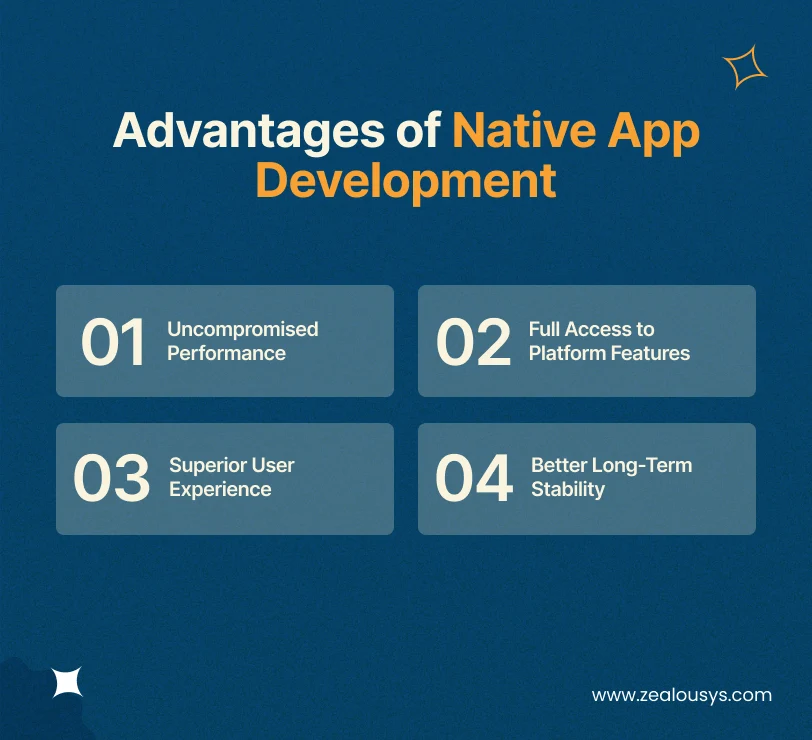
Native apps are compiled directly into machine code for the target platform. There is no intermediate layer translating your code at runtime. This makes a real difference in apps that rely on heavy computation, real-time data rendering, complex animations, or continuous background processing. For games, AR apps, and financial trading platforms, this level of performance is non-negotiable.
When Apple or Google releases a new hardware feature or OS-level API, native apps get access to it first. Face ID, haptics, background location, push notification customization, Bluetooth LE. Native gives you complete control over all of it without waiting for a framework update or building a custom plugin.
Native apps follow the design language of each platform naturally. iOS apps feel like iOS apps. Android apps feel like Android apps. Users notice the difference, even if they cannot articulate it. Scroll physics, transition animations, navigation patterns. These small details add up to an experience that feels right on the device.
When you own a native codebase, you are not dependent on a third-party framework’s release cycle or community support. You control your technical roadmap entirely. For large enterprises with long product lifespans, this kind of independence matters.
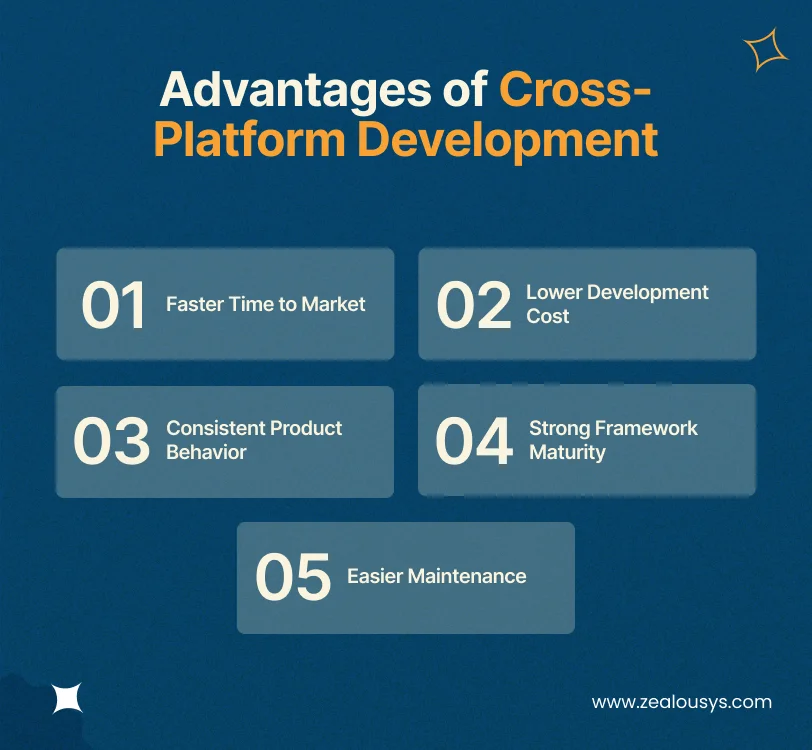
The cross-platform app development benefits are most visible for teams that need to move fast, keep costs in check, and still ship a quality product on both platforms. Here is where that approach actually pays off.
You write it once, and it runs on both platforms. For teams under pressure to ship quickly, this is a significant advantage. Instead of coordinating two parallel dev tracks, you maintain one. Bug fixes, feature releases, and updates ship simultaneously to both iOS and Android.
This is often the deciding factor for early-stage startups. Maintaining one codebase instead of two, hiring from a single talent pool (Flutter or React Native developers), and running one QA cycle instead of two translates directly into lower engineering costs. The savings can be substantial over a product’s first 12 to 18 months.
When your business logic lives in a single codebase, feature parity between iOS and Android is automatic. There is no risk of one platform getting a feature weeks before the other because of resourcing or scheduling.
Flutter and React Native are not experimental technologies. Flutter powers apps like Google Pay and BMW’s app. React Native runs Microsoft Teams mobile and Shopify’s merchant app. These are production-grade frameworks with large open-source ecosystems and strong corporate backing.
One codebase to update, one set of dependencies to manage, one CI/CD pipeline to configure. For small to mid-size teams, this simplicity compounds over time. You spend less energy on coordination and more on product iteration.
Choosing native makes the most sense in specific situations where performance depth, platform-specific behavior, or long-term scale are central to your product strategy.
Real-time video processing, augmented reality, complex 3D rendering, and high-frequency data streaming are categories where native’s direct hardware access genuinely matters. Cross-platform frameworks have improved significantly, but for these edge cases, native still holds the edge.
If your product’s core functionality is tightly tied to iOS-only or Android-only capabilities, building natively removes a layer of complexity. Deep integration with HealthKit, ARKit, Android’s NFC APIs, or custom Bluetooth protocols is significantly easier in a native environment.
If your organization already has the headcount and expertise, the cost argument for cross-platform weakens. In this case, native development preserves your team’s existing workflow without introducing a framework migration.
If you are building a product intended to grow into an enterprise-grade platform over five or more years, native gives you the most flexibility and independence. You are not constrained by what a cross-platform framework supports or when it supports it.
Healthcare, fintech, and defense applications often have specific compliance and security requirements. Native development gives you the tightest control over data handling, permissions, and security configurations.
Cross-platform development is a strong choice when speed, cost efficiency, and shared logic outweigh the need for platform-specific depth.
Your goal is to validate a product idea quickly and with minimal upfront investment. Cross-platform lets you put a functional, polished app in front of real users on both iOS and Android without doubling your engineering effort or budget.
If your application is primarily content-driven, form-based, or business-logic-heavy (think project management tools, e-commerce apps, booking platforms, or internal enterprise tools), cross-platform works extremely well. The UI differences between iOS and Android matter far less when the underlying experience is largely identical.
A three-person engineering team cannot realistically maintain two high-quality native codebases. Cross-platform allows a lean team to stay focused and ship consistently.
In markets where being first matters, shipping on both platforms simultaneously gives you reach from day one. Waiting to build and release two separate native apps could mean losing ground to a competitor who shipped faster.
Flutter, in particular, renders its own UI components rather than relying on platform widgets. This means your app looks identical on iOS and Android, which is a real advantage for brand-driven products where visual consistency is important.
The cost difference between native and cross-platform is real, but how large that gap is depends almost entirely on what you are building. Here is what the numbers actually look like, broken down by app complexity.
Basic App
This covers apps with a simple UI, limited screens, minimal backend interaction, and no custom integrations. Think login, a few content screens, and basic user flows.
The savings are meaningful for early-stage founders, and the trade-offs at this complexity level are minimal.
Medium Complexity App
This is where most business apps actually live. Custom UI components, third-party API integrations, user authentication, push notifications, payment gateways, and a proper backend.
The code-sharing advantage is most pronounced here. Your team is not duplicating business logic across two codebases.
High-Complexity App
Real-time features, complex animations, AI or machine learning integration, heavy use of device hardware, custom streaming, or enterprise-grade security requirements push costs significantly higher.
| App Complexity | What It Includes | Native (iOS + Android) | Cross-Platform |
|---|---|---|---|
| Basic / Simple | Simple UI, limited screens, minimal backend | $25,000 – $50,000 | $15,000 – $30,000 |
| Medium | Custom UI, API integrations, auth, payments | $50,000 – $85,000 | $30,000 – $60,000 |
| High Complexity / Enterprise | Real-time features, AI/ML, heavy hardware use | $85,000 – $120,000+ | $65,000 – $100,000+ |
Note: These are approximate market estimates. Actual costs vary based on your team’s location, seniority, scope changes, and the depth of platform-specific work required.
Where the cost picture shifts over time
The initial build cost is only part of the equation. Maintenance, updates, and adding new features over a product’s lifecycle tell a different story. With native, you are maintaining two codebases indefinitely.
Each OS update (a new iOS version, an Android API change) requires attention on both tracks. With cross-platform, a single update typically propagates to both platforms simultaneously. For teams with lean engineering headcount, that operational efficiency compounds significantly over 12 to 24 months.
That said, cross-platform is not always cheaper in the long run for complex products. If your app grows into a product that requires 30 to 40 percent platform-specific code, the shared-codebase advantage starts to thin out. At that point, investing in native development long-term becomes far more justifiable.
For most business applications, the performance difference between native and a well-built cross-platform app is not perceptible to the average user. Flutter in particular compiles to native ARM code and uses its own rendering engine (Impeller), which means its performance profile is quite close to native for standard UI interactions.
Push past standard UI interactions, though, and the difference becomes harder to ignore. Intensive animations at 120fps, real-time camera processing, complex AR interactions, and apps that push the GPU hard are where native development, with no abstraction layer in the way, produces results that cross-platform frameworks cannot fully replicate yet.
React Native has historically faced more performance criticism due to its JavaScript bridge architecture. The newer architecture (Fabric and JSI) addresses many of these concerns, but Flutter generally leads in raw performance among cross-platform options.
| Technology | Language | Rendering | Best For | Backed By |
|---|---|---|---|---|
| Swift (iOS Native) | Swift | Native UIKit/SwiftUI | iOS-only apps, Apple ecosystem | Apple |
| Kotlin (Android Native) | Kotlin | Native Jetpack Compose | Android-only apps | Google/JetBrains |
| Flutter | Dart | Own rendering engine | Cross-platform, consistent UI | |
| React Native | JavaScript | Native components | Cross-platform, web dev teams | Meta |
Flutter is the stronger choice when UI performance and design consistency are priorities. React Native has an edge when your team already knows JavaScript or React, or when you need to share code with a web application.
When people ask which is better, native or cross-platform apps, the answer is never the framework. It is always the fit between the framework and the product being built. There is no universal answer, but there is a structured way to think through the decision.
Is your app doing something that demands deep platform integration (camera, sensors, real-time processing)? Or is it primarily presenting data, managing workflows, or facilitating transactions? The more platform-dependent your core functionality, the stronger the case for native.
Adopting Flutter when your entire team is trained in React is not a smart move, regardless of what benchmarks say. Similarly, asking a JavaScript-heavy team to go fully native in Swift and Kotlin means a steep ramp-up period. Your current capabilities should factor into the decision.
An early-stage startup with six months of runway should almost never choose native for both platforms simultaneously. A well-funded scale-up building a mission-critical consumer app might make the opposite call. Context matters enormously here.
If you are building for a highly discerning user base (creative professionals, power users, enterprise clients accustomed to best-in-class software), native often pays for itself through superior UX. If your users care more about functionality than how the scroll physics feel, cross-platform is more than sufficient.
Some teams start cross-platform for speed and rewrite natively once they have product-market fit and the budget to invest. Others start native and never look back. Neither path is wrong. What matters is that your initial choice does not trap you in a corner.
Some mature products do not go fully native or stay fully cross-platform. They use a cross-platform base for standard screens and UI flows, then build platform-specific native modules for the features that truly need them: camera pipelines, real-time audio, and custom animations. This approach is more complex to manage, but it gives scaling teams the best of both worlds without a full rewrite.
The debate between native and cross-platform development does not have a winner. It has a context. The right choice depends on your product’s complexity, your team’s strengths, your timeline, and the experience you want to deliver to your users.
What you want to avoid is making this decision based on trends or what another company chose. A framework that works brilliantly for one product can be the wrong tool for another. The best approach is always the one that aligns with your specific constraints and goals.
If you are navigating this decision and want guidance from a team that has built across both native and cross-platform environments, the experts at Zealous System can help you evaluate your options and choose a path that fits your product roadmap. From Flutter and React Native to native iOS and Android development, Zealous works with startups and enterprises to develop mobile applications the right way, from the very start.
Our team is always eager to know what you are looking for. Drop them a Hi!

Hardik Gupta is the Team Lead for Mobile App Development at Zealous System. He specializes in creating innovative mobile applications for iOS and Android, focusing on delivering high-performance solutions and staying ahead of industry trends.


Comments