Nobody sees your backend. Everyone notices when it fails, which is why backend development costs deserve more attention than it usually gets.
A checkout that hangs during a sale, a login queue on launch day, an API that times out the week your biggest customer signs on: these are backend problems. And they get expensive when you fix them after the fact.
So how much does backend development cost? In 2026, backend development costs typically range from $15,000 to $250,000+, excluding web and mobile frontends. Where you land depends on scope, architecture, compliance needs, and who builds it.
This guide breaks that range down by project type, feature, region, and hiring model. It also covers the ongoing costs most estimates quietly leave out.
Short answer: A scalable backend costs $15,000 to $40,000 for an MVP, $40,000 to $100,000 for a mid-complexity SaaS or app backend, and $100,000 to $250,000+ for an enterprise-grade system. AI capabilities add roughly $25,000 to $150,000+ depending on how deep they go.
| Backend Type | What It Usually Includes | Estimated Cost | Timeline |
|---|---|---|---|
| MVP Backend | Auth, core APIs, one database, basic admin, cloud deployment | $15K – $40K | 6 – 10 weeks |
| Mid-Complexity Backend | Multiple user roles, payments, 3-6 integrations, real-time features, caching, CI/CD | $40K – $100K | 3 – 5 months |
| Enterprise Backend | Microservices, multi-tenancy, SSO, compliance, high availability, observability | $100K – $250K+ | 6 – 12 months |
| AI-Powered Layer (Add-On) | LLM integration, RAG pipelines, vector databases, AI agents | +$25K – $150K+ | 2 – 6 months |
These backend development cost ranges assume an experienced outsourced team at blended rates of about $40 to $60 per hour. A US-based agency can put the same scope at two to three times these figures.
Backend-only numbers also look lower than the “app development cost” figures you may have seen. That is expected, since full product estimates include UI/UX design, frontends, and platform-specific testing.
This tier suits founders validating an idea with real users. The goal is a clean foundation that can grow, not a system built for a million users on day one.
If you are still shaping scope, an experienced MVP development company can help you cut features without cutting the architecture you will need later.
Most SaaS products and marketplaces land here, and so does the typical cost to build a backend for an app with payments and user accounts. Costs climb with user roles, billing logic, third-party integrations, and the performance work needed for steady growth.
If multi-tenancy or subscription billing is on your roadmap, plan for it early. Retrofitting either one is where SaaS application development budgets tend to slip.
Enterprise systems pay for reliability. Multi-region deployments, audit trails, SSO, compliance controls, and zero-downtime releases all add engineering hours, and each one is hard to skip.
AI is now a separate budget line. A single LLM-powered feature is fairly affordable, while a production RAG system or multi-step AI agents sit at the higher end.
Totals help you plan. Component costs are what you will actually negotiate over, and they explain most of your custom backend development cost.
The table below shows typical effort and cost for common backend building blocks at blended rates of $40 to $60 per hour.
| Component | Typical Effort | Estimated Cost |
|---|---|---|
| Architecture and Technical Discovery | 40 – 120 hrs | $1,600 – $7,000 |
| Authentication and User Management (Roles, SSO) | 60 – 200 hrs | $2,400 – $12,000 |
| Core Business Logic and APIs (REST/GraphQL) | 200 – 1,200 hrs | $8,000 – $72,000 |
| Database Design and Data Modeling | 60 – 250 hrs | $2,400 – $15,000 |
| Payments and Billing | 60 – 200 hrs | $2,400 – $12,000 |
| Third-Party Integrations (Per Integration) | 30 – 150 hrs | $1,200 – $9,000 |
| Real-Time Features (Chat, Tracking, Live Updates) | 80 – 300 hrs | $3,200 – $18,000 |
| Admin Panel APIs and Reporting | 80 – 300 hrs | $3,200 – $18,000 |
| Security Hardening and Compliance Controls | 60 – 400 hrs | $2,400 – $24,000 |
| DevOps, CI/CD, and Cloud Setup | 60 – 250 hrs | $2,400 – $15,000 |
| QA and Automated Testing | 15 – 25% of Dev Effort | Varies |
Core business logic has the widest range because that line is your product, and it holds most of your API development cost. A simple booking app and a lending platform with credit decisioning both need “APIs,” yet they sit at opposite ends of that row.
Integrations are the line founders underestimate most. A well-documented payment API integration might take a few days, while a legacy ERP with no sandbox can take weeks. When several internal systems are involved, scope application integration as its own workstream.
Real-time features follow a similar pattern. Live tracking looks simple in a demo but needs careful design once thousands of devices report at once. You can see how that plays out in a real product category in this pickup and delivery app development cost analysis.
Two backends with the same feature list can differ in price by 3x. These decisions create that gap.
Your architecture, and how cloud-native it is, sets both the build cost and the monthly bill that follows.
Microservices get recommended far more often than they are needed. This guide to web application architecture covers the trade-offs in more detail.
Designing for 1,000 concurrent users and designing for 1,000,000 are different projects. Larger scale brings load balancing, Redis caching, read replicas, message queues, and horizontal scaling on Kubernetes. A sensible target for most businesses is the next 10x of growth, not the next 1,000x.
Language choice matters less than most people think. Node.js, Python, Go, Java, and .NET can all power scalable systems. The bigger cost driver is how easily you can find experienced developers in that stack. Database choices carry more weight. PostgreSQL and MongoDB are free to run, while SQL Server or Oracle add licensing costs. A poorly planned database architecture also gets expensive to change later.
Every system your backend talks to adds work, and legacy systems add the most. Missing documentation, no test environment, and messy data formats can turn a two-week integration into a two-month one.
The defense asset data tracking software integration case study shows what this kind of complex integration work involves.
Healthcare, fintech, and enterprise buyers bring requirements like HIPAA, PCI DSS, GDPR, or SOC 2. These call for encryption, audit logging, fine-grained access control, and documented processes. Build compliance in from the start. Adding it to a finished backend costs far more.
Refactor when the data model is sound and problems are limited to specific hotspots, like slow queries or one overloaded service.
Rebuild when every new feature breaks something else, the stack is no longer supported, or the data model no longer fits how your business works. Many teams take a middle path with incremental application modernization, replacing parts one at a time while the old system keeps running.
Who builds your backend, and where that team is based, is the biggest lever on backend development cost. Here are typical 2026 backend developer hourly rates through agencies and contract arrangements.
| Region | Typical Hourly Rate (USD) |
|---|---|
| United States and Canada | $100 – $180 |
| UK and Western Europe | $80 – $150 |
| Australia | $80 – $150 |
| Eastern Europe | $40 – $80 |
| Latin America | $35 – $70 |
| India | $25 – $50 |
Rates vary within each region by seniority and specialization. Treat them as planning ranges, not quotes.
Take a mid-complexity backend that needs about 1,500 hours. A US team at $100 to $180 per hour puts it at $150,000 to $270,000. An experienced Indian team at $25 to $50 per hour delivers the same scope for $37,500 to $75,000.
The rate alone does not tell the full story, though. Communication, time zone overlap, and code quality decide whether those savings survive the project. A cheap team that needs rework is the most expensive option you can pick.
According to the U.S. Bureau of Labor Statistics, software developers in the US earn a median salary of more than $130,000 a year. That excludes benefits, payroll taxes, recruiting fees, and equipment, so the real backend developer cost sits well above salary.
A scalable backend also rarely needs just one person. You will usually need backend engineers, DevOps ownership, and QA support.
| Hiring Model | Cost Profile | Speed to Start | Best For | Watch Out For |
|---|---|---|---|---|
| In-house Team | Highest (salaries + overhead) | Slow (months to hire) | Core product with a steady long-term roadmap | Recruiting time, retention, idle capacity |
| Freelancers | Lowest hourly | Fast | Small, well-defined tasks | Gaps in DevOps, security, and continuity |
| Outsourced Project Team | Moderate, often fixed scope | Fast | Defined projects like an MVP or migration | Scope changes need clear change control |
| Dedicated Team | Moderate, monthly | Fast | Ongoing development with shifting priorities | Needs strong product ownership on your side |
Freelancers suit isolated tasks, but scalable systems need architecture, DevOps, testing, and security working together. That is hard to coordinate across individual contractors. Agencies face the same gap, which is why many add backend capacity through a white-label partner instead of hiring.
Companies that need backend talent without a long recruiting cycle usually outsource backend development to a dedicated backend development team or set up an offshore development center. When comparing a backend development company, check how it handles code ownership, documentation, and handover. This page on how to hire backend developers covers the skills and engagement options worth checking.
The build is only the first line item in your backend development cost. Over three years, total cost of ownership can run two to three times the build price, as the example at the end of this section shows.
Cloud infrastructure cost usually starts at roughly $100 to $600 per month for a startup MVP. It climbs to $1,000 to $5,000 for a growing product and $10,000+ for high-traffic platforms. AWS, Azure, and Google Cloud price comparable services in a similar range, so credits, existing licenses, and team familiarity usually decide the winner.
Waste is the bigger risk. Flexera’s 2026 State of the Cloud Report estimates that 29% of IaaS and PaaS spend is wasted. Right-sizing instances and shutting down idle environments are the first fixes, and experienced cloud application development support helps you get them right from the start.
Most teams budget 15 to 20% of the original build cost per year. That covers security patches, dependency upgrades, bug fixes, and performance tuning.
Skipping it does not save money. It moves the cost into a painful upgrade project later, which is why ongoing application maintenance keeps budgets predictable.
Payment fees, SMS and email providers, maps, identity services, and LLM usage all bill monthly. Each looks small alone, but together they can rival your hosting bill.
Logging, error tracking, and performance monitoring are essential in production. Most tools price by data volume, so a service that logs everything can produce a surprising invoice.
Plan for penetration testing at least once a year and after major releases. Selling to enterprises adds SOC 2 or ISO 27001 audit fees plus internal engineering time.
Deadline shortcuts come back with interest. Hard-coded logic, missing tests, and quick database fixes slow every future feature until someone pays to clean them up.
A quick TCO example shows how backend development cost keeps growing after launch. A $60,000 backend with $1,500 per month in cloud costs and 18% annual maintenance adds about $54,000 in hosting and $32,400 in maintenance over three years. Total ownership lands near $146,000 before third-party services and tooling.
AI pulls your budget in two directions. It can lower the cost of building, and it adds a new cost layer when you put AI inside your product.
AI coding assistants now handle much of the routine work: CRUD endpoints, validation, migrations, unit tests, and API docs. Adoption is near universal, with 84% of developers using or planning to use AI tools in the 2025 Stack Overflow Developer Survey.
The same survey shows why savings are uneven. Two-thirds of developers said their biggest frustration is AI output that is almost right but not quite. Architecture, data modeling, security review, and debugging still need experienced engineers, so the real gains go to teams with strong review and testing habits.
If you plan to add AI to an existing backend, budget for it as its own workstream.
| AI Capability | Estimated Build Cost | Ongoing Cost Drivers |
|---|---|---|
| Single LLM-powered Feature (Summaries, Smart Search, Drafting) | $8K – $25K | Model API usage per request |
| RAG System with a Vector Database | $25K – $70K | Embedding updates, vector DB hosting, model usage |
| AI Agents and Multi-step Workflows | $40K – $150K+ | Model usage, tool integrations, monitoring and evaluation |
RAG costs depend heavily on your data. Clean documents index quickly, while scattered PDFs and legacy databases need real data engineering first.
The RAG-enabled multilingual AI chatbot for the travel industry case study is a good example of that data work in practice. For agent-based systems, this breakdown of the cost of agentic AI workflows covers PoC, MVP, and production budgets.
AI features bill every time a user touches them. Response caching, routing simple requests to smaller models, and per-plan usage limits protect your margins as adoption grows. Teams that treat AI integration services as a one-time build are often surprised by the monthly model bill.
Cutting costs is easy. Cutting costs without creating a rewrite in 18 months takes more thought.
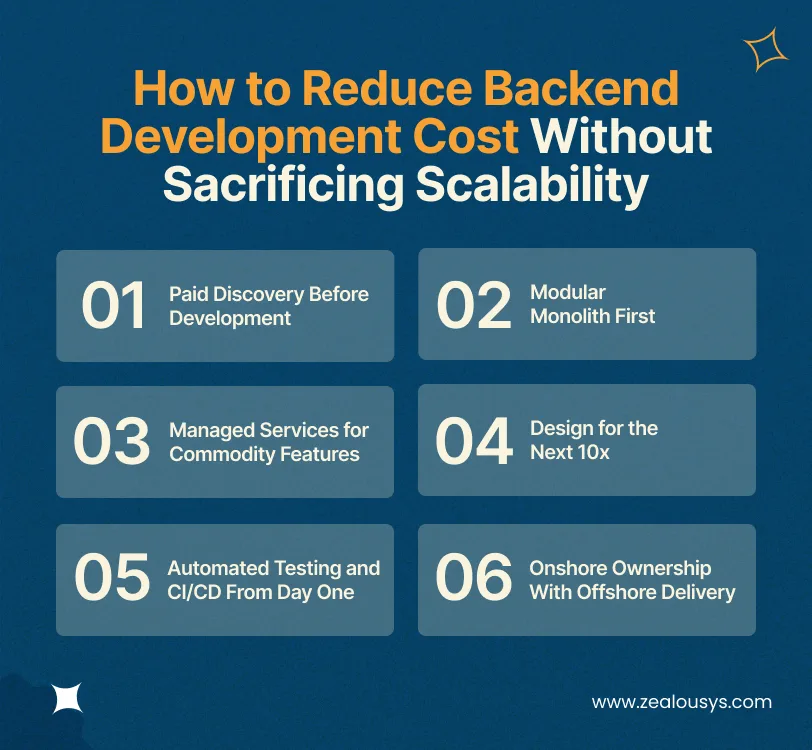
A short discovery phase turns a vague idea into a clear scope, data model, and architecture plan. It costs a small fraction of the build and prevents the most expensive mistake: building the wrong thing well.
Start with one deployable application split into clear modules. You get most of the maintainability of microservices at a fraction of the cost. Later, you can split out a service when it truly needs to scale alone.
Authentication, file storage, email delivery, search, and managed databases are solved problems. Paying for a managed service is almost always cheaper than building and maintaining your own.
Plan capacity for realistic growth over the next 12 to 24 months. Stateless services, sensible indexing, and a caching strategy go a long way for far less than infrastructure built for traffic you may never see.
Tests and deployment pipelines cost a little upfront and save a lot every week after. They cut regression bugs and make releases routine.
Keep product ownership close to your business and let an experienced offshore team handle delivery. For a side-by-side view against local agencies and in-house hiring, see custom software development cost in the UK.
Zealous System is an AI-powered software development company with over a decade of delivery experience and more than 1,000 clients worldwide. Its backend development services cover startups building a first MVP and enterprises modernizing systems that have run for years.
A mobile app backend typically costs $15,000 to $40,000 for an MVP with authentication, core APIs, push notifications, and an admin panel. Apps with payments, real-time features, or many integrations usually fall between $40,000 and $100,000.
A SaaS backend usually costs $40,000 to $100,000 for a product with multiple user roles, subscription billing, and several integrations. Enterprise SaaS platforms with multi-tenancy, SSO, and SOC 2 requirements often cost $100,000 to $250,000+.
An MVP backend takes about 6 to 10 weeks. A mid-complexity backend takes 3 to 5 months, and enterprise systems often take 6 to 12 months, usually delivered in phases.
Plan for 15 to 20% of the original build cost each year. For a $60,000 backend, that is roughly $9,000 to $12,000 annually, with cloud hosting and third-party services billed separately.
In the serverless vs traditional backend cost comparison, serverless usually wins for low or unpredictable traffic because you pay only when code runs. For heavy, steady workloads, containers often cost less per request, so many teams use both.
A single LLM-powered feature costs roughly $8,000 to $25,000 to build. A RAG system usually runs $25,000 to $70,000, while AI agents can reach $150,000+, plus monthly model and hosting costs.
Backend development cost in 2026 ranges from about $15,000 for a focused MVP to $250,000+ for enterprise-grade systems, with AI as a growing line item on top. The number that matters most, though, is total cost of ownership: what it takes to build, run, and keep the backend healthy for years.
The smartest backend development cost plans start with clear scope, choose architecture for realistic growth, and plan for maintenance and cloud costs from day one.
At Zealous System, we help startups, SaaS companies, and enterprises plan and build backends that scale without runaway costs. If you want a realistic estimate for your project, contact us with your requirements, and our architects will map out scope, timeline, and cost with you.
Our team is always eager to know what you are looking for. Drop them a Hi!

Nandini Pare is a CAPM® Certified Business Analyst at Zealous System, specializing in business analysis, Agile delivery, and helping organizations build technology solutions that solve real business challenges.


Comments