
In the real estate industry, where competition is high and timing matters, technology plays a crucial role in success. MLS (Multiple Listing Service) software has changed how real estate professionals work. It helps them manage property listings and ensures smooth communication between agents and clients. But what exactly is MLS software, and why is it so important?
MLS software is the foundation of real estate operations. It provides a single platform to list, search, and analyze properties. Realtors and brokers can access real-time, accurate property details, allowing them to serve clients more effectively.
Whether you manage a few properties or run a large real estate business, MLS software makes operations easier, improves data accuracy, and strengthens client relationships.
How can you develop an effective MLS software solution? How do you ensure it meets your business needs and adapts to future changes?
This guide will walk you through the MLS software development process. You’ll learn about its key features, benefits, challenges, and future trends. By the end, you’ll have a clear strategy to build or invest in MLS software that helps your real estate business grow.
Multiple Listing Service (MLS) software is a centralized database platform that allows licensed real estate professionals to share, search, and manage property listings within a cooperative network. It is the operational backbone of modern real estate, enabling brokers and agents to access verified, real-time property data from a single, authoritative source.
Without MLS software, real estate transactions would rely on fragmented, siloed information, making it harder to match buyers with the right properties or give sellers adequate market exposure. The MLS eliminates that fragmentation. When a broker lists a property on an MLS system, every participating agent in the network can immediately see it, share it with clients, and act on it.
MLS software has evolved significantly from its origins as a printed booklet passed among brokers. Today, it encompasses property listing management, advanced search filtering, CRM integration, document handling, virtual tour hosting, and AI-powered market analytics. Real estate businesses that develop or invest in a custom MLS system gain a competitive edge in speed, accuracy, and client service quality.
MLS software operates on a cooperative data-sharing model. Real estate brokers and agents who belong to an MLS organization agree to list their properties on the shared platform and, in return, gain access to every other member’s listings. This creates a comprehensive, mutually beneficial property marketplace.
At a technical level, the software works in several interconnected layers. The data layer stores property records including price, location, square footage, images, legal identifiers, and listing agent details. The application layer manages user access, permissions, and workflows. The integration layer connects the MLS to external services such as payment gateways, CRM platforms, government property databases, and consumer-facing real estate portals.
When a buyer’s agent searches for properties on behalf of a client, the MLS system runs queries against this shared database using filters the agent specifies, such as price range, neighborhood, number of bedrooms, or lot size. Results are returned in real time, and agents can then share curated listings directly with clients through the platform’s client portal.
The cooperative structure also governs commission arrangements. When a property listed by one broker sells through another broker, the MLS agreement sets the terms for commission sharing, reducing disputes and standardizing professional practice across the market.
The main purpose of Multiple Listing Service (MLS) software is to centralize and streamline property listings and real estate data. It allows real estate professionals to efficiently search for, manage, and share property information from a single platform.
Let’s explore the top benefits of MLS software development services:
The most immediate benefit of MLS software is that it gives everyone in the transaction a single source of truth. Instead of agents maintaining separate spreadsheets or chasing down property details from multiple sources, the MLS houses all critical data in one place. This eliminates duplication, reduces manual errors, and ensures that listing details are consistent across every agent’s screen.
For brokerage firms managing large inventories, this centralization is transformative. A property update made once propagates instantly to all users viewing that listing, whether they are across the office or across the country.
When a seller lists a property through an MLS-connected broker, that listing becomes visible to every participating agent in the network simultaneously. This cooperative visibility is something no single brokerage’s private website can replicate. The seller benefits from maximum exposure without the broker needing to individually market to every potential buyer’s agent.
Studies consistently show that properties listed on an MLS sell faster and at higher prices compared to off-MLS listings, because the buyer pool is larger and more competitive from day one.
Buyers working with MLS-connected agents get access to the most complete and current property information available in their market. They see accurate pricing, verified property details, and up-to-date availability status. This reduces the friction of chasing listings that are already under contract or discovering inaccuracies mid-transaction.
Custom MLS software can go further by enabling personalized client dashboards where buyers save favorite properties, receive alerts when new listings match their criteria, and track the status of properties they are monitoring.
MLS software can automate the financial mechanics of real estate cooperation. When a sale is completed, the platform can calculate commission splits based on pre-agreed terms, generate transaction summaries, and integrate with accounting tools. This removes a significant administrative burden from brokers and reduces the risk of payment disputes.
MLS membership creates professional relationships between agents who might otherwise be competitors. When a buyer’s agent and a listing agent collaborate through the MLS, both serve their respective clients better. The MLS facilitates this through standardized communication protocols, shared showing schedules, and co-brokerage agreements built into the platform.
For new agents, MLS access is often the fastest way to build professional relationships with established brokers and develop market knowledge quickly.
Modern MLS platforms generate enormous amounts of transactional data over time. Custom MLS software can transform this data into actionable intelligence: average days on market by neighborhood, price per square foot trends, seasonal demand patterns, and comparable sales analysis. Real estate professionals who can present this data to clients are better positioned to win listings and close deals.
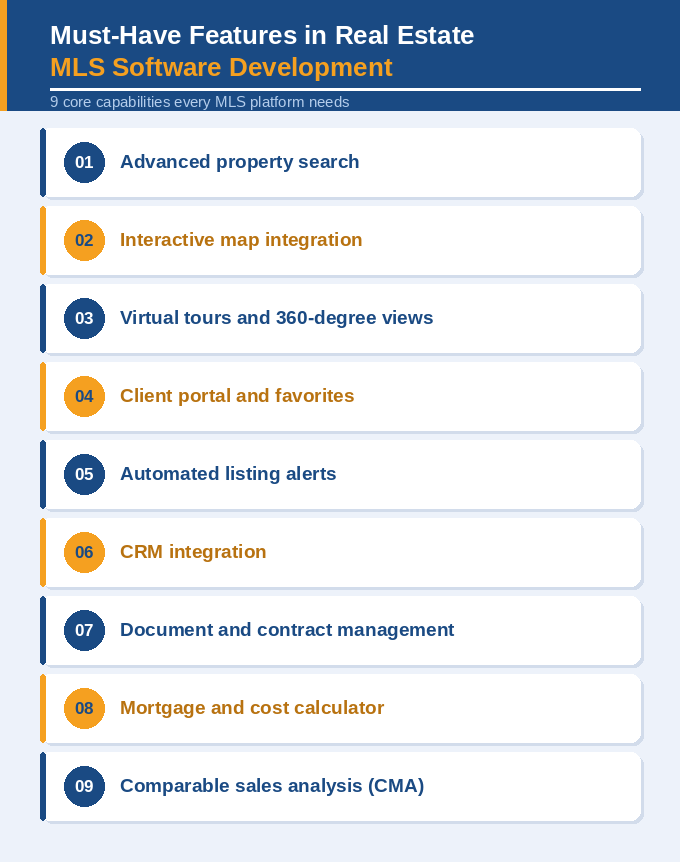
Some features to include in your Multiple Listing Service (MLS) software development process for real estate industry are given as follows:
The search experience is the heart of any MLS platform. A well-built search system must support filtering by price range, location radius, property type, bedroom and bathroom count, square footage, lot size, year built, and amenities. Beyond basic filters, users expect the ability to draw custom geographic boundaries on a map and receive listings within that shape.
Search results should display in both list and map views, with enough detail at the listing card level, such as a primary photo, price, bedroom count, and address, to make initial judgments without opening each listing individually.
Map-based property browsing has become a standard expectation. Integrating a mapping service like Google Maps or Mapbox allows users to visually assess a property’s proximity to schools, transit, shopping, and employment centers. Agents can cluster listings geographically and show clients how a neighborhood’s listing inventory looks at a glance.
Heatmaps showing price density or market activity can also be overlaid on the map, giving agents a powerful tool for educating clients about market conditions in different pockets of the city.
The ability to offer virtual tours has moved from being a luxury feature to a practical necessity. Buyers increasingly conduct initial property evaluations remotely, especially when relocating from another city or state. MLS software should support the embedding or hosting of 360-degree photo tours, video walkthroughs, and where appropriate, immersive virtual reality experiences.
Augmented Reality (AR) tools can enhance this further by allowing buyers to visualize how a vacant property would look furnished, or how structural changes like removing a wall would affect the space. These capabilities reduce the number of in-person showings required and speed up the buyer’s decision-making process.
A dedicated client-facing portal enables buyers to log in, view personalized property recommendations, save favorites, leave notes, and communicate with their agent. This feature dramatically improves the client experience because buyers can review listings at their own pace and engage meaningfully before appointments.
The favorites feature is particularly valuable for buyers evaluating multiple properties simultaneously. Being able to compare saved listings side by side, with notes, reduces the anxiety and indecision that often slow real estate transactions.
Buyers set their criteria once and receive automated notifications whenever a new listing matches those parameters. In competitive markets where well-priced properties receive offers within hours of listing, this feature can be the difference between a client securing their ideal home and missing it entirely.
Alerts should be configurable for email, SMS, or in-app delivery, and agents should be able to see which listings triggered alerts for their clients, allowing timely follow-up conversations.
MLS software should integrate smoothly with Customer Relationship Management (CRM) tools to help agents track their client relationships, manage follow-up tasks, and monitor the progression of active deals. When a client’s behavior in the MLS platform generates signals, such as repeatedly viewing a specific property or adjusting their search parameters, those signals should flow into the CRM so agents can respond proactively.
Built-in lead capture forms, contact management, and communication logging reduce the need for agents to context-switch between multiple software tools throughout their workday.
Real estate generates substantial paperwork. Purchase agreements, disclosures, inspection reports, title documents, and commission agreements all need to be organized, accessible, and securely stored. MLS software should include a document management module where agents can upload, tag, share, and obtain e-signatures on transaction documents without leaving the platform.
Version control is critical here. When a contract is amended, the system should maintain a clear audit trail showing who changed what and when, which protects all parties in the event of a dispute.
Buyers often want to evaluate affordability before engaging with an agent. A built-in mortgage calculator that estimates monthly payments based on purchase price, down payment percentage, interest rate, and loan term provides immediate value and keeps users engaged with the platform longer.
Additional calculators for estimated property tax, homeowners insurance, and HOA fees give buyers a more realistic picture of their total monthly housing cost, which supports better financial decisions and reduces the incidence of deals falling through late in the process.
For listing agents, the ability to generate a Comparative Market Analysis directly within the MLS platform is a major productivity advantage. CMA tools pull recent sales data for comparable properties, allow agents to adjust for differences in size and condition, and produce professional reports that can be shared with sellers to justify pricing recommendations.
This capability, when built well, replaces third-party CMA tools and positions the MLS as the definitive source of market pricing intelligence.
The following steps will make your real estate Multiple Listing Service (MLS) software development process easier:
Every successful MLS development project begins with a clear definition of who the software serves and what problems it solves. The primary user groups in an MLS system are listing agents, buyer’s agents, brokers and administrators, and in some configurations, clients who interact with a public-facing portal.
Each group has distinct needs. Listing agents need efficient tools for creating and updating property records. Buyer’s agents prioritize search quality and client communication. Brokers need oversight, reporting, and compliance tools. Clients want a clean, intuitive browsing experience.
Requirements gathering should produce a formal specification document that covers functional requirements (the features and behaviors the software must have), non-functional requirements (performance, security, scalability, and accessibility standards), and integration requirements (the external systems the MLS must connect to).
Before committing to a feature set, analyze what existing MLS platforms do well and where they fall short. Major MLS software providers in North America include Flexmls, Matrix MLS, Paragon MLS, and Bright MLS. Reviewing how these platforms handle search UX, data ingestion, mobile experience, and agent tools will surface opportunities for your custom solution to deliver genuine improvements.
Research should also examine emerging technology trends in real estate technology, often referred to as PropTech. AI-powered valuation tools, blockchain-based title management, and predictive analytics for buyer intent are all areas where forward-thinking MLS platforms are beginning to invest.
System architecture decisions made early have long-lasting consequences for performance, maintainability, and cost. The architecture must address how data is stored and structured, how the application handles concurrent users, how integrations with external services are managed, and how security is enforced at every layer.
Most modern MLS platforms use a cloud-native architecture on providers such as AWS, Google Cloud, or Microsoft Azure. This approach offers scalable infrastructure, managed database services, and built-in redundancy. A microservices architecture, where different functional areas such as search, listings, user management, and notifications operate as independent services, allows teams to develop, deploy, and scale components independently.
The database design is particularly critical for MLS software. Property data is complex, with many attributes varying by property type. Relational databases like PostgreSQL handle structured transactional data well, while Elasticsearch is commonly added for fast, flexible full-text and faceted search. Media files including photos and virtual tour assets should be stored in object storage services like Amazon S3.
The technology stack for MLS software development should balance developer productivity, long-term maintainability, performance, and the availability of skilled engineers. The following is a commonly used and well-proven combination:
For the backend, Node.js or Python with Django or FastAPI provide excellent performance and extensive library ecosystems. Java and Spring Boot are strong choices for enterprise environments where robust concurrency handling and strict typing are priorities.
For the frontend, React.js is the dominant choice for building dynamic, component-based user interfaces. Combined with Next.js for server-side rendering, it delivers both strong SEO performance and fast page load times. For mobile applications, React Native allows shared code across iOS and Android, reducing development cost.
For the database layer, PostgreSQL serves as the primary relational database, with Elasticsearch providing the search index. Redis handles caching and session management. For mapping, the Google Maps Platform or Mapbox API provides interactive map capabilities.
For cloud infrastructure, AWS offers the most comprehensive set of managed services relevant to MLS development, including RDS for managed PostgreSQL, OpenSearch for managed Elasticsearch, CloudFront for global content delivery, and SES for transactional email.
Development typically follows an agile methodology, with two-week sprint cycles that deliver working, testable increments of the software. The first sprint should produce a functional property listing creation and retrieval workflow, establishing the data model and API contract early.
Subsequent sprints build outward from this core: search and filtering, the map interface, user authentication and permissions, the client portal, document management, and integrations. Each sprint should conclude with a demonstration to stakeholders and an opportunity for feedback before the next sprint begins.
Building a Minimum Viable Product (MVP) first and releasing it to a limited user group is strongly advisable. Real-world usage exposes UX friction and performance bottlenecks that no amount of internal testing can fully anticipate. The feedback from an MVP release typically reshapes the feature roadmap in ways that improve the final product significantly.
MLS software rarely operates in isolation. It typically needs to connect with the RETS (Real Estate Transaction Standard) or RESO Web API, the industry-standard data exchange protocol that allows property data to flow between different MLS systems and consumer-facing portals like Zillow or Realtor.com.
Additional integrations to plan for include e-signature providers such as DocuSign or HelloSign for document execution, payment processing for transaction fees or subscription billing, SMS and email notification services, and property tax and public records databases that can automatically populate listing data.
Each integration adds complexity to the development and testing process. Mapping the integration requirements early, and identifying which are essential for launch versus which can be added post-launch, keeps the development timeline realistic.
MLS software handles sensitive personal and financial data. Security must be a first-class concern from day one, not an afterthought applied during testing.
Access control should implement role-based permissions, ensuring that agents can only see and modify their own listings, while brokers have broader administrative access, and clients see only the public-facing information their agent has shared with them. All data transmitted between clients and servers must be encrypted using TLS. Stored data, particularly personally identifiable information (PII), should be encrypted at rest.
The platform must comply with applicable data protection regulations, which may include GDPR for operations involving European users, CCPA for California users, and industry-specific real estate privacy standards. Regular penetration testing, dependency audits, and security code reviews should be built into the ongoing development process.
Thorough testing across multiple dimensions is non-negotiable before launching an MLS platform.
Unit testing verifies that individual code components behave correctly in isolation. Integration testing confirms that different modules work together as expected. Performance testing under simulated peak load ensures the system can handle the concurrent users anticipated at launch and beyond. User Acceptance Testing (UAT) with actual real estate professionals validates that the software meets their practical needs in real working conditions.
Cross-browser and cross-device testing ensures consistent behavior for the full range of browsers and screen sizes agents and clients use. Accessibility testing against WCAG 2.1 standards ensures the platform is usable by people with disabilities, which is both an ethical obligation and a legal requirement in many jurisdictions.
A staged deployment approach, releasing first to a small internal user group, then to a beta group, then to the full user base, reduces the risk of a catastrophic failure affecting all users simultaneously.
Post-launch monitoring should track application performance (response times, error rates, server resource utilization), user behavior (which features are used most, where users drop off, what searches are most common), and security events (failed login attempts, unusual data access patterns). Application performance monitoring tools like Datadog, New Relic, or AWS CloudWatch provide the visibility needed to catch and resolve issues before they affect users significantly.
MLS platforms are only as valuable as the data they contain. Ensuring data quality requires validation rules at the point of listing entry, automated checks that flag suspicious or incomplete records, and moderation workflows for administrators to review reported inaccuracies. Investing in data quality from the beginning prevents the trust-eroding experience of agents finding incorrect or stale listings in the system.
Real estate markets have seasonal patterns, and listings surge in spring and autumn in most markets. The platform architecture must be designed to scale horizontally, adding server capacity automatically during high-demand periods and scaling back during quiet periods to control costs. Cloud-native auto-scaling capabilities make this manageable without manual intervention.
Technology is only valuable if it gets used. MLS platforms often face resistance from experienced agents who have built habits around existing tools. Involving agents in the design and testing process, providing thorough onboarding documentation and training, and creating a feedback channel for improvement suggestions are all important strategies for driving adoption.
The Real Estate Standards Organization (RESO) publishes data standards that govern how property information is structured and shared between MLS systems. Building to RESO compliance from the start ensures your platform can interoperate with other MLS organizations, consumer portals, and data aggregators. Ignoring these standards creates costly rework when interoperability becomes a business requirement.
Real estate is heavily regulated, and MLS participation rules vary by region and MLS organization. The software must accommodate differences in required disclosures, commission structures, listing durations, and agent licensing verification. Legal counsel familiar with real estate regulations in the target markets should be involved in requirements definition.
AI is moving from a buzzword to a practical tool within MLS software. Machine learning models trained on historical sales data can predict the likely sale price of a listing with increasing accuracy. Natural language search interfaces allow agents to type queries like “three-bedroom homes near good elementary schools under $500,000” and receive semantically relevant results rather than exact keyword matches. AI can also identify which buyers in the system are most likely to be interested in a new listing, enabling more targeted outreach.
Automated Valuation Models use statistical analysis of comparable sales, property characteristics, location factors, and market trends to generate instant property value estimates. While they do not replace professional appraisals, AVMs integrated directly into MLS software give agents and clients a quick reference point that can anchor pricing discussions and accelerate decision-making.
Blockchain technology offers a potential solution to the trust and verification challenges inherent in real estate transactions. Smart contracts on a blockchain could automate escrow release when conditions are met, create an immutable record of ownership transfers, and reduce the reliance on paper-based title processes. While widespread adoption is still emerging, forward-looking MLS platforms are beginning to build the technical foundations for blockchain integration.
Real estate professionals spend much of their time away from desks. MLS mobile apps must go beyond basic property search to support the full agent workflow: scheduling showings, updating listing statuses, responding to client inquiries, reviewing offers, and generating CMAs, all from a phone or tablet. Voice-activated commands and AI assistants that can answer market questions in real time are natural extensions of this mobile-first direction.
The shift from legacy RETS protocols to the modern RESO Web API is accelerating. The Web API uses standard HTTP methods and JSON data formats, making integration dramatically simpler for third-party developers. MLS platforms that embrace this open standard benefit from a growing ecosystem of compatible tools, portals, and analytics platforms, while those clinging to legacy protocols face increasing isolation.
MLS software development cost varies significantly based on the scope of features, geographic market complexity, team composition, and whether the platform is built from scratch or assembled from existing components and APIs.
A basic MLS platform covering property listing management, agent search tools, and a client portal typically requires between four and eight months of development with a team of five to eight engineers. A fully featured platform with AI analytics, virtual tour hosting, custom CRM, and multi-region data feeds may take twelve to eighteen months and a larger team.
Development teams in India, which offer strong technical talent at cost-effective rates, generally range from USD 25 to USD 75 per hour depending on seniority. Development teams in North America or Western Europe typically range from USD 100 to USD 250 per hour. Many businesses choose a hybrid model, with senior architects and project management based locally and development execution handled by an offshore team.
Ongoing operational costs after launch include cloud infrastructure (typically USD 500 to USD 5,000 per month depending on scale), licensing fees for third-party APIs and data providers, security auditing, and the engineering time required for maintenance and feature development.
A real estate website is typically a consumer-facing marketing tool that displays listings to the public. MLS software is a professional-grade platform used by licensed real estate agents and brokers to share, search, and manage property listings within a cooperative membership organization. Many real estate websites pull their listing data from MLS feeds via the RESO Web API, making the MLS the authoritative source behind the consumer-facing display.
Yes. Many regional MLS organizations operate their own custom-built platforms tailored to the specific rules, data standards, and workflows of their membership. Custom development allows for complete control over the feature set, user experience, integration landscape, and data governance policies.
A functional MVP of MLS software typically takes four to six months to develop. A full-featured production platform with advanced search, virtual tours, CRM integration, document management, and analytics can take twelve to eighteen months depending on team size and scope.
The most critical integrations for MLS software are the RESO Web API for data interoperability, e-signature tools for document execution, mapping services for location-based search, CRM platforms for agent workflow management, and email/SMS notification services for automated alerts.
MLS operations are governed by rules set by the MLS organization itself and by the National Association of Realtors (NAR) in the United States, which establishes baseline participation standards. The software must also comply with applicable data privacy laws, consumer protection regulations, and real estate licensing requirements in the jurisdictions where it operates.
Zealous System is a leading real estate software development services provider with extensive experience in developing custom software applications, including MLS (Multiple Listing Service) software. MLS software is crucial for real estate professionals, as it facilitates the listing, searching, and management of property data. Zealous System’s expertise in this field can help you create a powerful, efficient, and user-friendly MLS system tailored to your specific needs.
We ensure:
✔️ Developers with domain expertise.
✔️ Adoption of agile methodologies.
✔️ Use of the latest technology to deliver high standards.
✔️ Transparent communication to build trust.
✔️ Rigorous testing throughout the development process.
Check our Work:
Let us help you gain a competitive edge. Don’t let outdated systems hold you back—contact us today to start your journey towards a more efficient, effective MLS solution. Let’s build something extraordinary together and make your app the talk of the town!
Our team is always eager to know what you are looking for. Drop them a Hi!

Pranjal Mehta is the Managing Director of Zealous System, a leading software solutions provider. Having 10+ years of experience and clientele across the globe, he is always curious to stay ahead in the market by inculcating latest technologies and trends in Zealous.


Comments