Quick Overview:
Building a music streaming app like Spotify takes three things: a licensing route you can afford, infrastructure that holds up under load, and personalization that improves with use. Costs run $20,000 to $200,000, and the first version ships in three to four months.
Here is what matters most before you commit budget:
Most guides on this topic hand you a feature checklist and a cost range, then stop. That is not where founders get stuck. The hard questions are whether you can legally launch, what a realistic first version looks like, and whether the numbers work once people start listening.
This guide answers those in order: current market data, the rights you must clear before writing code, an MVP you can build in a quarter, the architecture behind low-latency playback, honest cost bands, and the unit economics that decide whether a music app survives its first thousand paying users.
Yes, if you are building for a specific audience rather than competing head-on with Spotify. The market is growing, and the growth sits in places the incumbents serve poorly.
According to the IFPI Global Music Report 2026, global recorded music revenues grew 6.4% to reach $31.7 billion in 2025, the eleventh consecutive year of growth. Total streaming revenue passed $22 billion and now accounts for 69.6% of all recorded music income.
Paid subscription streaming alone grew 8.8% and made up 52.4% of global revenue, across 837 million paid subscription accounts worldwide. Subscriptions, not advertising, fund this industry.
IFPI recorded double-digit growth across four regions in 2025: Latin America at 17.1%, MENA and Sub-Saharan Africa at 15.2% each, and Asia at 10.9%. In these markets, local-language catalogs, lower price points, and mobile-first payments matter more than 100 million tracks.
Spotify reported 300 million Premium subscribers and 777 million monthly active users in its Q2 2026 results. You are not going to out-catalog that, and you should not try.
What you can do is serve an audience a general platform flattens: devotional music with liturgical calendars, children’s audio with parental controls, or a regional catalog with the search behavior that language actually requires. Smaller audience, better fit, affordable licensing.
Before scoping features, decide what you are building. Spotify-like app development covers five distinct models, and this choice sets your licensing burden, infrastructure bill, and realistic path to revenue.
Users pick any track, build playlists, and download for offline listening. Full user control commands the highest royalty rates, so this carries the heaviest licensing load. Viable only with serious funding.
These serve a defined audience: regional-language music, devotional audio, independent artists, children’s content, or wellness and focus soundscapes. Smaller catalogs sourced directly make licensing far simpler, which is why this is the most realistic starting point for most founders.
A label, artist collective, or management company streams its own catalog straight to fans. Rights are already controlled, removing the biggest external dependency. Success rests on the fan relationship rather than catalog depth.
Telecom operators, fitness apps, OTT services, and retail brands add music to deepen engagement with an existing user base. The music is a retention feature, not the product, and licensing usually runs through a bundled or B2B deal.
The engineering question differs from a standalone build. You are integrating against systems that already exist: identity and SSO, billing or carrier billing, your analytics pipeline, and the entitlement logic governing your paid tiers. Mapping those four integration points is where scoping starts, because they decide how much of the streaming layer you buy versus build. This is application integration work before it is streaming work.
Ambient and background audio, generated or licensed royalty-free, with no per-stream payouts. A different product category with different expectations: it works for wellness and productivity listening, poorly when people want a specific song.
Where your audio comes from matters as much as what you build. Four routes:
| Content Model | Licensing Burden | Time to Launch | Catalog Scale |
|---|---|---|---|
| Licensed Commercial Music | Highest: direct label deals, advances, minimum guarantees | 9 to 18 months | Millions of tracks |
| Independent and Aggregator Catalog | Moderate: distributor or direct artist agreements | 3 to 6 months | Thousands to hundreds of thousands |
| Original or Royalty-Free Content | Low: one-time or subscription license | 1 to 3 months | Limited but fully controlled |
| White-Label Platform | Handled by the vendor, with less product control | 4 to 10 weeks | Vendor-dependent |
Most founders should start in the middle two rows and move up as revenue justifies it.
This is where most music app projects stall. Get it wrong, and you face takedown notices, blocked store listings, or a rebuild.
A single song carries more than one copyright, and streaming touches several at once.
You need recording rights and composition rights. Clearing one and not the other is the most common and most expensive mistake in this category.
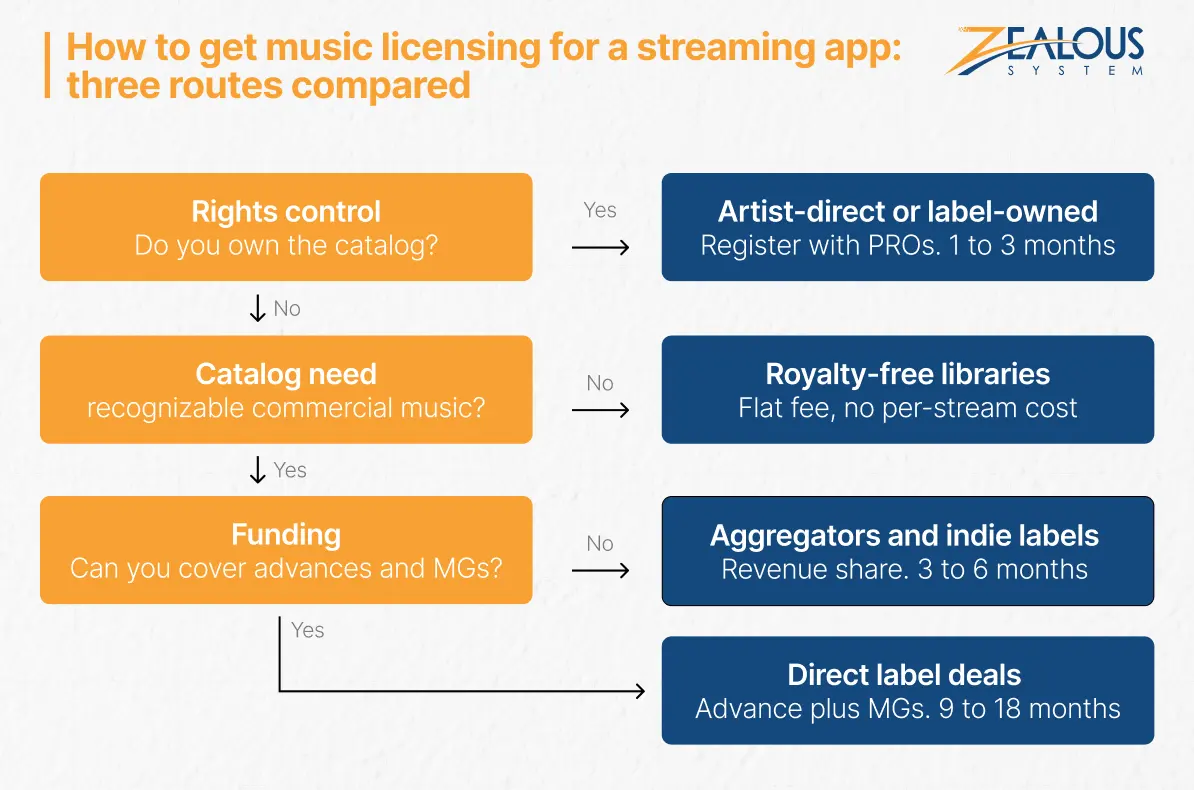
In ascending order of cost and difficulty:
1. Royalty-free and Creative Commons libraries let you launch fast with no per-stream obligation, though you cannot offer music people already know. Suitable for wellness, focus, and background audio.
2. Aggregators and independent catalogs connect you to distributors and independent labels licensing in bulk. In industry terms, you are becoming a DSP, a digital service provider, and aggregators are set up to deal with new ones. The practical middle path: real music, negotiable terms, no major-label minimum guarantee between you and launch.
3. Direct label deals with Universal, Sony, Warner, and larger independents give you the recognizable catalog, on commercial terms that assume scale you do not have yet.
Exact rates are rarely public. Label and aggregator deals are negotiated individually and sit under NDA, so any guide quoting a fixed per-stream figure is guessing.
What you can plan around is the shape. Royalty-free libraries charge a flat annual or per-track fee. Aggregator deals run on revenue share, so you pay only when you earn. Direct label deals add an upfront advance, minimum guarantees you owe whether or not the listening materializes, and per-stream rate floors that apply regardless of revenue.
They also require usage reporting in DDEX format, the industry-standard messaging suite for rights and royalty data, plus accurate ISRC codes for recordings and ISWC codes for compositions. Build your ingestion pipeline without these standards, and you will rebuild it before your first label conversation.
The number that matters most is the share. Spotify’s Q2 2026 gross margin of 33.4% means roughly two-thirds of every subscription dollar leaves again as rights and content costs. Model on that ratio until you have quoted terms in hand.
Collecting societies administer performance and mechanical rights, and they vary by territory:
Launching across the US, UK, and UAE means three separate registration processes in parallel. Build that into the timeline.
If your plan involves generative audio, the legal ground moved this past year sharply. Universal Music Group settled with Udio in October 2025 and agreed to co-develop a licensed AI music platform. Warner Music Group settled with Suno in November 2025, letting artists opt in to the use of their voices and likenesses, as Reuters reported.
Nothing is fully resolved. Sony Music has not settled with either company, and in July 2026 the Munich Regional Court ruled for German collecting society GEMA against Suno, barring use of specific compositions in both training and outputs.
AI-generated audio can reduce royalty exposure, but only if you can document your training and licensing chain. Treat provenance as a compliance requirement, not a technical detail.
IFPI’s 2026 report named streaming fraud, alongside AI, as one of the two forces shaping the industry’s next phase. Artificial streams drain the royalty pool that funds legitimate artists.
Any platform paying per-stream royalties needs bot detection, listening-pattern anomaly checks, and an audit trail on payouts. Distributors now ask about this during due diligence, and retrofitting it after an incident costs far more.
Resist matching Spotify feature for feature. Ship the smallest product that proves people will listen daily, then expand on what they actually do.
These five carry the entire first release:
| Feature | What It Involves | Why It Matters at MVP |
|---|---|---|
| Registration and Profiles | OAuth 2.0 login with early preference capture | These preferences feed your recommendation system later |
| Audio Playback | Chunked delivery, buffering logic, background play | This is the product; failures cost users immediately |
| Search and Browse | Track, artist, album, and genre search with filters | Users need a specific song in two or three taps |
| Playlists and Library | Create, edit, reorder, save, synced across devices | The main reason users come back |
| Offline Downloads | Encrypted storage, entitlement checks, license expiry | The most common reason free users upgrade |
That last one deserves a note. Offline playback needs encrypted device storage, playback authorization checks, and license expiry rules. Teams routinely underestimate it by several weeks.
If independent artists supply your catalog, they need a reason to stay: editable profiles, an upload flow that validates files and enriches metadata, and analytics showing plays, saves, skips, and listener geography.
Artist analytics is what keeps creators uploading rather than drifting to a platform that shows them their numbers.
The invisible half of the product. Content management for audio, artwork, metadata, and publishing states with role-based access. A royalty management system that logs every stream with region, subscription type, and playback context, then aggregates it into rights-holder reports. Moderation workflows for duplicates, copyright flags, and takedowns. And observability covering buffering rates, playback latency, and CDN performance.
A phased view of what goes where:
| Phase | Scope | Typical Timeline |
|---|---|---|
| MVP | Playback, search, playlists, offline, basic admin, single region | 3 to 4 months |
| Phase 2 | Recommendations, artist tools, social sharing, web player, multi-region | 4 to 6 months |
| Phase 3 | Lossless audio, live audio, voice and smart device support, advanced royalty reporting | Ongoing |
Phase 2 and 3 items are where differentiation lives, and where budgets disappear if you start them before the core is stable. Getting the phase-one boundary right is the core discipline of MVP development.
Catalog size is a moat you cannot afford. Recommendation quality is one you can, and it improves with use rather than spend.
Two signals combine. Collaborative filtering finds users with overlapping habits and surfaces what one group plays that another has not heard. Content-based matching turns audio attributes such as tempo, energy, key, and timbre into vector embeddings, then finds tracks sitting close together in that space. Good systems weight both and shift the balance as they learn.
This draws on the same machine learning solutions used in any recommendation product, applied to audio rather than purchase history.
People listen differently at 7 am than at 11 pm. Contextual playlists use time of day, recent listening, session length, and device type to shift what gets surfaced, recalculating on a schedule rather than by hand. That raises daily session frequency without editorial headcount.
Keyword search fails when someone wants music that feels a certain way rather than music with a certain name. Storing audio embeddings in a vector database lets you match on sonic similarity across genres and languages. This matters most for regional and multilingual catalogs, where genre labels are inconsistent, and users describe what they want by mood.
Once your app reaches cars, speakers, and wearables, voice becomes a primary input. The hard part is intent: partial artist names, mispronunciations, and commands that depend on what is playing. Voice routes through the same search infrastructure as text with an added disambiguation layer. Phase 2 or 3, not MVP.
A recommendation engine needs listening data, and a new platform has none. Neither does a new user.
Three fixes: capture preferences during onboarding with a quick artist or genre picker, lean on content-based matching until behavioral data accumulates, and seed with curated playlists for the first few weeks. Expect generic recommendations for a month and clear improvement by month three. This gap is normal in any artificial intelligence development project that learns from live behavior.
At scale, music streaming platform development stops being a UI problem and becomes a concurrency and delivery problem. The systems that hold up were built for uneven traffic and global distribution from day one.
Your pipeline uploads the audio, transcodes it into multiple bitrates, stores it in object storage, and pushes it to CDN edge nodes. When a user presses play, the client requests a manifest and pulls short segments while monitoring the network and switching quality as needed. Every play, skip, and save fires an event into a pipeline that feeds recommendations, artist analytics, and royalty reporting from the same stream.
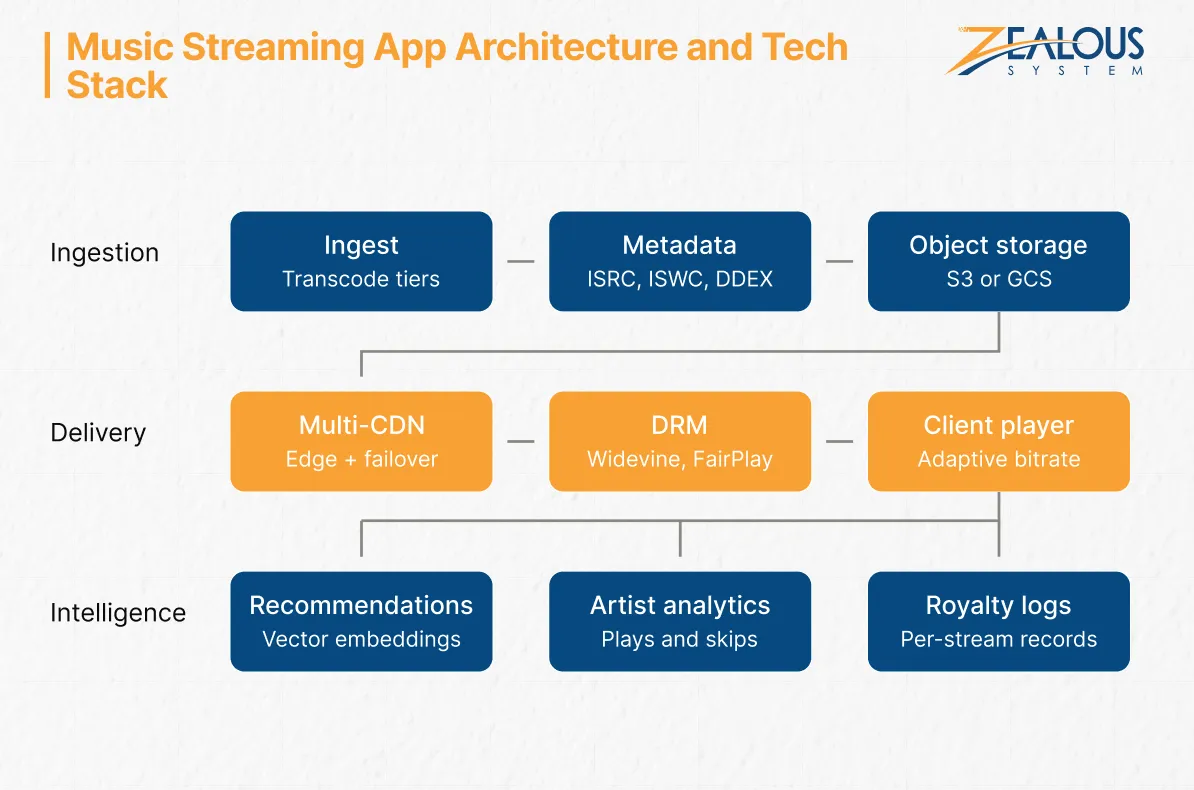
Uploads trigger a pipeline that validates the file, transcodes it into several quality tiers, extracts audio features for the recommendation layer, and enriches metadata. This is also where you attach ISRC and ISWC identifiers and apply region-specific availability rules. Getting metadata right here saves painful reconciliation when royalty reports come due.
Both split audio into short segments and let the client pick quality based on bandwidth. HLS has broader native support on Apple, DASH is more flexible on Android and web, so most platforms run both. Client-side switching beats server-driven changes: faster response, no playback interruption.
A single CDN is a single point of failure, and performance varies by region. Multi-CDN routing sends traffic by geography and load, failing over automatically when a provider degrades. This is less about shaving milliseconds than about not going dark in one market because one provider had a bad afternoon, which makes it a cloud application development exercise as much as an application one.
Licensed catalogs come with contractual protection requirements. Widevine covers Android and Chrome, FairPlay covers Apple, and both integrate with your entitlement service. Budget for DRM as its own line item rather than folding it into a general playback estimate.
| Layer | Options | Why |
|---|---|---|
| Mobile | Swift and Kotlin, or React Native and Flutter |
Native gives finer audio session control; cross-platform halves build cost |
| Backend | Node.js, Go, or Python |
Go handles concurrency cleanly; Node.js suits real-time features |
| Database | PostgreSQL for users, MongoDB or Cassandra for catalog | Relational integrity where it matters, flexible schema where it does not |
| Storage and Delivery | S3 or GCS behind a multi-CDN layer | Storage is cheap; delivery is where cost sits |
| Vector Search | Pinecone, Milvus, or pgvector | Powers similarity-based discovery |
| Streaming | HLS and MPEG-DASH | Broad device coverage with adaptive quality |
Knowing how to create a music streaming app is mostly a sequencing problem. Teams that phase the work ship sooner than teams that start everything at once.
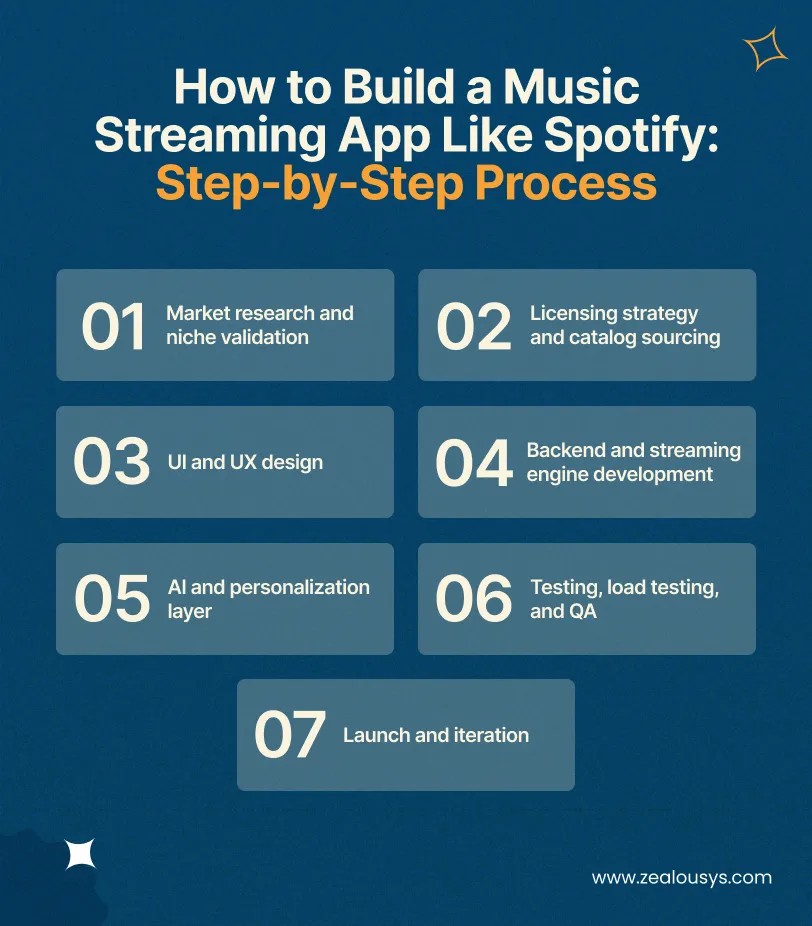
Deciding how to make a music app starts with the audience. Define it precisely, then check whether existing apps already serve them. Read the one-star reviews of the closest competitor: unmet needs are documented there in the users’ own words.
Decide your content model and open conversations before design starts. Licensing is the least controllable part of this project, and every other decision depends on the answer.
Music apps get used while walking, driving, and exercising, often without looking at the screen. Large touch targets, a persistent mini-player, and one-thumb controls matter more than visual polish.
Build the ingestion pipeline, entitlement service, playback APIs, and event stream. Run frontend work in parallel against mocked endpoints so neither team blocks the other.
Add the recommendation engine once real listening data exists. Build it earlier, and you are tuning against synthetic data that will not resemble your users. This overlaps with standard AI software development practice in any data-driven product.
Functional testing is not enough. Test playback across poor networks, mid-session switches, lock-screen behavior, and load at several times the expected peak. Buffering is the failure users punish fastest.
Roll out to one region first. Watch session length, skip rate, and playback error rate rather than downloads.
| Phase | Duration | Key Output |
|---|---|---|
| Discovery and Licensing Groundwork | 3 to 5 weeks | Scope, content model, licensing plan |
| Design | 4 to 6 weeks | Complete UI, clickable prototype |
| Core Development | 10 to 14 weeks | Playback, search, playlists, offline, admin |
| Testing and Hardening | 3 to 4 weeks | Load-tested, store-ready build |
| Launch and Stabilization | 2 to 3 weeks | Live in first region |
An MVP lands in three to four months. A full-scale platform with personalization, multi-region support, and a web player takes six to nine months.
The cost to build an app like Spotify ranges from $20,000 to $200,000, driven by catalog scale, feature depth, and the number of platforms you support. Here is how that breaks down.
$20,000 to $50,000.
A single-platform app with core playback, search, playlists, offline downloads, a limited catalog, and a basic admin panel. One launch region, minimal personalization. This is where most music streaming app development for startups begins: enough to validate demand with a defined niche audience before committing further.
$50,000 to $120,000.
iOS, Android, and a web player, with an AI recommendation layer, artist upload and analytics tools, social sharing, DRM-protected offline playback, and multi-region support. Most funded startups land here after their MVP proves out.
$120,000 to $200,000 and above.
Large catalogs across multiple territories, high-concurrency architecture, multi-CDN delivery, lossless and live audio, full royalty reconciliation, and compliance tooling for several jurisdictions. Typical for telecom, OTT, and label-backed platforms.
| Component | Estimated Range |
|---|---|
| UI and UX Design | $3,000 – $12,000 |
| iOS and Android Apps | $8,000 – $30,000 |
| Web Player | $5,000 – $15,000 |
| Backend and APIs | $8,000 – $30,000 |
| Streaming Setup and CDN Integration | $5,000 – $20,000 |
| DRM and Offline Playback | $4,000 – $15,000 |
| AI Recommendation Engine | $8,000 – $35,000 |
| Admin Panel and Royalty Management System | $6,000 – $25,000 |
| QA and Load Testing | $3,000 – $12,000 |
The build quote is not the budget. Five costs that catch teams out:
For wider benchmarking, our roundup of mobile app development statistics covers median costs, timelines, and lifecycle spend from Clutch, GoodFirms, and OutSystems survey data.
Most platforms layer several revenue streams. The mix should follow how your audience actually listens.
Recurring revenue for ad-free listening, offline downloads, and higher audio quality. This is what funds the industry: IFPI attributes 52.4% of all global recorded music revenue to paid subscriptions.
Audio and display ads between tracks for free-tier users. Useful at scale and as a conversion funnel, though revenue per user is a fraction of subscription revenue. Spotify’s Q2 2026 figures show advertising contributing €446 million against €4.33 billion from Premium.
Three smaller streams that layer on top.
In-app purchases cover one-time upgrades like a lossless pass or event access, capturing users who will not commit monthly.
Brand partnerships fund sponsored sessions and branded playlists, which are easier to sell to a defined niche audience than a general one.
Creator subscriptions let fans pay artists directly through tips or exclusive access, fitting artist-direct platforms where the relationship is the product.
This is the calculation that decides whether the business works, and almost nobody publishes it.
Spotify reported Premium ARPU of €4.89 and a gross margin of 33.4% in Q2 2026. Roughly two-thirds of subscription revenue goes straight back out as rights payments and content costs.
The ratio travels even though the currency does not. Ten thousand paying users at $5 per month is $50,000 gross. At comparable economics, roughly $16,500 remains for infrastructure, support, payment processing, and acquisition. At a $15 acquisition cost and an eight-month average stay, that cohort costs $150,000 to acquire and returns about $132,000.
Which is why retention, not acquisition, is the lever that matters. A cohort that stays twelve months instead of eight changes the picture without a single extra signup.
Music apps rarely fail dramatically. They lose momentum quietly, usually for one of these five reasons.
Royalties are paid per stream while revenue arrives per subscriber, so heavy listeners can cost more than they pay. Tie premium features to higher-value users, trim regional catalogs to what people play, and raise ARPU rather than limiting listening.
Early traffic hides problems that surface once usage becomes consistent. Push delivery to CDNs, keep streaming services stateless, and monitor playback errors and buffering ratio rather than server uptime. Multi-platform playback consistency is where most mobile app development effort goes after launch.
New users explore for a week, run out of things to play, and leave. Better to hold every notable devotional recording in one language than a scattered sample of ten genres.
Retrofitting per-stream attribution into a system not designed for it is expensive and error-prone. Log region, subscription type, and playback context on every stream from day one, even before you owe royalties.
Matching Spotify on catalog, price, and features is a losing position. Compete on relevance: better regional metadata, better mood-based discovery, stronger artist relationships, or better offline behavior in low-connectivity markets.
Audio products fail on details: playback that stutters on a weak connection, downloads that expire at the wrong moment, royalty logs that cannot be reconciled. Ask a development partner about those.
Zealous System has built products where these constraints are central. Our live workout streaming and fitness tracking app for a UAE client handled real-time sessions, video consultations, and cross-device sync using React Native, Node.js, Agora, and MongoDB. The AI-based social media platform covers the recommendation and content-moderation layer that any catalog product needs. And our marketplace app for music professionals, built for a Canadian client, connects students with music teachers through bookings, scheduling, and integrated payments.
Teams are structured around the stage you are at. Founders validating a niche work with a lean startup software development team focused on shipping in a quarter. Product and technology leaders adding streaming to an existing ecosystem get a broader digital product development engagement covering architecture, integration, and rollout. We work under NDA from the first conversation, with delivery teams across India, Australia, the USA, and Poland.
If you are weighing scope, licensing route, or budget for a music streaming platform, a conversation with our team will get you a clearer picture of what your specific idea requires.
Yes, provided you license the music. You need rights to both the sound recording and the composition, obtained through labels, aggregators, royalty-free libraries, or collecting societies such as ASCAP, BMI, PRS, or The MLC.
Between $20,000 and $200,000. A single-platform MVP runs $20,000 to $50,000. A multi-platform product with AI recommendations and artist tools costs $50,000 to $120,000. Enterprise platforms with large catalogs and multi-region compliance start around $120,000.
There is no fixed rate. Royalty-free libraries charge a flat annual or per-track fee. Aggregator deals usually run on revenue share. Direct label deals require an upfront advance plus minimum guarantees. Plan on roughly two-thirds of subscription revenue going to rights holders until you have quoted terms.
An MVP takes three to four months. A full platform with personalization, a web player, and multi-region support takes six to nine months. Licensing runs in parallel and is usually the longest dependency.
Fewer than most founders assume, if the catalog is focused. A niche platform can launch credibly with 3,000 to 10,000 well-chosen tracks in one genre or language. Depth retains users better than a thin spread.
Not on catalog or price, but on relevance. Regional-language, devotional, children’s, and wellness audio serve audiences general platforms treat as secondary. Better metadata, better discovery, and the right price point beat scale.
Spotify runs a microservices architecture built largely in Java and Python on Google Cloud, with Kafka handling event streaming at scale. You do not need that complexity at launch. Node.js or Go with PostgreSQL, object storage, and a CDN covers an MVP comfortably.
White-label gets you live in four to ten weeks cheaply, but limits differentiation, catalog control, and monetization. Custom development costs more and is the only route if your product depends on a specific catalog, a distinct discovery experience, or integration with existing systems. White-label suits validation; custom suits anything you intend to scale.
Our team is always eager to know what you are looking for. Drop them a Hi!

Raj Kewlani is a Project Manager and Mobile & Open Source Development Lead at Zealous System, specializing in agile-driven digital solutions. He focuses on delivering high-quality mobile apps and open-source projects that align with business goals.


Comments