
Key Takeaways:
UK financial services firms now spend more than £33.9 billion a year on regulatory compliance, which works out at over 13% of average operating costs, according to research by TheCityUK and PwC UK. In the same study, 84% of compliance leaders said their costs had risen over the past five years.
Most people searching for RegTech software development cost in the UK are not trying to fix a sector-wide problem, though. They have a narrower question.
What does it actually cost to build the KYC system, the transaction monitoring engine or the reporting tool, and can that number survive a board meeting?
This guide answers that. You will find cost ranges by solution type, by module and by development stage, along with the factors that move those numbers, the costs that rarely appear in a quote, and where firms genuinely save money without creating regulatory risk.
One note before the numbers. Every range below reflects typical UK delivery for mid-market and growth-stage firms, and they are planning figures rather than quotes.
Two projects with identical feature lists can still differ by 40% on data quality alone.
RegTech development cost in the UK generally falls between £20,000 and £150,000 or more, depending on how many regulatory obligations the platform covers and how much of your existing infrastructure it has to talk to.
The cost to build a RegTech platform varies that much because two firms rarely start from the same place. It helps to break it down three ways: by what you are building, by which modules go into it, and by where the money goes across the project lifecycle.
This is the fastest way to place your project in a budget bracket. Timelines assume a small dedicated team rather than a single developer.
| Solution Type | Typical Cost (GBP) | Timeline |
|---|---|---|
| Single Compliance Module or MVP | £20,000 – £45,000 | 6 – 10 weeks |
| KYC and KYB Onboarding Platform | £40,000 – £80,000 | 3 – 5 months |
| AML Transaction Monitoring with Case Management | £60,000 – £120,000 | 4 – 7 months |
| Regulatory Reporting Engine | £55,000 – £110,000 | 4 – 7 months |
| Multi-Module Compliance Platform | £110,000 – £150,000+ | 7 – 12 months |
A firm approaching FCA authorisation usually needs the first or second row, not the last. RegTech MVP development cost in the UK starts near the £20,000 mark, while regulatory reporting software development cost sits mid-table because the engineering is well understood. What moves that figure is the number of return formats and submission channels you have to support.
The common mistake is scoping a platform when the application actually requires evidence that one obligation is handled properly and repeatably. If you are costing a first version to prove the model, the MVP development company route keeps initial spend at the lower end while leaving room to extend.
Most platforms are assembled from a handful of components. Costing them separately makes it easier to sequence the build and defend the budget line by line. It also explains why KYC software development cost in the UK varies so much between quotes: some vendors include the full onboarding journey, others only the verification call.
| Module | Typical Cost (GBP) |
|---|---|
| KYC and KYB Verification with Onboarding Flow | £18,000 – £40,000 |
| Sanctions, PEP and Adverse Media Screening | £12,000 – £28,000 |
| AML Transaction Monitoring Rules Engine | £25,000 – £55,000 |
| Alert Triage and Case Management | £15,000 – £35,000 |
| Regulatory Reporting and Submission | £20,000 – £45,000 |
| Rules-Based Risk Scoring | £12,000 – £25,000 |
| Machine Learning Risk Scoring with Explainability | £30,000 – £65,000 |
| Audit Trail, Dashboards and Analytics | £10,000 – £25,000 |
Two things stand out here.
Screening looks cheap because the heavy lifting sits with a licensed data provider. You are paying for integration and workflow, not the underlying lists.
Case management looks expensive for what it appears to be. Firms consistently underestimate it, then discover their analysts are working out of spreadsheets six months after launch. Transaction monitoring software cost is really two line items, the rules engine and the workflow that clears the alerts, and AML software development cost only makes sense when you count both.
The jump between rules-based and machine learning risk scoring is also worth noting. AI-powered compliance software development cost rises less because of the model and more because of everything around it: training data preparation, validation, model monitoring and the documentation an auditor will ask for.
Knowing where the money goes helps you spot a quote that has been thinned out in the wrong place.
| Stage | Share of Budget | Cost on a £60,000 Build |
|---|---|---|
| Discovery and Regulatory Mapping | 10% | £6,000 |
| UX and Interface Design | 9% | £5,400 |
| Architecture and Data Modelling | 10% | £6,000 |
| Backend Development | 30% | £18,000 |
| Frontend Development | 13% | £7,800 |
| Integrations and Data Pipelines | 11% | £6,600 |
| Security Engineering | 7% | £4,200 |
| QA, UAT and Audit Preparation | 10% | £6,000 |
Watch the discovery line. A quote with 2% or 3% allocated there is not cheaper. It has moved the regulatory mapping into the development phase, where changes cost several times more to make.
Backend takes the largest share because compliance logic lives there: the rules, the decision records, the data lineage that has to hold up under examination.
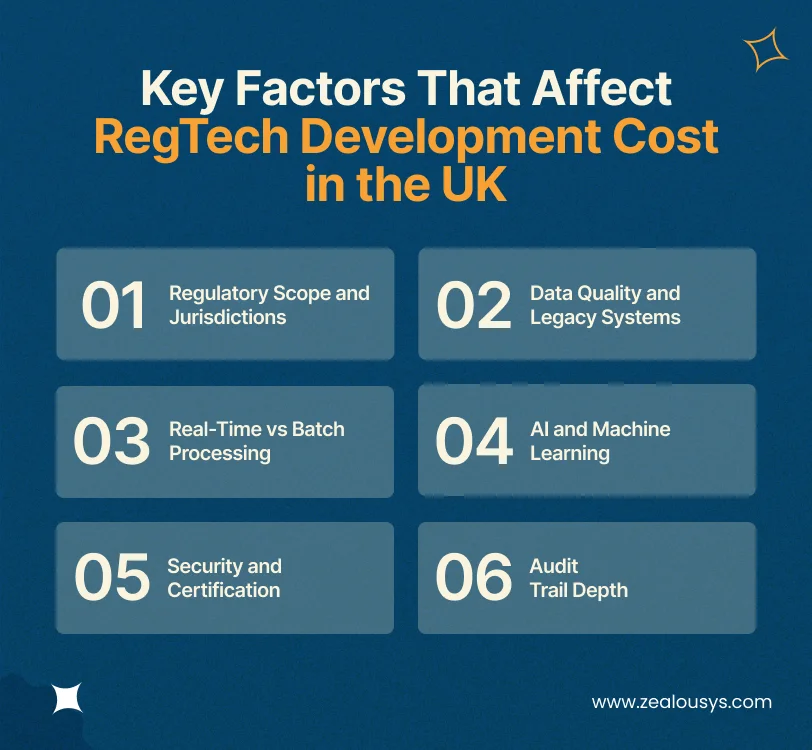
Six variables account for most of the spread between a £30,000 project and a £130,000 one.
FCA compliance software development cost is at its lowest when one UK entity is in scope and the obligations are familiar ones: MLR 2017 record-keeping, Consumer Duty outcomes reporting, standard SAR workflows. Add EU exposure and you are dealing with data residency, parallel reporting formats and rules that diverge over time. Each additional jurisdiction adds cost that compounds rather than accumulates.
This factor decides more budgets than any other. If customer records live across a core banking system, a CRM and three spreadsheets with inconsistent identifiers, the reconciliation work alone can match the cost of the compliance logic. Firms with a clean single source of truth routinely build the same platform for a third less.
Where data sits behind older systems, application integration becomes a distinct budget line rather than a task inside development.
Nightly batch screening is straightforward engineering. Real-time transaction monitoring needs event streaming, low-latency pipelines and infrastructure that costs more to build and more to run every month. Decide this early, because retrofitting real time into a batch architecture usually means rewriting the core.
Model work adds cost in three places: data preparation, validation, and the explainability layer that lets you defend a decision to a regulator. Firms that skip the third end up rebuilding the first two, usually when someone asks how the model fits their model risk management framework. An AI software development company with regulated-sector experience prices all three from the start.
Encryption, role-based access control, and UK GDPR alignment are baseline. ISO 27001 or SOC 2 readiness during the build costs noticeably less than retrofitting it after launch, which is a lesson most firms learn during their first enterprise sales cycle.
Every decision the system makes needs to be reconstructable: what data was used, which rule fired, who reviewed it, when. This is unglamorous engineering that adds real hours. It is also the difference between a smooth FCA examination and a very expensive one, particularly where SM&CR puts a named individual behind the decision.
Build quotes describe the build. They rarely describe the two years afterwards, which is where compliance platforms quietly become expensive.
Handbook amendments and new reporting formats mean rolling code changes, not occasional maintenance tickets. Firms that treat this as contingency run out of budget by month eight. Treat it as a standing line item instead.
Identity verification, sanctions screening and PEP checks are usually priced per query. At 500 onboardings a month, the cost is barely noticeable. At 50,000, it can exceed your annual development spend, and it scales exactly when the business is growing and least wants a surprise.
Compliance data carries long statutory retention periods. Storage, backup and disaster recovery for records you must keep for years adds up more quickly than initial cloud estimates suggest.
These are recurring costs, not one-off ones. Certification lapses if the testing stops.
A monitoring system that fires too often costs you analyst hours every single day. Tuning is ongoing work. Firms that budget for it get far more from the platform than those who treat launch as the finish line.
Planning figure: RegTech maintenance cost per year sits between 15% and 25% of the original build. A £60,000 platform therefore carries roughly £9,000 to £15,000 in annual running cost before any new features.
Structured application maintenance keeps that number predictable rather than climbing with every rule change.
| Factor | In-House Team | Outsourced Partner |
|---|---|---|
| Cost Basis | Salaries, recruitment, benefits, management overhead | Fixed project or monthly team cost |
| UK Day Rate Benchmark | Around £550 for a software engineer | Blended team rate, typically lower |
| Time to Start | 2 – 4 months to hire | 2 – 4 weeks |
| Domain Knowledge | Builds internally, stays with you | Depends entirely on partner’s track record |
| Flexibility | Fixed capacity | Scales with regulatory workload |
| Main Risk | Opportunity cost of pulling engineers off product | Coordination and regulatory context gaps |
The median contractor day rate for a UK software engineer sits around £550, according to ITJobsWatch. A three-person team for six months is a serious commitment before a single compliance rule has been written.
For most mid-market firms the question is not whether internal engineers are capable. It is whether pulling them off product work to build a reporting engine is the best use of them.
Outsourcing changes that maths. It only works, though, when the partner understands the regulatory context and not just the technical specification.
| Approach | Best When | Cost Profile |
|---|---|---|
| Buy Off-the-Shelf | Requirements look like everyone else’s | Low upfront, per-check fees that scale with volume |
| Build Custom | Risk model is genuinely specific to you | Higher upfront, predictable running cost |
| Hybrid | Most firms, most of the time | Moderate upfront, commodity checks bought in |
The honest answer for most firms is the third row.
Buy the commodity components, identity verification and sanctions lists, where the vendor’s data is the product and rebuilding it would be wasteful. Build the orchestration, risk logic and case management, where your requirements are specific and vendor tools force awkward workarounds.
Before deciding, calculate the break-even. Take projected monthly check volume, multiply by the per-check fee, then compare three years of that against a build plus its annual running cost.
Below a certain volume, buying wins comfortably. Above it the maths flips, and faster than most projections assume.
Offshore RegTech development cost for UK companies runs well below UK agency rates, and the engineering capability gap is far smaller than the price gap suggests.
The real risks sit elsewhere: communication quality, time zone overlap and regulatory familiarity.
A team that has never worked on an FCA-regulated product will build exactly what the specification says. That is a problem when the specification has gaps only domain experience would catch.
A structured offshore development center with UK working-hours overlap solves the first two risks. Only relevant delivery experience solves the third.
Cutting cost in compliance software is possible. Cutting corners is not, and the two look similar on a quote.
Build the obligation with the highest regulatory exposure first and get it into production. A working AML module beats a half-finished platform in every conversation you will have with a regulator or an investor.
Nobody needs to rebuild sanctions list infrastructure. Integrate proven providers and spend engineering budget on the logic specific to your firm.
If a compliance officer can adjust a monitoring threshold through an interface, you avoid a development cycle every time guidance shifts. Slightly more upfront, considerably less every year afterwards.
Reconciling identifiers and cleaning records reduces the cost of everything downstream. Skipping it does not remove the work; it relocates it to a more expensive phase.
Two to three weeks of regulatory mapping produces a specification vendors can quote against accurately. Without it, every quote is a guess, and the cheapest guess is usually the one that assumed the least.
Audit trails, user management, and reporting frameworks do not need to be reinvented for each module.
The most expensive way to save two weeks. Requirements discovered mid-build force database restructuring, and restructuring a compliance database means revalidating everything that touches it.
Custom identity verification and proprietary sanctions screening are rarely worth it. The data is the value, and you would be licensing it anyway.
Firms budget carefully for detection and treat the analyst workflow as an afterthought. The result is a system generating alerts nobody can process efficiently.
It is not an unexpected event. It is the one thing certain to happen, repeatedly, for as long as the platform runs.
Retrofitting data lineage into a system not designed for it is close to a rebuild. Design it in from the first sprint.
A quote well below the others usually reflects a narrower reading of scope. The difference reappears as change requests.
Vendor selection locks in more of your total cost than any single technical decision, and it happens before anyone writes a line of code.
These questions separate partners who have done this from partners confident they could:
A partner who answers the regulatory change question vaguely is telling you something useful. It is the cost line that runs for the entire life of the platform.
Some firms need a RegTech app development company in the UK for a single module and nothing more. If your requirements extend further into financial infrastructure, a fintech software development company that handles both avoids the integration seams that appear when compliance is bolted onto someone else’s platform.
Compliance platforms fail for reasons that have little to do with code quality. They fail because the data was messier than anyone admitted during scoping, because the audit trail was designed after the fact, or because nobody budgeted for the fourth regulatory change of the year.
Zealous System builds compliance and financial software for regulated firms across the UK, working as a custom software development company in the UK with delivery teams that handle the integration work most quotes underestimate.
On a recent AML and onboarding build for a UK payments firm, the largest single work item was not the monitoring logic at all. It was reconciling customer records across three legacy systems before any rule could run reliably, which is exactly the work generic estimates leave out.
The approach is deliberately modular:
If you are costing a RegTech build and want a scoped estimate rather than a range, we are happy to walk through your requirements and tell you honestly which parts you should not be building at all.
Between roughly £20,000 for a single compliance module and £150,000 or more for a multi-module platform. A KYC onboarding system typically lands between £40,000 and £80,000, while AML transaction monitoring with case management runs from £60,000 to £120,000.
A focused module takes 6 to 10 weeks. A KYC or AML platform takes 3 to 7 months. A multi-module compliance platform takes 7 to 12 months, with data quality and integration complexity being the main variables.
Plan for 15% to 25% of the original build cost each year. That covers regulatory updates, hosting, third-party check fees, security testing, and support.
It depends on volume. Below a few thousand checks a month, off-the-shelf tools usually cost less. Above that, per-check fees compound quickly and a custom or hybrid build often pays back within two to three years.
Around £40,000 to £80,000 for a full onboarding platform with verification, screening and audit trails. A narrower module covering a single onboarding journey can start near £20,000.
Sometimes, but only for work that resolves genuine technological uncertainty. Routine development on standard frameworks does not qualify. Speak to a specialist adviser before assuming relief in your budget.
A transaction monitoring rules engine alone typically costs £25,000 to £55,000. Adding alert triage and case management brings the total to £60,000 to £120,000 for a production-ready system.
Yes, mainly through data preparation, model validation, and the explainability documentation regulators expect. Machine learning risk scoring costs roughly two to three times its rules-based equivalent, so confirm that rules genuinely cannot meet the requirement first.
Our team is always eager to know what you are looking for. Drop them a Hi!

Nandini Pare is a CAPM® Certified Business Analyst at Zealous System, specializing in business analysis, Agile delivery, and helping organizations build technology solutions that solve real business challenges.


Comments