Australian businesses are managing increasingly complex workforces across industries like healthcare, logistics, construction, retail, hospitality, and mining. From shift scheduling and payroll management to Fair Work compliance and remote workforce tracking, businesses today need smarter and more scalable workforce operations.
However, many organizations still rely on outdated systems, spreadsheets, and manual processes that lead to scheduling conflicts, payroll errors, compliance risks, and poor workforce visibility. As employee expectations continue to evolve, businesses also need mobile access, flexible scheduling, and real-time workforce insights.
This is why many enterprises are investing in custom workforce management software development in Australia. Custom solutions help businesses automate scheduling, track attendance, integrate payroll systems, improve compliance, and optimize workforce productivity with AI-powered insights and analytics.
In this guide, we’ll explore the key features, development costs, industry use cases, compliance requirements, and AI trends shaping workforce management software development in Australia.
The demand for workforce management software in Australia is growing rapidly as businesses invest in automation, compliance management, AI-driven workforce planning, and remote workforce solutions.
According to industry reports, the Australia workforce management software market is projected to grow significantly over the next decade, driven by increasing adoption of cloud-based HR and workforce technologies. One market report estimates the Australian workforce management software market could reach USD 19.45 billion by 2033, growing at a CAGR of 8.85%.
The broader Australia HR technology market was valued at USD 774.7 million in 2025 and is expected to reach USD 1.45 billion by 2034.
This growth is being fueled by several factors, including:
Many businesses in Australia still rely on spreadsheets, manual processes, and disconnected tools to manage their workforce. While these methods may work for smaller teams, they often create inefficiencies, errors, and compliance issues as operations grow.
Traditional workforce systems struggle to keep up with modern business demands, especially when companies manage multiple locations, remote employees, or complex shift schedules.
Many organizations still use spreadsheets for scheduling, attendance tracking, and payroll calculations. This increases the chances of manual errors, duplicate entries, and outdated employee records.
A small mistake in a spreadsheet can lead to staffing shortages, payroll issues, or scheduling confusion. As teams grow, managing workforce operations through spreadsheets becomes time-consuming and difficult to control.
Disconnected attendance and payroll systems often create salary calculation errors. Incorrect overtime tracking, missing work hours, or delayed updates can result in inaccurate payments.
In Australia, payroll mistakes can also create Fair Work compliance risks and damage employee trust.
Modern workforce software helps businesses sync attendance, shifts, leave, and payroll data automatically.
Australian businesses must follow strict labor regulations related to work hours, overtime, breaks, and leave policies. Manual recordkeeping makes compliance management difficult and increases the risk of missing or inaccurate data.
Without automated tracking and audit logs, businesses may face penalties, employee disputes, or operational risks.
Manual scheduling often causes overlapping shifts, understaffing, and last-minute changes. Managers spend too much time coordinating employee availability, leave requests, and shift updates.
This becomes a major challenge in industries like healthcare, retail, logistics, and hospitality where workforce demands frequently change.
Many companies still manage leave requests, overtime approvals, and attendance corrections manually through emails or paperwork. This slows down decision-making and creates unnecessary administrative work.
Employees experience delayed responses, while managers struggle to track pending approvals efficiently.
Traditional workforce management usually involves separate systems for HR, payroll, scheduling, and attendance. Since these platforms are not connected, employee data often becomes inconsistent across departments.
This leads to duplicate work, reporting inaccuracies, and limited visibility into workforce performance.
Different industries face different workforce challenges. A generic workforce management platform often fails because it cannot adapt to industry-specific workflows, compliance requirements, and operational complexities.
That is why Australian businesses increasingly invest in custom workforce management software tailored to their operational environment, employee structure, and regulatory needs.
Here’s how workforce management software is transforming key industries across Australia.
Healthcare organizations operate in one of the most compliance-heavy workforce environments in Australia. Hospitals, clinics, aged care providers, and healthcare networks must manage rotating shifts, overtime limits, staff shortages, and patient care continuity simultaneously.
Custom workforce management software helps healthcare providers streamline scheduling while reducing administrative workload and compliance risks.
Key Use Cases:
AI-powered workforce systems can predict staffing demand based on patient volume, historical admissions, seasonal trends, and emergency patterns. This helps hospitals avoid understaffing during peak periods while reducing unnecessary overtime costs.
Example:
A multi-location healthcare provider can automatically allocate nurses based on skill sets, certifications, availability, and patient demand instead of relying on manual scheduling spreadsheets.
Construction companies manage distributed teams working across multiple project sites, making workforce visibility and coordination extremely difficult.
Traditional attendance systems often fail in construction environments where workers move between locations and operate in remote areas.
Custom workforce management software helps construction firms improve workforce tracking, compliance, and operational efficiency.
Key Use Cases:
Why It Matters:
Construction companies often lose productivity due to delayed reporting, manual attendance errors, and lack of real-time visibility into workforce availability.
A centralized workforce management platform helps project managers monitor workforce activity across all sites from a single dashboard.
AI-Powered Benefits:
AI can help forecast labor demand, identify productivity bottlenecks, and optimize workforce allocation across ongoing projects.
Logistics businesses depend heavily on shift coordination, driver scheduling, fleet operations, and real-time workforce visibility.
Managing warehouse teams, delivery staff, drivers, and dispatch operations manually becomes extremely challenging at scale.
Custom workforce management software helps logistics companies automate operations while improving delivery efficiency.
Key Use Cases:
Operational Challenges Solved:
AI-Driven Capabilities:
AI-powered scheduling systems can optimize workforce allocation based on delivery volumes, route demand, seasonal spikes, and traffic patterns.
This helps logistics companies reduce operational costs while improving delivery timelines.
Retail businesses experience constant fluctuations in staffing demand due to weekends, holidays, sales campaigns, and seasonal shopping trends.
Without proper workforce planning, retailers often face understaffing during peak hours or unnecessary labor expenses during low-traffic periods.
Custom workforce management software helps retailers balance staffing efficiency with customer experience.
Key Use Cases:
How Workforce Software Helps Retailers
Retail managers can monitor staffing requirements across locations, automate schedules, and reduce scheduling conflicts using a centralized workforce platform.
Employees can also access schedules, request leave, swap shifts, and track attendance directly from mobile apps.
AI in Retail Workforce Management
AI systems can forecast staffing requirements based on:
This helps retailers improve workforce efficiency while reducing labor costs.
Mining operations often involve remote locations, rotating shifts, high-risk environments, and strict fatigue management regulations.
Managing workforce safety and productivity manually in such environments creates serious operational and compliance risks.
Custom workforce management software enables mining companies to improve workforce visibility, safety compliance, and operational control.
Key Use Cases:
Why Mining Companies Need Specialized Workforce Solutions
Mining environments require workforce systems that work reliably even in remote or low-connectivity areas.
Custom platforms can support offline functionality, mobile accessibility, and real-time synchronization when connectivity becomes available.
AI-Powered Workforce Monitoring
AI-driven systems can analyze workforce patterns to identify:
This helps mining companies reduce operational risks while improving employee safety.
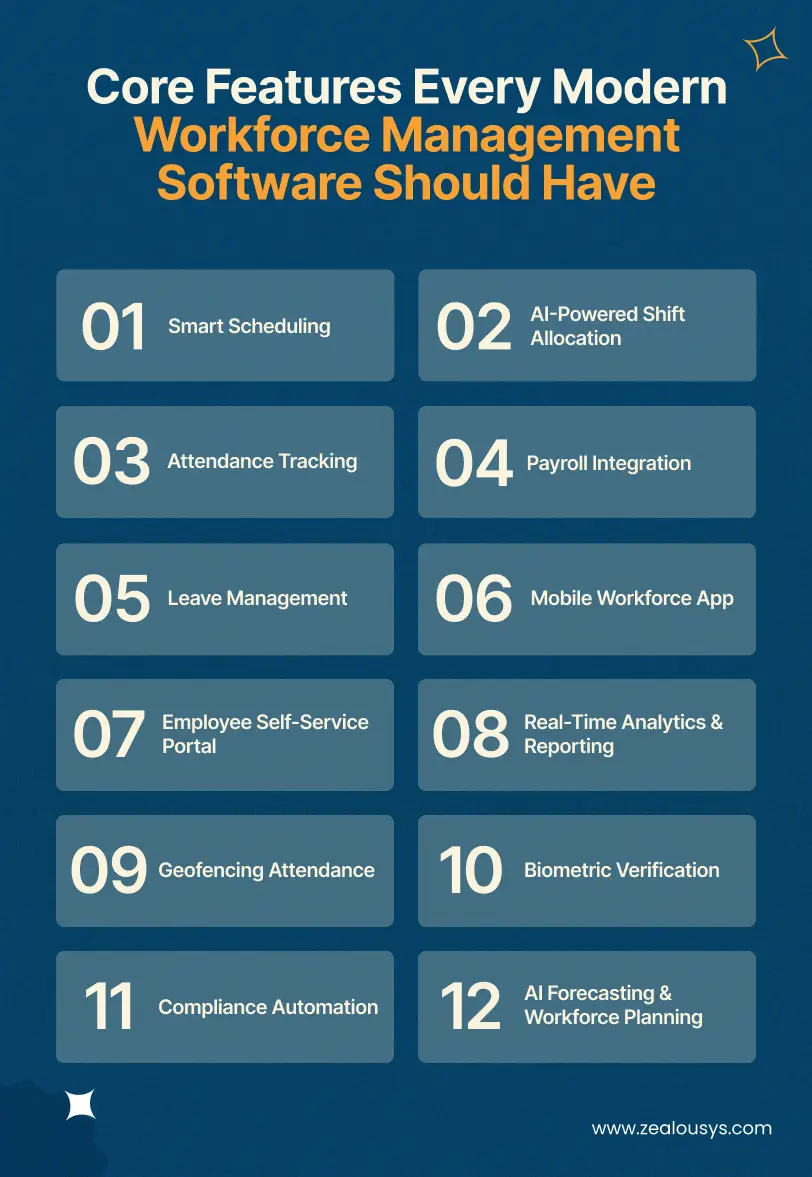
Building workforce management software today is no longer just about tracking employee attendance. Australian businesses now need intelligent systems that can automate scheduling, improve workforce visibility, simplify compliance, and reduce operational overhead across multiple teams and locations.
Here are the essential features businesses should prioritize while developing a modern workforce management solution.
Manual scheduling often leads to shift conflicts, overtime issues, understaffing, and employee dissatisfaction. Smart scheduling helps managers create optimized schedules based on employee availability, workload, labor laws, skill sets, and business demand.
A modern workforce management system should allow businesses to:
For industries like healthcare, retail, logistics, and hospitality, smart scheduling significantly improves operational efficiency while reducing administrative effort.
AI-powered scheduling takes workforce management to the next level by using historical workforce data, employee performance, seasonal demand, and attendance patterns to recommend the best shift allocation.
Instead of manually assigning shifts, AI can automatically:
For Australian enterprises managing large field or shift-based teams, AI scheduling helps improve productivity while maintaining compliance with Fair Work regulations.
Real-time attendance tracking gives businesses complete visibility into workforce activity across offices, remote locations, warehouses, or construction sites.
Modern attendance management systems should support:
This helps HR teams reduce payroll discrepancies and improve workforce accountability.
Disconnected payroll systems are one of the biggest operational challenges businesses face. Workforce management software should seamlessly integrate with payroll systems to automate salary calculations and reduce manual errors.
Key payroll integration capabilities include:
For Australian businesses, payroll integration is especially important due to complex labor laws, overtime structures, and award compliance requirements.
An efficient leave management module simplifies how employees request leave while helping managers maintain workforce availability.
The system should support:
This reduces administrative overhead and improves transparency between employees and management.
Modern workforce operations increasingly depend on mobility, especially for industries with remote or field employees.
A mobile workforce application enables employees and managers to:
A mobile-first approach is critical for industries like logistics, construction, mining, healthcare, and facility management where employees are constantly on the move.
Employees today expect self-service capabilities instead of relying on HR teams for every update or request.
An employee self-service portal allows users to:
This improves employee experience while significantly reducing HR workload.
Data-driven workforce decisions are becoming essential for modern businesses. Workforce management software should include advanced analytics dashboards that provide real-time operational insights.
Key analytics capabilities include:
These insights help businesses identify inefficiencies and make faster operational decisions.
For businesses with remote or field teams, geofencing ensures employees can only mark attendance from approved job locations.
Using GPS and location intelligence, geofencing helps businesses:
This feature is highly valuable for industries such as construction, logistics, delivery services, and facility maintenance.
Biometric authentication adds an additional layer of security and accuracy to workforce tracking systems.
Businesses can integrate:
Biometric verification minimizes attendance fraud while improving workforce authentication in high-security environments.
Australian workforce regulations can be complex, especially for businesses managing multiple employee categories, shift structures, and overtime policies.
Compliance automation helps organizations:
This is particularly important for healthcare, retail, hospitality, and enterprise organizations operating across multiple states.
AI forecasting helps businesses predict workforce demand using historical operational data, seasonal trends, sales activity, and workforce behavior patterns.
Advanced forecasting systems can help businesses:
For fast-growing businesses, AI forecasting transforms workforce management from reactive planning into proactive workforce optimization.
Modern workforce management software requires more than basic scheduling and attendance tracking. Businesses today need scalable, secure, and integration-ready platforms that can support real-time workforce operations across multiple locations and teams.
Most modern workforce platforms are built using cloud-native architecture on AWS or Microsoft Azure. This allows businesses to scale operations easily, improve system reliability, and support remote workforce access without infrastructure limitations.
Cloud platforms also help with:
Instead of using a single monolithic application, modern workforce systems use microservices architecture where modules like payroll, attendance, scheduling, and reporting operate independently.
This approach offers:
Technologies like Node.js, .NET Core, PostgreSQL, MongoDB, Redis, and Kubernetes are commonly used to build scalable backend infrastructure capable of handling large workforce data in real time.
An API-first approach ensures seamless integration with third-party platforms such as:
Workforce management software can integrate with platforms like Xero, MYOB, SAP, Oracle ERP, Microsoft Dynamics 365, and QuickBooks to automate payroll, attendance syncing, reporting, and workforce analytics.
AI is transforming workforce management by helping businesses automate scheduling and improve workforce planning.
AI-powered features may include:
This helps businesses reduce operational inefficiencies and improve workforce utilization.
Modern workforce platforms are designed with a mobile-first approach to support remote and field employees.
Employees can:
Managers can monitor workforce operations and approvals in real time through mobile dashboards.
Since workforce platforms handle sensitive employee and payroll data, security is a critical part of the architecture.
Key measures include:
A strong technical foundation ensures workforce management software remains scalable, secure, and future-ready as business operations grow.
AI is no longer just a futuristic add-on in workforce management software. In 2026, Australian businesses are using AI to solve real operational problems like staff shortages, overtime costs, scheduling conflicts, compliance risks, and employee burnout.
From healthcare and logistics to retail and construction, companies are investing in AI-powered workforce management systems to improve productivity, reduce manual work, and make faster workforce decisions based on real-time data.
Here are some of the most impactful ways AI is transforming workforce management software development in Australia.
Traditional scheduling often relies on manual planning or fixed shift templates. This creates problems like understaffing during peak hours or overstaffing during slow periods.
AI-powered predictive scheduling analyzes historical workforce data, seasonal trends, employee availability, public holidays, and customer demand patterns to automatically recommend optimized shift schedules.
For example, a retail business in Australia can use AI to predict increased staffing needs during holiday sales or weekend rush hours. Similarly, hospitals can forecast patient load trends and allocate nursing staff more efficiently.
This helps businesses:
One of the biggest challenges businesses face is accurately predicting workforce demand across locations, departments, or projects.
AI-driven workforce forecasting models use historical operational data, sales patterns, weather conditions, customer traffic, and business trends to estimate future staffing requirements.
For industries like logistics, hospitality, and construction, this becomes extremely valuable because workforce demand changes frequently.
Instead of reactive staffing decisions, businesses can proactively prepare for:
This improves planning accuracy and helps organizations avoid costly labor inefficiencies.
Manual attendance monitoring makes it difficult to identify irregular workforce behavior at scale. AI-powered attendance systems can automatically detect unusual patterns in employee attendance data.
The system can identify issues such as:
Modern workforce management software can combine biometric authentication, GPS tracking, geofencing, and AI analytics to improve attendance accuracy and reduce payroll fraud.
This is especially useful for industries managing remote or field-based employees, such as construction, mining, logistics, and facility management.
Employee burnout has become a major workforce challenge, particularly in high-pressure industries like healthcare, customer support, and logistics.
AI can analyze workload patterns, overtime frequency, shift rotation history, leave behavior, and productivity trends to identify employees who may be at risk of burnout.
Instead of waiting for performance issues or resignations, HR teams can take proactive steps such as:
This not only improves employee well-being but also helps businesses reduce turnover and maintain workforce productivity.
Australian workforce regulations can be complex, especially when businesses manage multiple employee types, shifts, overtime rules, and award interpretations.
AI-powered workforce management software can automatically monitor compliance requirements and flag potential violations before they become costly issues.
The system can help businesses manage:
Automated compliance monitoring reduces manual HR workload while lowering the risk of penalties, payroll disputes, and legal complications.
HR teams often spend significant time answering repetitive employee queries related to shifts, leave balances, payroll, attendance, or company policies.
AI-powered HR chatbots can provide instant support through web or mobile applications, helping employees access information without waiting for HR intervention.
Employees can use AI assistants to:
This improves employee experience while reducing administrative workload for HR departments.
One of the most common questions businesses ask before starting a workforce management software project is:
“How much does workforce management software development cost in Australia?”
The answer depends on several factors, including platform complexity, integrations, AI capabilities, compliance requirements, and scalability needs.
A simple workforce scheduling app will cost significantly less than an enterprise-grade workforce management platform with payroll integration, AI-powered forecasting, compliance automation, and real-time analytics.
Here’s a realistic cost breakdown based on current Australian software development trends.
| Software Type | Estimated Cost (AUD) | Ideal For |
|---|---|---|
| Basic Workforce Tracking App | AUD 15,000 – 30,000 | Small businesses & startups |
| MVP Workforce Management App | AUD 20,000 – 40,000 | Early-stage workforce automation |
| Mid-Level WFM Platform | AUD 30,000 – 75,000 | Growing businesses with multiple teams |
| Enterprise Workforce Management System | AUD 50,000 – 100,000+ | Large enterprises & multi-location operations |
| AI-Powered Workforce Management Platform | AUD 75,000 – 150,000+ | Enterprises requiring automation & predictive analytics |
Several technical and operational factors directly impact the final development cost.
The more advanced the platform, the higher the development effort.
Basic systems may include:
Advanced workforce management platforms often include:
Complex workflows require more backend logic, testing, and infrastructure planning.
Integrations are one of the biggest cost-driving factors in workforce management software development.
Australian businesses often need integrations with:
Common integrations include:
Each integration adds development, API management, testing, and maintenance costs.
AI-powered workforce management systems require additional investment because they involve:
For example, AI can automatically:
These capabilities increase both development and infrastructure costs but deliver long-term operational savings.
Compliance plays a major role in workforce management software development in Australia.
Businesses must comply with:
Building compliance-ready systems often requires:
Industries like healthcare, logistics, mining, and construction typically require additional compliance workflows, increasing development complexity.
Cloud architecture significantly impacts both initial and ongoing costs.
Modern workforce management systems usually rely on cloud platforms like:
Infrastructure costs depend on:
Enterprise-grade systems also require:
Many Australian businesses require mobile workforce management apps for:
Developing separate iOS and Android apps increases development time and cost, especially when offline functionality, GPS tracking, or push notifications are required.
A workforce management platform used daily by employees and managers must be simple and intuitive.
Custom UI/UX design increases cost but improves:
Enterprise dashboards, scheduling interfaces, and analytics visualizations require additional design effort.
For many Australian businesses, yes.
Custom workforce management software provides:
Unlike off-the-shelf platforms, custom solutions can adapt to evolving workforce processes and business growth without forcing companies into rigid workflows.
Zealous System helps businesses develop scalable workforce management software tailored to their operational requirements, workforce structure, and compliance needs.
From MVP workforce apps to enterprise-grade AI-powered workforce management platforms, our team focuses on:
Whether you need employee scheduling software, workforce analytics, attendance management, or AI-driven workforce automation, we help businesses build secure and future-ready workforce solutions for the Australian market.
One of the biggest decisions Australian businesses face is whether to build a custom workforce management system or purchase a ready-made SaaS platform. The right choice depends on your workflows, compliance needs, scalability goals, and integration requirements.
| Factor | Custom Workforce Management Software | Off-the-Shelf Workforce Software |
|---|---|---|
| Workflow Flexibility | Built around your exact business processes | Limited to predefined workflows |
| Scalability | Easily scales with business growth and multi-location operations | Scaling often requires higher subscription tiers |
| Integrations | Seamless integration with payroll, ERP, HRMS, CRM, and legacy systems | Integration options may be limited or costly |
| Compliance Management | Tailored to Australian Fair Work and industry-specific compliance needs | Generic compliance features |
| User Experience | Personalized dashboards and role-based access | Standardized interface for all businesses |
| AI & Automation | Custom AI scheduling, forecasting, and analytics features | Limited AI customization |
| Ownership | Full ownership of code, data, and infrastructure | Vendor controls platform and roadmap |
| Upfront Cost | Higher initial investment | Lower starting cost |
| Long-Term Cost | Lower dependency on recurring license fees | Ongoing monthly or annual subscription fees |
| Vendor Dependency | Independent platform management | Reliance on third-party vendor updates and pricing |
| Security Control | Custom security architecture and access policies | Shared security environment |
| Competitive Advantage | Supports unique operational processes | Similar features available to competitors |
Building workforce management software is not just about developing features. Australian businesses must also consider Fair Work compliance, payroll accuracy, mobile workforce accessibility, operational scalability, and employee adoption from day one.
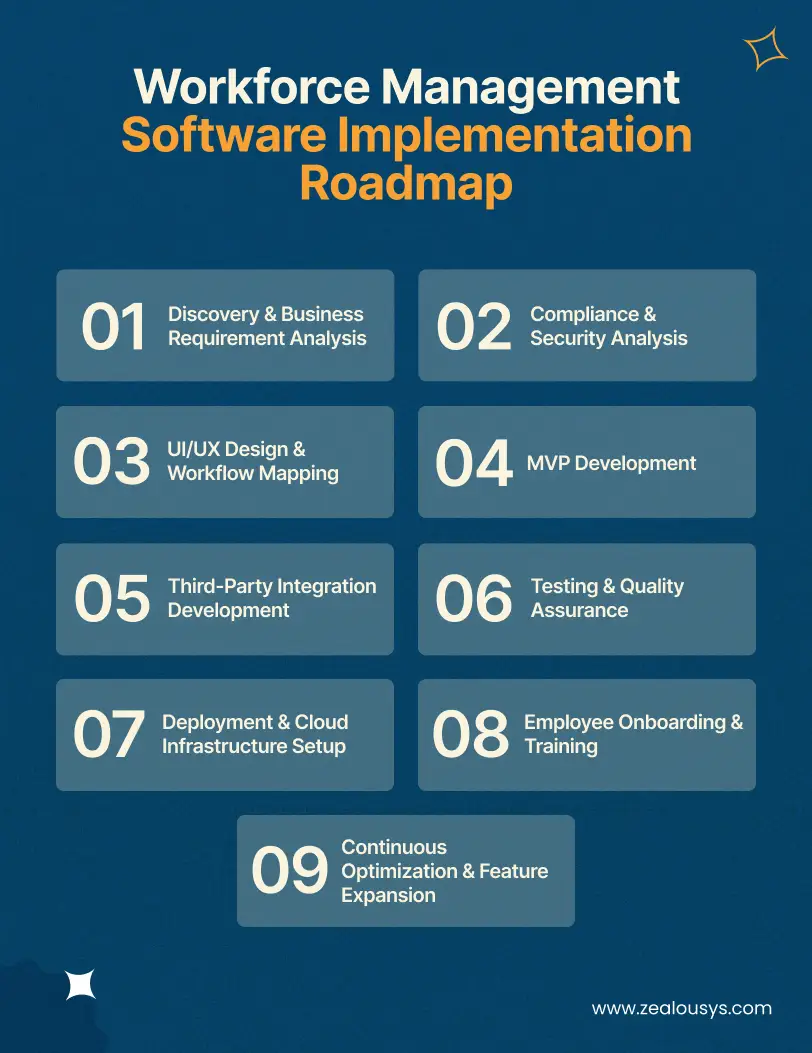
A structured implementation roadmap helps reduce development risks, speeds up deployment, and ensures the platform aligns with real business operations.
Here’s a step-by-step roadmap Zealous System follows for successful workforce management software development projects.
The first phase focuses on understanding how your workforce operates and identifying the operational gaps your software needs to solve.
During this stage, the development team collaborates with stakeholders, HR managers, operations teams, and IT departments to gather detailed requirements.
This phase typically includes:
The goal is to define a clear product vision before development begins.
For Australian businesses, compliance is one of the most critical parts of workforce management software development.
Ignoring compliance requirements can lead to payroll disputes, legal penalties, and operational inefficiencies.
In this phase, the team evaluates:
Security planning is also finalized here, including cloud security architecture, data encryption, authentication systems, and backup strategies.
A workforce management platform is used daily by employees, managers, HR teams, payroll staff, and administrators. Poor usability can reduce adoption and productivity.
This phase focuses on creating a user-friendly and operationally efficient experience.
The design process includes:
Interactive prototypes and wireframes are created before development begins to validate workflows early.
Instead of building a large enterprise platform all at once, businesses should first launch a Minimum Viable Product (MVP).
An MVP helps validate workflows, gather employee feedback, and reduce development risks before full-scale implementation.
The initial MVP usually includes:
This agile approach allows businesses to launch faster and improve the system based on real operational usage.
Modern workforce management systems must connect with multiple business platforms to ensure smooth operations.
This phase focuses on integrating external systems such as:
API-first integration architecture ensures scalability and future expansion without major redevelopment.
Before deployment, the software undergoes rigorous testing to ensure stability, security, and performance under real-world conditions.
This phase includes:
For workforce platforms handling sensitive employee and payroll data, testing becomes especially critical.
Once testing is complete, the workforce management platform is deployed to the production environment.
Businesses can choose deployment models based on operational needs:
This phase also includes:
A scalable cloud architecture ensures the system can support workforce growth across multiple locations.
Even the best workforce software can fail if employees and managers do not understand how to use it effectively.
This phase focuses on smooth user adoption through:
The goal is to minimize operational disruption and improve adoption rates across the organization.
Workforce management software is not a one-time implementation. As businesses grow, workforce operations evolve.
Continuous optimization helps improve efficiency, automation, and employee experience over time.
Post-launch improvements may include:
Regular updates ensure the platform remains scalable, secure, and aligned with changing business requirements.
A well-planned implementation roadmap helps businesses:
For Australian enterprises managing complex workforce operations, a phased development strategy creates a much smoother transition from manual processes to intelligent workforce automation.
Zealous System helps businesses build custom workforce management software tailored to their operational needs. From employee scheduling and attendance tracking to payroll integration and performance monitoring, we develop solutions that streamline workforce operations and improve productivity. Our team focuses on building intuitive platforms that work seamlessly across web and mobile devices.
Using modern technologies, cloud infrastructure, and secure architecture, Zealous System develops scalable workforce management solutions for startups, SMEs, and enterprises. Whether businesses need an MVP or a full-scale enterprise platform with AI-powered scheduling and analytics, we create flexible systems that integrate smoothly with ERP, HRMS, CRM, and payroll software.
With strong expertise in custom software development, Zealous System also ensures workforce management solutions align with industry-specific compliance requirements and business goals. Our developers collaborate closely with clients throughout the development process to deliver reliable software that improves operational efficiency and supports long-term business growth.
Related Case Study: Workforce Management Software for Australian Mining Industry
Many Australian businesses invest in workforce management software expecting instant operational improvements, but the reality is different. Poor planning, compliance gaps, and disconnected systems often lead to delayed adoption, payroll disputes, and expensive redevelopment later.
Here are some of the most common mistakes companies make and how to avoid them.
One of the biggest mistakes businesses make is underestimating how complex Australian labor laws and Modern Awards can be.
Different industries have different rules for:
Many off-the-shelf workforce platforms are not designed specifically for Australian compliance requirements. As a result, businesses often end up handling award interpretation manually, increasing payroll errors and compliance risks.
A well-designed workforce management system should automate compliance calculations and integrate directly with payroll systems to reduce manual intervention.
Workforce management software rarely works as a standalone platform. It must communicate smoothly with payroll software, HR systems, ERP platforms, biometric devices, and accounting tools.
Many businesses focus heavily on frontend features but overlook backend integrations during planning. This creates problems later, such as:
Australian enterprises often use platforms like MYOB, Xero, SAP, Oracle, and Employment Hero. Ensuring seamless API integration with these systems should be part of the initial architecture strategy that not an afterthought.
Traditional workforce systems were built for office environments, but modern Australian businesses increasingly manage distributed and field-based teams.
Industries like:
require mobile-first workforce management capabilities.
Many companies still invest in desktop-heavy systems that create friction for field employees. Without mobile accessibility, businesses struggle with:
Modern workforce software should support mobile apps, geolocation tracking, offline functionality, push notifications, and employee self-service features.
Another common mistake is selecting generic SaaS workforce tools that cannot adapt to evolving business operations.
While ready-made platforms may appear cost-effective initially, businesses often face limitations when they need:
As operations grow, rigid platforms become operational bottlenecks.
Australian enterprises with unique workforce structures often benefit more from custom workforce management software that aligns with their processes instead of forcing teams to adapt to software limitations.
Manual compliance management is one of the biggest operational risks in workforce management.
Many businesses still rely on spreadsheets or manual audits to monitor:
This increases the risk of compliance breaches, payroll disputes, and administrative overhead.
Modern workforce management systems should include automated compliance monitoring, real-time alerts, digital audit trails, and rule-based workflows to reduce risk and improve operational transparency.
Some businesses treat workforce management software as just a scheduling tool. However, modern workforce platforms are evolving into intelligent operational systems powered by analytics and AI.
Without workforce intelligence capabilities, businesses miss opportunities to:
AI-powered analytics can help Australian businesses make faster and more informed staffing decisions while improving overall operational efficiency.
Even technically strong workforce software can fail if employees find it difficult to use.
Complex interfaces, slow mobile apps, and confusing workflows reduce adoption rates and create resistance among staff.
Successful workforce management platforms prioritize:
The easier the system is for employees to use, the faster organizations see operational improvements.
Many organizations build workforce software for current operational needs without planning for future growth.
As businesses expand into multiple regions, locations, or departments, scalability becomes critical.
A scalable workforce management platform should support:
Future-ready architecture reduces redevelopment costs and ensures long-term flexibility.
Workforce management software development in Australia can cost between AUD 205,000 and AUD 150,000+, depending on features, integrations, AI capabilities, and platform complexity.
A basic MVP costs less, while enterprise solutions with payroll integration, analytics, and compliance automation require a higher investment.
The development timeline usually ranges from 3 to 12 months.
A simple MVP can be built within 10–14 weeks, while enterprise-grade workforce management software with custom integrations and AI features may take several months longer.
Core workforce management software features include:
Advanced systems may also include geofencing, biometric attendance, and predictive workforce analytics.
Custom workforce management software offers better flexibility, scalability, and integrations compared to SaaS platforms.
It is ideal for businesses with unique workflows, compliance requirements, or industry-specific operational needs.
AI improves workforce management by automating scheduling, forecasting staffing needs, detecting attendance anomalies, and optimizing labor costs.
It also helps businesses improve productivity, compliance, and workforce planning.
Australian workforce management software should support Fair Work compliance, award interpretation, payroll regulations, overtime tracking, and employee record management.
Businesses in healthcare, construction, and mining may also require industry-specific compliance features.
Industries that benefit most include:
These industries use workforce management software to improve scheduling, workforce tracking, compliance, and operational efficiency.
Workforce management today goes far beyond scheduling and attendance tracking. Australian businesses need scalable and compliance-ready solutions that improve productivity, automate operations, and provide real-time workforce visibility. Industries like healthcare, logistics, retail, and construction are increasingly adopting custom software for workforce management to streamline complex day-to-day operations.
While off-the-shelf platforms may suit basic business needs, they often lack flexibility, customization, and advanced integration capabilities. Custom workforce management software offers better scalability, stronger compliance management, seamless integrations, and AI-powered features like predictive scheduling and workforce analytics, making it a smarter long-term investment for growing businesses.
At Zealous System, we help businesses develop secure, scalable, and future-ready workforce management solutions tailored to their industry and operational requirements. From workforce scheduling and employee tracking to payroll integration and AI-driven automation, we build solutions designed to support long-term business growth and efficiency.
Our team is always eager to know what you are looking for. Drop them a Hi!

Pranjal Mehta is the Managing Director of Zealous System, a leading software solutions provider. Having 10+ years of experience and clientele across the globe, he is always curious to stay ahead in the market by inculcating latest technologies and trends in Zealous.


Comments