Quick Overview
You have probably collected three quotes for crowdfunding platform development and found them wildly apart. A freelancer says $12,000. An agency says $250,000. Neither explains why.
Both can be correct. A reward-based donation site with Stripe checkout genuinely is a small build. An equity crowdfunding platform with investor accreditation, escrow, cap table records, and regulatory reporting is a different product wearing the same name.
This guide covers what sits behind crowdfunding platform development pricing: features, compliance load, technology choices, and the cost ranges that follow from each.
A crowdfunding platform is a two-sided marketplace for money. Creators list what they are raising for, backers contribute, and the platform handles discovery, payment collection, fund holding, and payout.
The mechanics are where the engineering lives. Money never travels directly from backer to creator. It sits with a processor or in escrow until conditions are met, then gets released, minus your commission. Building that flow correctly, with refunds, failed payments, chargebacks, and cross-border payouts handled properly, is most of the backend work.
Platform commission: Reward and donation platforms typically charge 3% to 8% of funds raised. US equity portals commonly sit in the 4% to 8% range, sometimes plus equity or warrants.
Payment processing margin: You pay your processor roughly 2.9% plus a fixed fee. Some platforms pass this on with a small markup.
Subscription or listing fees: Monthly plans for organizations running repeat campaigns.
Promotion and placement: Paid featuring on the homepage, category pages, or backer emails.
It can be, but the unit economics are unforgiving at small scale. Revenue is funding volume multiplied by take rate. At 5% commission, you need $2 million in annual volume to produce $100,000 gross, before processing and support costs.
Public data shows how uneven the market is. The SEC publishes running statistics on Regulation Crowdfunding, and between May 2016 and the end of 2025 there were 9,461 offerings, of which only 4,303 reported any proceeds at all. Those that did raised about $1.55 billion between them, averaging roughly $359,000 per offering, far below the $5 million cap. Fewer than half of the campaigns that launch report raising anything.
General-purpose platforms are already dominated. The ones getting funded now are narrow: medical equipment for clinics, fractional farmland, community energy, diaspora giving for a specific country. A focused audience converts better and needs less marketing spend to reach critical mass.
The model you choose is the single biggest cost factor, because each one carries a different amount of regulated machinery behind the same-looking campaign page. Here is what each adds to your scope.
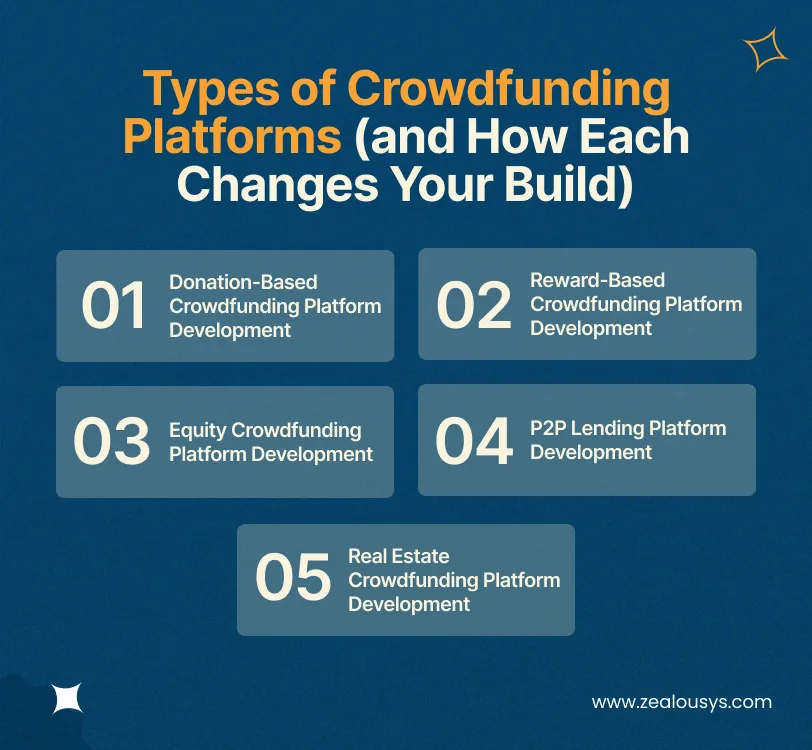
Backers give with no expected return. Charity appeals, medical funds, disaster relief. The lightest build: campaign pages, one-off and recurring payments, receipts, and payout, plus tax receipting and donor data protection.
Backers receive a product or perk. Add reward tiers with inventory limits, shipping collection with regional pricing, all-or-nothing funding logic, and fulfillment tracking. Delayed payment capture matters here, since cards are only charged if the goal is met.
Backers receive shares, and cost jumps sharply. You need investor accreditation, per-investor annual limits, subscription agreements with e-signature, cap table records, escrow with a qualified agent, and ongoing regulatory reporting. In the US, you also register as a funding portal.
Backers lend and expect repayment. Add credit assessment, loan origination, amortization schedules, automated repayment collection, arrears and default handling, and investor return statements. The accounting engine alone can cost as much as an entire donation platform, which is why P2P lending platform development cost sits at the top of the range.
Backers fund property deals for rental income or capital gain. Equity mechanics plus asset-level reporting: valuations, rent distribution, property documents, and long hold periods that demand a durable investor dashboard.
| Model | Revenue Mechanism | Regulatory Load | Relative Build Cost |
|---|---|---|---|
| Donation-based | Commission, tips | Low | 1x |
| Reward-based | Commission, promotion | Low to medium | 1.3x |
| Equity | Commission, listing fees | High | 2.5x |
| P2P lending | Origination and servicing fees | High | 2.5x to 3x |
| Real estate | Commission, management fees | High | 2.5x to 3x |
Every crowdfunding platform is three products sharing one database. Scoping them separately is how you avoid surprises later.
This third panel is the one most often under-scoped, and it is where your operations team will spend every working day.
Once the basics work, a small number of features separate platforms that grow from platforms that stall. Most are data problems rather than interface problems.
Campaign success scoring: Train a model on your historical campaigns to predict funding likelihood at submission. Flag weak campaigns for coaching before launch, prioritize strong ones in discovery. Improving your success rate improves creator retention, the hardest number to move.
Personalized discovery: Browsing and pledge history is enough signal to power a useful recommendation system. Homepage relevance is worth more than any redesign, because repeat backers are your cheapest funding source. On mature platforms, a large share of total backers have pledged more than once, and reaching them costs you nothing.
Fraud and AML detection: Rule-based engines generate enormous false-positive volume, and the review cost lands on your operations team. On one project for a UK non-banking financial company, the rules engine produced more than 12,000 alerts a month, over 90% of them legitimate, with analysts spending 15 to 20 minutes on each.
An AI triage agent that enriched each alert and recommended an action cut manual reviews by 62% and brought resolution time from 14 hours to about 3. Card testing, mule accounts, and fake campaigns generate the same kind of alert queue on a crowdfunding platform.
Compliance determines your architecture, so it belongs in week one, not near the end. Get a lawyer in your target market before you write code. What follows is orientation, not legal advice.
Creators need identity and business verification before receiving funds. Backers need verification above certain thresholds, and always for investment models.
Use a specialist vendor such as Onfido, Sumsub, or Persona rather than building this yourself. You pay per verification, typically $1 to $3, a real line item at volume. Add sanctions and politically exposed person screening, plus transaction monitoring with a documented escalation path. Card data must stay within PCI DSS scope, which in practice means never touching it and using hosted payment fields.
Backer money is not your money. Mixing it with operating funds is a regulatory problem and a solvency risk. Escrow integration is the single most scrutinized piece of a crowdfunding build, and regulators will ask to see it. You need segregated accounts, and for investment models, a qualified escrow agent holding funds until the offering closes.
Milestone-based payouts release funds in tranches as a campaign hits agreed checkpoints. This reduces fraud exposure but adds real engineering: partial release, clawback handling, and a dispute state that pauses distribution.
For donation and reward-based platforms, usually not, though you still need money transmission arrangements. Most platforms solve this by using a licensed processor’s marketplace product rather than holding funds themselves. For equity and lending platforms, almost always yes.
| Region | What Applies |
|---|---|
| United States | Reg CF (up to $5M per 12 months) or Reg A+; funding portals register with the SEC and FINRA |
| United Kingdom | FCA authorization for loan-based and investment-based crowdfunding; the Public Offer Platform regime took effect on January 19, 2026 |
| European Union | ECSP Regulation, a single authorization that passports across member states |
| India | SEBI has not permitted retail equity crowdfunding; P2P lending sits under RBI’s NBFC-P2P framework |
| UAE and Singapore | Licensing through the relevant financial authority, with regulatory sandbox routes available |
Two details founders miss. The SEC’s Division of Economic and Risk Analysis counted 83 funding portals registered with the SEC and FINRA as of the end of 2024, with the five largest accounting for roughly 70% of initiated offerings. The US market is both licensed and heavily concentrated. And data protection applies regardless of model: if you handle EU or UK residents’ data, GDPR compliance shapes your consent flows, retention policy, and deletion handling from day one.
Your crowdfunding website tech stack is less about developer preference and more about two constraints: campaign pages need to rank in search, and money movement needs to be provably correct. Everything below follows from those two.
| Layer | Typical Choice | Why |
|---|---|---|
| Frontend | React or Next.js | Server-side rendering matters, since campaign pages need to rank |
| Backend | Node.js, Laravel, or Django | Mature payment SDKs and fast delivery |
| Database | PostgreSQL | Transactional integrity is non-negotiable for money movement |
| Search | Elasticsearch or Algolia | Campaign discovery at scale |
| Mobile | React Native or Flutter | Shared codebase covers both platforms |
| Cloud | AWS or Azure | Regional data residency for compliance |
| Queue and Cache | Redis, RabbitMQ | Payout jobs, notifications, webhook retries |
Your gateway constrains your product more than your framework does. You need a marketplace or multi-vendor product, not standard checkout.
For investment platforms, pair the gateway with a dedicated escrow provider. The gateway moves money; the escrow agent holds it on the terms your regulator expects.
Traffic here is spiky. A campaign featured in a newsletter can bring more load in an hour than the previous month combined, and it always happens at the deadline.
Cache campaign pages behind a CDN, move payouts and notifications into background workers, and put an idempotency key on every payment operation so a retried webhook never charges twice. Keep an immutable ledger of money movement separate from your application tables, because you will need it during audits and disputes. A modular application architecture also lets you isolate compliance and payments, the parts most likely to change when you enter a new market.
Seven steps, in this order. The sequence matters more than the durations, and step two is the one teams most often get wrong by pushing it later.
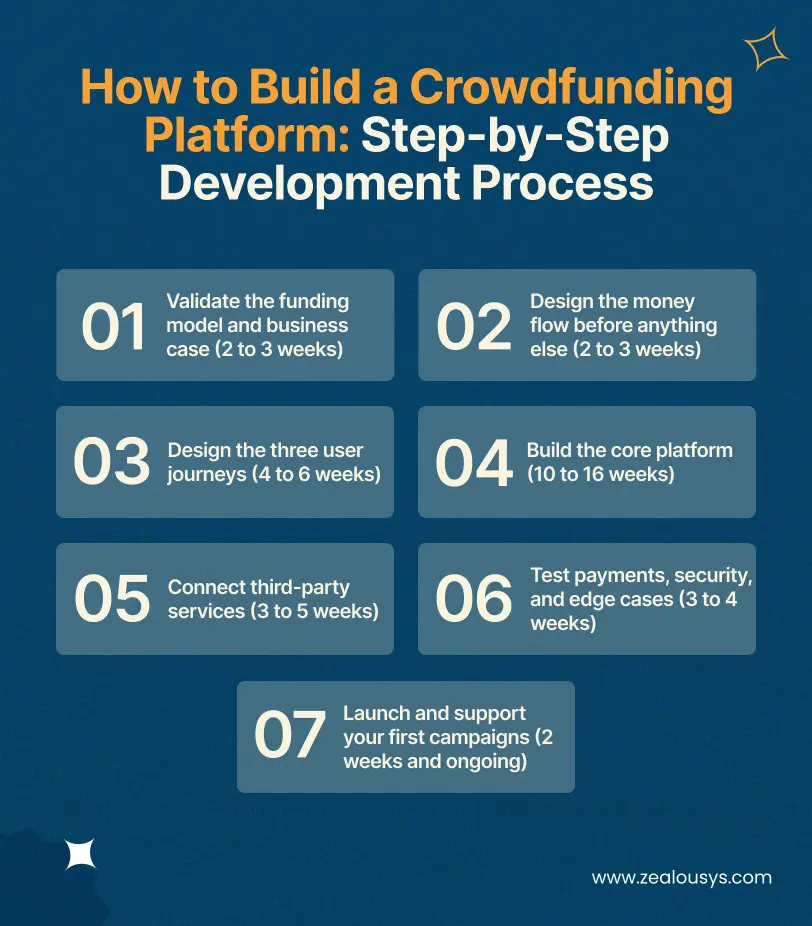
Pick your funding model, target market, and take rate, then check whether the volume you can realistically reach produces a viable business. Confirm which regulator you will answer to. Getting this wrong makes every later step more expensive.
Map exactly how a dollar travels from a backer’s card to a creator’s bank account, including who holds it in between and under what conditions it gets released. Select your payment gateway, escrow provider, and KYC vendor now, not later. Teams that postpone this end up rebuilding onboarding after their provider rejects the flow.
Wireframe and design the backer, creator, and admin experiences as three separate products. Verification steps need to sit where they feel natural, not where they are convenient to build. Every extra field between interest and payment costs you conversions.
Campaign creation and management, the payment and payout engine, dashboards, and the admin panel. Build the ledger first and the interface second. Reversing that order is how platforms end up unable to reconcile their own transactions.
KYC and AML checks, escrow, notifications, analytics, and your accounting system. Each integration needs its own failure handling, because a webhook that fails silently is worse than one that fails loudly.
Functional testing is the easy part. What matters is the edge cases: partial refunds, failed payouts, expired cards on recurring donations, currency conversion rounding, and duplicate webhooks. Add penetration testing before you handle a single real transaction.
Deploy with monitoring and alerting already in place, then run your first campaigns with the development team still close by. Your earliest creators will find problems no test suite caught, and fixing them quickly earns the referrals that fill your platform.
A donation or reward-based MVP takes 3 to 4 months, a mid-tier platform with mobile apps takes 5 to 8 months, and an equity or lending platform takes 9 to 14 months. Licensing often runs longer than the build, so start both at once.
Here is where the earlier decisions turn into numbers. The ranges below include design, development, QA, and project management, and exclude licensing fees, legal counsel, and marketing.
| Scope | What You Get | Cost | Timeline |
|---|---|---|---|
| MVP | Single model, web only, one gateway, basic admin | $20,000 to $45,000 | 3 to 4 months |
| Mid-tier | Web plus mobile, multiple payment methods, full admin, analytics | $45,000 to $110,000 | 5 to 8 months |
| Enterprise | Equity or lending, escrow, multi-region compliance, AI features | $110,000 to $200,000+ | 9 to 14 months |
If you are still validating the idea, build the MVP. A version that proves people will fund campaigns on your platform is worth more than a feature-complete product nobody uses. Our guide to MVP development covers how to decide what makes the first release.
| Module | Cost Range |
|---|---|
| User Accounts, Roles, Authentication | $2,500 to $5,000 |
| Campaign Creation and Management | $5,000 to $12,000 |
| Search, Filtering, and Discovery | $3,000 to $8,000 |
| Payment Gateway and Multi-party Payouts | $6,000 to $15,000 |
| Escrow and Milestone-based Release | $5,000 to $14,000 |
| KYC and AML Integration | $4,000 to $10,000 |
| Backer or Investor Dashboard | $4,000 to $9,000 |
| Admin Panel and Reporting | $6,000 to $14,000 |
| Mobile Apps (iOS and Android) |
$12,000 to $30,000 |
| AI Scoring, Recommendations, or Fraud Detection | $8,000 to $25,000 |
| Region | Typical Hourly Rate |
|---|---|
| North America | $100 to $180 |
| Western Europe and Australia | $80 to $150 |
| Eastern Europe | $40 to $70 |
| India | $25 to $50 |
Zealous System’s rates sit at $25 to $30 per hour, which is why a mid-tier platform quoting at $180,000 in the US lands closer to $60,000 here for the same scope. When comparing bids, normalize them to hours first, since a low hourly rate on a padded estimate is not cheap. Our guide on reducing software development costs covers the wider trade-offs.
This is usually the first real decision a founder makes, and it reverses in only one direction. Moving from white-label to custom later is possible but costly. Moving the other way rarely happens.
| White-label | Custom Build | |
|---|---|---|
| Upfront Cost | $5,000 to $30,000 plus monthly licensing | $20,000 to $200,000+ |
| Time to Launch | 2 to 6 weeks | 3 to 14 months |
| Payment and Payout Logic | Fixed by the vendor | Fully yours to define |
| New Regulatory Workflow | Wait for the vendor’s roadmap | Build it when you need it |
| Code Ownership | None | Full, and it counts as an asset |
| Migrating Away Later | Expensive once campaigns are live | Not applicable |
| Best For | Standard donation or reward campaigns, testing demand | Equity, lending, escrow, or any unusual fund flow |
White-label works when your campaigns look like everyone else’s and speed matters more than control. The constraint that bites hardest is payment logic: the moment you need a fund flow the vendor did not anticipate, you are stuck waiting or rebuilding.
A useful test: if your differentiation is in how money moves, build. If it is in your audience and brand, and money moves in a standard way, start white-label and rebuild when volume justifies it.
Choosing a partner for this kind of build comes down to two questions: have they moved regulated money before, and can they staff the project in a way that survives a mid-project change in requirements?
Crowdfunding platforms sit between marketplace mechanics and regulated money movement, and most teams are strong at one but not both. Our work spans both: multi-vendor marketplaces with split payments, fintech software development covering KYC and escrow flows, and AI systems including the fraud triage work above. That combination keeps compliance decisions from becoming expensive rewrites at month six.
Fixed-price works when scope is clear, usually a defined MVP. A dedicated offshore team suits longer builds where regulatory feedback will change requirements mid-project. Staff augmentation fits companies with an in-house team that needs payments or compliance specialists for a phase.
The questions founders ask most often before committing to a build.
Between $20,000 and $200,000 or more. A web-only MVP runs $20,000 to $45,000, a mid-tier platform with mobile apps runs $45,000 to $110,000, and equity or lending platforms start around $110,000.
Three to four months for an MVP, five to eight for a mid-tier platform, nine to fourteen for equity or lending. Licensing often runs longer than development, so start both in parallel.
Donation and reward-based platforms usually do not, though you need proper money transmission arrangements. Equity and lending platforms almost always do: SEC and FINRA registration in the US, FCA authorization in the UK, ECSP authorization in the EU.
React or Next.js on the frontend, Node.js, Laravel, or Django on the backend, PostgreSQL for transactional data, Elasticsearch or Algolia for discovery, Stripe Connect for multi-party payments, and React Native or Flutter for mobile.
It depends on volume. At 5% commission, you need roughly $2 million in annual funding volume to reach $100,000 gross, so niche platforms serving a defined community usually get there faster than general-purpose ones.
Technically yes, and the core features are well understood. The hard part is supply and demand, not software, so most successful new entrants pick a narrow category where they already have an audience.
Budget 15% to 20% of build cost annually, plus payment processing fees, KYC charges per verification, cloud hosting, and periodic compliance audits.
White-label if you need to launch fast with standard donation or reward campaigns. Custom if the platform is your core business, your funding model is unusual, or you need regulator-specific workflows you control.
The cost of a crowdfunding platform follows from three decisions: which funding model you run, which markets you operate in, and whether you build the money infrastructure or integrate it. Settle those three and the estimate stops being a guess.
If you want a figure for your specific scope rather than a range, talk to our team. We will map your funding model against the compliance and payment work it actually requires and give you a breakdown you can plan against.
Our team is always eager to know what you are looking for. Drop them a Hi!

Ruchir Shah is Technology Head at Zealous System with hands-on expertise in AI/ML, Microsoft Azure, .NET, Node.js, Python, React, and Angular. He leads enterprise software development, champions digital transformation, and mentors developers building the future of intelligent apps.




Comments