Launching your app was supposed to be the expensive part, and then the invoices kept arriving. If you have already had the uncomfortable conversation where a bill for “a few small fixes” turns out to look nothing like what you had in mind, you are in good company. So is everyone whose finance team has asked for a benchmark before signing off on next year’s maintenance line.
The short answer is that app maintenance cost usually runs between 15% and 25% of your original build price every year. On a $25,000 app, that works out to roughly $3,750 to $6,250 annually. On a $150,000 build, you are looking at $22,500 to $37,500. What follows is a breakdown of where that money actually goes, which factors push it higher, and what you can do to keep it under control.
We derived these figures by applying the 15% to 25% rule to standard 2026 build costs, which range from $25,000 for a basic app to $150,000 or more for advanced and enterprise builds. If you are unsure where your own project sits, our breakdown of the cost to create an app covers what drives that starting figure. This is the simplest form of software maintenance cost estimation, and it holds up well as a starting point, since every number here traces back to that one calculation.
| App Tier | Development Cost | Annual Maintenance (15–25%) | Monthly Equivalent |
|---|---|---|---|
| Basic | $25,000–$50,000 | $3,750–$12,500 | $310–$1,040 |
| Mid-Complexity | $50,000–$100,000 | $7,500–$25,000 | $625–$2,080 |
| Advanced | $100,000–$150,000 | $15,000–$37,500 | $1,250–$3,125 |
| Enterprise | $150,000–$500,000 | $22,500–$125,000 | $1,875–$10,400 |
The monthly column gives you the app maintenance cost per month, which is how most retainers are actually billed. These figures assume a single platform and steady user growth. Add a second platform, real-time features, or a fast-growing user base, and you move toward the upper end of your tier or past it.
The rule works because maintenance effort scales with the amount of custom code you own. More code means more surface area for bugs, more dependencies to update, and more to re-test after every OS release.
It breaks in three situations. Regulated apps in finance and healthcare carry audit costs that sit outside the ratio entirely. High-traffic consumer apps see hosting grow with users, not with code. And apps built quickly on ageing frameworks accumulate technical debt that eventually demands more than a maintenance budget can absorb.
The cost to maintain an app after launch is front-loaded. Those first twelve months absorb everything QA missed, the first round of OS compatibility work, and performance tuning against real traffic rather than projected traffic.
Budget at 20% to 25% for year one, then expect 15% to 18% by years two and three if you are not adding major features. Ship a significant new capability and the clock resets.
Maintenance is rarely one bill. It is closer to seven or eight smaller ones, and each behaves differently from the others.
The work splits into four categories.
Our guide to software maintenance maps these four to the maintenance lifecycle.
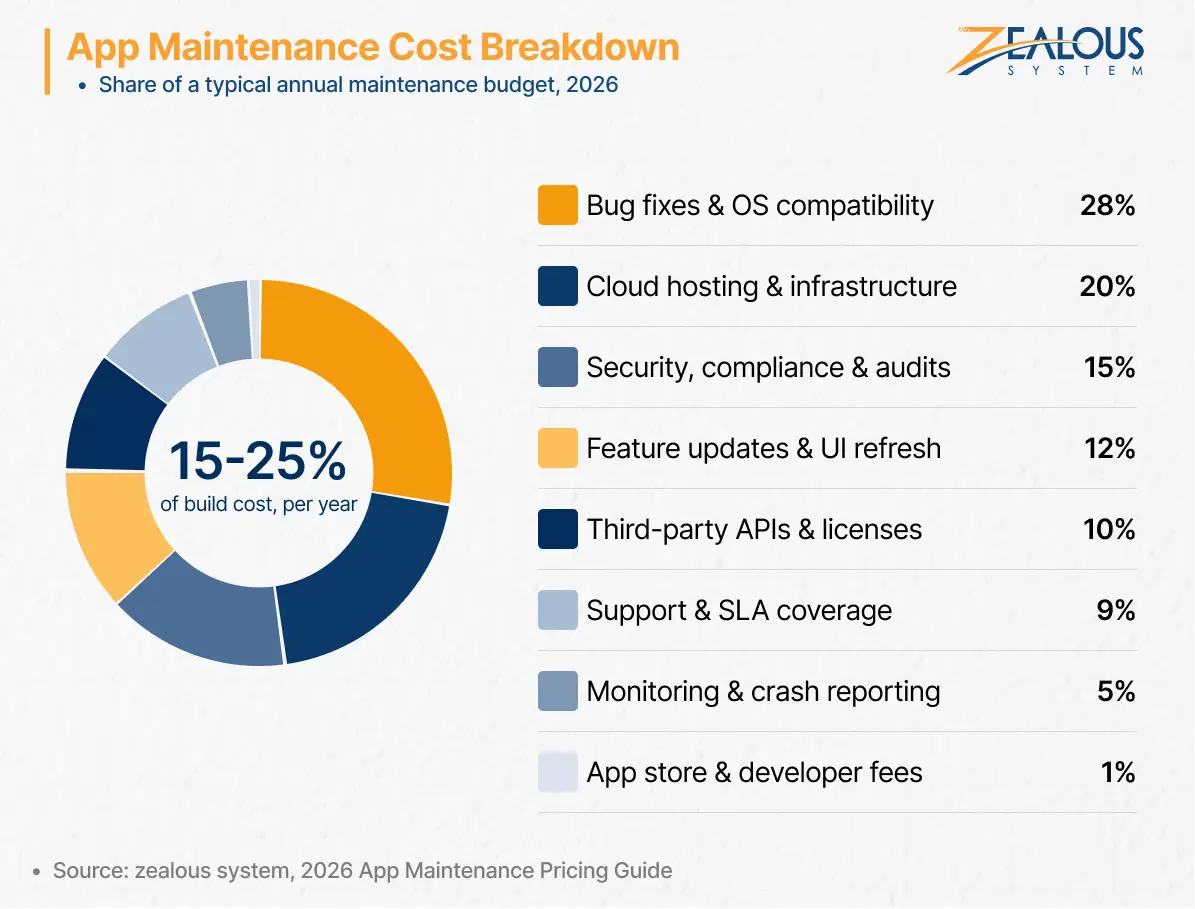
Hosting scales with usage, not with app complexity. A low-traffic app runs comfortably on $50 to $200 a month. An app with real-time features, video, or heavy media can push past $2,000 to $5,000 monthly once traffic builds.
The architecture decision made at build time matters more than the provider you pick. Static provisioning wastes money during quiet hours and struggles during spikes.
These are the smallest numbers on the sheet, and also the easiest to overlook. Apple’s Developer Program costs $99 a year and renews annually, while Google Play charges a single $25 fee that covers the life of the account. If you distribute privately to employees through an internal system or an MDM solution, you may qualify for Apple’s Enterprise Program instead, which runs $299 a year.
No budget breaks over $99, so the real risk here is administrative rather than financial. Let an Apple membership lapse and your app sits in a short grace period before Apple pulls it from the store entirely.
This is usually the largest slice of the maintenance budget, and it is the one you cannot schedule. Major OS version updates land every year from both Apple and Google, and each one brings behavioural changes that force code updates and a fresh round of testing.
The compliance side leaves you even less room to manoeuvre. Google’s target API level requirements now oblige existing apps to hit Android 15 (API level 35) or higher by August 31, 2026, and developers who need breathing room can request an extension to November 1. Miss it, and your app quietly stops appearing to new users on newer devices, though it carries on working normally for anyone who already installed it.
None of this is a one-off. Google raises the bar every August, one level for new submissions and one for existing apps: API 34 in 2024, API 35 in 2025, API 36 in 2026. Treat it as a fixed annual line in your budget rather than a discretionary improvement, because that is exactly what it has become.
Security work runs from a few thousand dollars a year for a straightforward consumer app to $25,000 or more for anything handling payments or patient data. A single penetration test on a mid-sized application typically lands between $10,000 and $30,000, and that figure covers finding the problems, not fixing them.
Regulatory exposure has grown sharply over the past two years. The CMS GDPR Enforcement Tracker Report counted roughly 2,685 documented fines worth around €6.11 billion as of its March 2026 cut-off, which is 440 more cases and €487.6 million more in penalties than the edition before it. What should worry app owners is the pattern behind those numbers: a good share of them involved products that collected data perfectly lawfully at launch, then failed to keep pace as the guidance moved. Keeping software GDPR compliant is ongoing work, not a launch checkbox.
Payment gateways, mapping services, push notification platforms, and analytics tools all price by usage. Your bill at 1,000 users looks nothing like your bill at 50,000. API deprecation is the sharper risk here: when a provider retires an SDK version, you get a deadline rather than a choice.
Uptime monitoring, crash reporting, and log aggregation typically add $50 to $500 a month depending on data volume. Teams cut this line first when budgets tighten, then discover outages from user complaints instead of alerts.
This is the discretionary portion of the budget, and it is where most of the internal arguments happen. Improvements based on real user behaviour keep retention healthy, but every one of them expands your codebase and raises next year’s baseline. Both things are true at the same time, which is what makes the decision genuinely difficult.
This is the single biggest variable that almost nobody thinks to ask about. A next-business-day response costs a fraction of a four-hour guarantee, simply because the faster one requires somebody to be on call. Get the bug-fix turnaround commitment in writing before you sign, along with a clear definition of what counts as a critical incident.
The same build budget produces very different maintenance bills depending on what the app does.
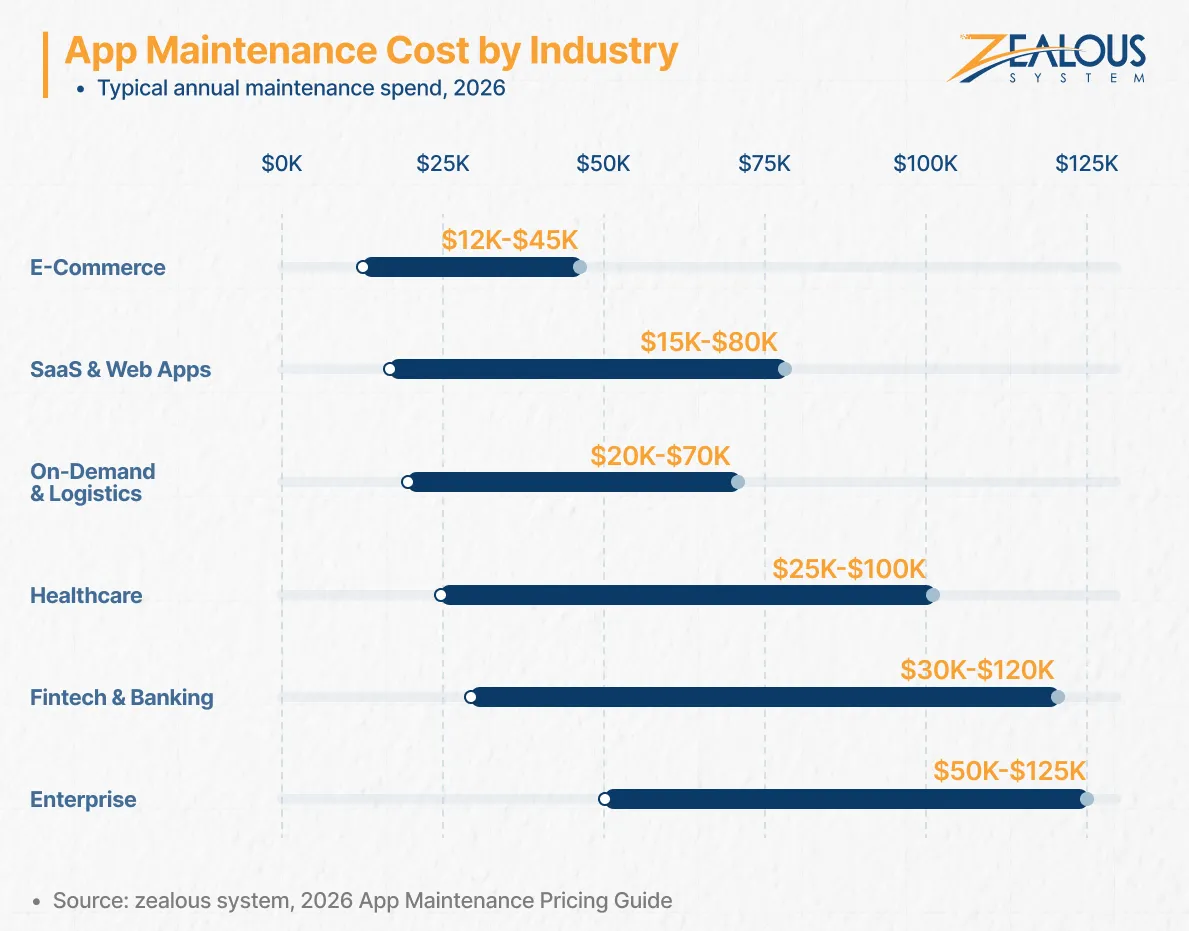
Most retail apps land between $12,000 and $45,000 a year. Payment gateway updates, catalogue performance work, and seasonal traffic spikes account for the bulk of it. Peak-season readiness is effectively a fixed annual cost for anyone running eCommerce app development at scale.
Budget $30,000 to $120,000 a year here, and often a good deal more. Security audits, penetration testing, and regulatory reporting all sit on top of ordinary maintenance rather than replacing any of it. Compliance requirements in fintech software development change more often than the code does.
Annual costs typically run from $25,000 to $100,000. HIPAA and GDPR obligations bring encryption reviews, audit logging, and documented breach procedures, and EHR integrations push the figure higher still because hospital systems update on schedules you have no say in. That combination is standard territory for healthcare software development teams.
Plan for $20,000 to $70,000 a year. Real-time tracking and driver-side apps leave you maintaining three codebases rather than one, and mapping costs climb in step with trip volume. That makes logistics software development projects unusually sensitive to growth.
These usually fall between $15,000 and $80,000 a year. You avoid the store review cycle entirely, but continuous deployment, multi-tenant database management, and browser testing take its place. Most SaaS application development products also carry contractual uptime commitments.
At this level, $50,000 to $125,000 a year is normal, and very large estates run higher still. You are managing multiple integrations, SSO, role-based access, and user bases in the thousands. Enterprise maintenance is less about bugs and more about change management across connected systems.
Mobile app maintenance cost splits differently across the two platforms, and neither one is reliably cheaper than the other. The work simply lands in different places.
| Factor | iOS | Android | Cross-Platform |
|---|---|---|---|
| OS Update Cycle | Annual, predictable | Annual, plus manufacturer skins | Follows both, plus framework releases |
| Device Fragmentation | Low | High | Inherits Android’s range |
| QA Hours per Release | Lower | Higher | Lower per platform, higher integration testing |
| Store Review | Manual, stricter rejection risk | Mostly automated | Both apply |
| Annual Cost Impact | Higher per release cycle | Higher total QA volume | 30–40% lower combined, with caveats |
Thousands of device and OS combinations exist in active use. Testing a release properly means covering a representative spread of screen sizes, chipsets, and manufacturer modifications. iOS testing covers a much narrower set.
The offset is Apple’s review process. Manual review means rejections, and each rejection costs developer time and delays your release.
A shared codebase means one bug fix rather than two, which typically cuts combined maintenance by 30% to 40%. The saving is real but not unconditional.
Cross-platform frameworks release their own breaking changes, and platform-specific bugs still require native debugging. Our comparison of native vs cross-platform development and the detailed Flutter vs React Native breakdown cover where each approach holds up over a multi-year horizon.
Two apps with identical build budgets can differ by a factor of three in annual maintenance. Here is what accounts for the gap.
Hosting, bandwidth, database load, and support ticket volume all scale with users. An app at 100,000 monthly actives costs meaningfully more to run than the same app at 5,000, even with zero code changes.
Code written quickly, without tests, by a team that has since moved on is the most expensive kind to maintain. Every change requires investigation before it requires work, and undocumented modules mean the next developer rebuilds their understanding from scratch.
The scale of this problem is easy to underestimate. The Consortium for Information and Software Quality put accumulated US software technical debt at roughly $1.52 trillion in its 2022 cost of poor software quality report, a figure the authors noted was close to the entire US IT labour spend that year. Your share of it shows up as a maintenance invoice.
Each integration is a dependency you do not control. Ten integrations mean ten possible deprecation notices, ten sets of pricing changes, and ten points of failure.
Certification renewals, audit preparation, and documentation updates recur annually regardless of whether your app changed.
Monthly releases cost more than quarterly ones. Each carries QA, store submission, and rollback readiness overhead.
The gap between a next-business-day SLA and a four-hour SLA can double your retainer. Match the tier to actual business impact rather than buying the highest one available.
App maintenance services pricing comes in four shapes. The work is much the same in each case, but what you pay for it is not.
A developer capable of handling both platforms costs $70,000 to $120,000 a year in North America once benefits and overhead are included. That is one person doing reactive work. Add QA, DevOps, and security review, and you are staffing a small department to keep one app running. It makes sense when your app is under continuous feature development.
Rates run $25 to $150 per hour depending on region and seniority. You pay only for work performed, which suits apps that need occasional attention. The weakness is that hourly billing rewards reaction, not prevention. Nobody is monitoring your app between tickets.
The most common arrangement, typically $1,500 to $8,000 a month for a defined block of hours, monitoring, and a response-time commitment. Annual maintenance contracts are the same structure, billed yearly, often at a modest discount. Retainers suit teams that want predictable budgeting and proactive monitoring.
$8,000 to $25,000 a month for named engineers assigned to your product. They learn your codebase deeply and stay available. This is the model behind most offshore development center arrangements, and it suits enterprise apps where downtime carries real cost.
Some development partners include a maintenance window in the original build price, typically four to five months after launch. It removes the year-one budgeting problem, since the period when costs are least predictable is already covered. Worth asking about before you sign a build contract, because it is easier to negotiate then than afterwards.
| Model | Typical Cost | Best For | Trade-Off |
|---|---|---|---|
| In-House | $70k–$120k+/year per developer | Continuous feature work | Fixed cost regardless of workload |
| Hourly / T&M | $25–$150/hour | Stable, low-change apps | No proactive monitoring |
| Monthly Retainer | $1,500–$8,000/month | Most growing apps | Unused hours may not roll over |
| Dedicated Team | $8,000–$25,000/month | Enterprise, high-uptime needs | Highest recurring commitment |
Regional rates vary by a factor of six for comparable skill levels. What follows are market ranges for application maintenance and support cost across the main outsourcing regions in 2026.
| Region | Hourly Rate | Notes |
|---|---|---|
| United States and Canada | $100–$180 | Highest rates, closest time zone alignment for North American teams |
| United Kingdom and Western Europe | $80–$150 | Strong compliance familiarity for GDPR-heavy products |
| Australia | $90–$160 | Limited local supply pushes rates up |
| Eastern Europe | $40–$80 | Common nearshore choice for UK and EU businesses |
| Latin America | $35–$70 | Time zone overlap with US teams |
| India | $25–$50 | Largest talent pool, widest quality variance |
The cheapest hourly rate rarely produces the cheapest total cost. A team that takes three times as long, or introduces defects that need rework, costs more at $30 an hour than a competent team at $70. Evaluate on delivered outcomes rather than rate cards, and check what our analysis of IT outsourcing statistics says about how these markets have moved.
This is the part of the maintenance equation that genuinely changed in the past two years, and most cost guides have not caught up.
Instead of waiting for users to report a problem, models trained on your performance metrics flag deviations before they become outages. On one predictive maintenance build documented in our write-up on AI in software development and maintenance, a monitoring stack built on Prometheus, Grafana, and Python anomaly detection models delivered 99.9% application uptime, cut incident response times by 35%, and produced 20% savings on emergency fixes.
Emergency work is the most expensive category of maintenance. Reducing it is where the money actually is.
Manual QA after every release is the quiet driver of maintenance bills, and it grows every time you add a feature. Automated regression suites shift that from a recurring cost to a one-time investment with ongoing upkeep. Teams running automated pipelines through tools like GitLab and Jenkins ship releases in hours rather than days.
For undocumented legacy code, AI tooling can generate readable documentation from the codebase itself, which shortens onboarding when developers rotate. Code review assistance catches defects earlier, when they cost far less to fix.
Hosting bills stay where they are. So do third-party API pricing, store fees, and compliance audits, along with anything that calls for human judgment on a mission-critical system.
What AI reduces is labour hours on repetitive work, and that is a meaningful saving. It does not remove the recurring cost of running software, and any vendor suggesting otherwise is selling you something.
1. Build cross-platform where it makes sense. One shared codebase means one fix, not two.
2. Automate regression testing early. The investment pays back within two or three release cycles.
3. Buy commodity features instead of building them. Custom authentication and payment flows are rarely worth their maintenance cost.
4. Right-size hosting architecture. Auto-scaling avoids both over-provisioning waste and emergency scaling costs.
5. Schedule preventive maintenance quarterly. A planned security and performance review costs a fraction of an unplanned outage.
6. Consolidate third-party vendors. Fewer dependencies mean fewer deprecation deadlines.
7. Insist on documentation as a deliverable. Cheap to write during development, expensive to reconstruct later.
8. Plan for the annual API deadline. A scheduled sprint costs less than an emergency.
These are operating habits, not one-time fixes, and they compound. An app maintained this way in year three usually costs less than the same app maintained reactively in year one.
Sometimes the maintenance bill is a symptom rather than the problem. If none of the tactics above move your number, the codebase itself is the constraint.
Signs it is time to stop patching:
Rewriting is expensive and disruptive, so it is rarely the first answer. But when maintenance has become a subscription to an ageing product, application modernization usually costs less across three years than continuing to pay interest on technical debt.
Ask these before signing anything:
A quote that omits monitoring and security cadence is not cheaper. It has moved those costs to the invoice you receive after something breaks.
Between 15% and 25% of the original development cost. A $50,000 app typically needs $7,500 to $12,500 a year. Enterprise applications can exceed $125,000 annually.
Maintenance runs 15% to 25% per year. Budget toward 20% to 25% in year one and 15% to 18% from year two onward if you are not adding major features.
Recurring. Hosting, store fees, OS compatibility work, and security patching all repeat annually for as long as your app is live.
Most apps at that scale sit in the mid-complexity tier, so roughly $7,500 to $25,000 a year. Hosting is the main variable.
It falls out of App Store compliance within a release cycle or two, becomes a security liability, and loses visibility to new users. Google enforces its target API level requirement every August, so an unmaintained app stops being discoverable to new users on newer devices within a year of the deadline it misses. Existing users keep the app, but you stop acquiring new ones.
It reduces labour hours on monitoring, testing, and documentation, which cuts emergency fix costs by 20% or more. It does not reduce hosting, licensing, or audit costs.
Similar totals, different distribution. iOS costs more per release because of manual review. Android costs more in QA hours because of device fragmentation.
Most fall between $18,000 and $96,000 a year, matching a $1,500 to $8,000 monthly retainer.
Yes, if you have the internal capacity for it. Most teams find that a single in-house developer covers reactive fixes but not QA, DevOps, and security review, which is why so many end up on a retainer or choose to hire mobile app developers on a dedicated basis.
Usually, since they know the codebase. The exception is when documentation is poor, and the working relationship has broken down, in which case a fresh audit is worth paying for.
Maintenance should not be the part of your budget that surprises you. It is the most predictable line item you have, provided you plan it as a percentage of build cost rather than treating it as an emergency fund.
The businesses whose apps still run cleanly three years after launch budgeted for upkeep from day one, kept dependencies current, and treated the annual OS deadline as a scheduled sprint rather than a scramble.
At Zealous System, maintenance is scoped into the engagement from the start. Every app built through our mobile app development practice includes a post-launch maintenance period at no extra cost, covering the stretch where bug discovery and OS compatibility work are least predictable. Beyond that window, our application maintenance team works on retainer and dedicated-team models, with AI-assisted monitoring built in rather than sold as an add-on.
If you want an estimate based on your actual codebase rather than a percentage rule, that is a conversation worth having before your next renewal.
Our team is always eager to know what you are looking for. Drop them a Hi!

Pranjal Mehta is the Managing Director of Zealous System, a leading software solutions provider. Having 10+ years of experience and clientele across the globe, he is always curious to stay ahead in the market by inculcating latest technologies and trends in Zealous.


Comments