Custom software development in South Africa costs between ZAR 80,000 and ZAR 2,500,000 or more, depending on what you are building. A focused internal tool sits at the low end. A multi-tenant SaaS platform or an enterprise system with deep integrations sits at the top. Developer rates in the South African market run from roughly ZAR 280 per hour for junior developers to ZAR 1,600 for senior architects, and maintenance adds 15 to 20 percent of the build cost every year.
Those numbers are wide for a reason. Two projects described in the same sentence can differ tenfold once you count the user roles, the systems they must talk to, and how much of the data they touch is personal information.
This guide breaks the range down by project type, shows where the money actually goes, and gives you the questions to ask before accepting a quote.
The table covers the five project shapes that make up most custom software work in South Africa. USD equivalents use a rate of ZAR 16.15 to USD 1.
| Project Type | ZAR Range | USD Equivalent | Typical Timeline |
|---|---|---|---|
| Internal Tool or Process Application | ZAR 80,000 to 250,000 | USD 5,000 to 15,500 | 6 to 10 weeks |
| MVP or First Product Version | ZAR 250,000 to 600,000 | USD 15,500 to 37,000 | 3 to 5 months |
| Custom CRM or Business Application | ZAR 450,000 to 1,200,000 | USD 28,000 to 74,000 | 4 to 8 months |
| SaaS or Multi-Tenant Platform | ZAR 900,000 to 2,000,000 | USD 56,000 to 124,000 | 6 to 12 months |
| Enterprise System with Integrations | ZAR 1,500,000 to 2,500,000+ | USD 93,000 to 155,000+ | 9 to 18 months |
Not sure which row applies to you? A quick way to place yourself:
If your project is specifically a mobile app, pricing works differently by platform and codebase. Our breakdown of mobile app development cost in South Africa covers that separately.
A quote is a summary of assumptions. When two vendors price the same brief at ZAR 400,000 and ZAR 1,200,000, the gap almost always sits in the factors below.
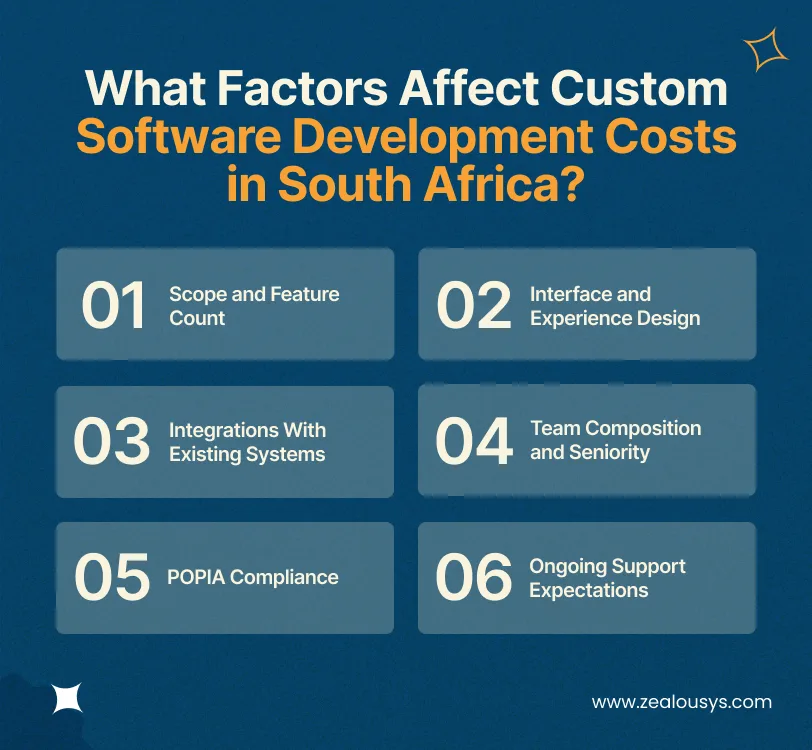
The number of distinct things your software does is the largest single cost driver.
A system with one user type and eight screens is a different animal from one with five roles, permission rules for each, and an admin layer on top. Every additional role multiplies testing effort, not just development effort.
Standard component libraries keep design costs low and work well for internal tools nobody needs persuading to use.
Customer-facing products usually justify proper user research and original interface design, which adds 10 to 15 percent to a project budget.
Connecting to a modern, well-documented API is routine work. Connecting to a twenty-year-old accounting package with no API, or to a bank’s payment infrastructure with its own certification process, is not.
Each integration needs scoping, building, error handling, and testing for when the other system is unavailable. Projects pulling data out of an older platform also carry data migration work, which is consistently underestimated. Messy legacy data often takes longer to clean than the new system takes to build.
Three mid-level developers cost less per hour than a team with an architect, but can cost more overall if the architecture needs rebuilding in year two.
Well-understood business software needs fewer senior hours than a product doing something genuinely new.
Any software handling personal data belonging to South African residents falls under the Protection of Personal Information Act, enforced by the Information Regulator of South Africa.
Consent capture, encryption at rest and in transit, deletion workflows, and audit logging all need to be designed in rather than added later. For a medium-sized business application, this adds roughly ZAR 40,000 to ZAR 100,000, and considerably more for fintech and healthcare systems facing additional standards. Our guide to POPIA compliance for software developers covers the specific requirements.
A system with next-business-day support costs less to run than one with a two-hour response guarantee and weekend cover.
Decide what you actually need before signing an SLA. Support terms shape annual cost more than most buyers expect.
Knowing where your money goes helps you spot a quote that has quietly skipped something.
| Stage | Share of Budget | What Happens |
|---|---|---|
| Discovery and Scoping | 8 to 12% | Requirements, technical approach, effort estimates |
| Interface and Experience Design | 10 to 15% | Wireframes, visual design, prototypes |
| Development | 50 to 55% | Backend, frontend, API integration work |
| Quality Assurance and Testing | 12 to 15% | Functional, security, and performance testing |
| Deployment and Handover | 5 to 8% | Environment setup, migration, training |
Two of these get cut when a vendor competes on price. Discovery gets compressed into a phone call, and testing gets folded into development time. Both cuts reappear later as change requests, which is how a ZAR 400,000 quote becomes a ZAR 700,000 project.
Maintenance sits outside the build budget entirely. Plan for 15 to 20 percent of the original cost each year, covering security patches, library updates, bug fixes, and small improvements. Application maintenance is not optional, because software left alone for two years becomes expensive to touch again.
The rates below reflect the South African market in 2026. Johannesburg and Cape Town sit at the upper end of each band, driven by fintech and offshore-facing firms competing for the same senior engineers.
| Role | Junior (ZAR/hr) | Mid-level (ZAR/hr) | Senior (ZAR/hr) |
|---|---|---|---|
| Backend Developer | 300 to 500 | 550 to 800 | 850 to 1,300 |
| Frontend Developer | 280 to 450 | 500 to 750 | 800 to 1,200 |
| Solution Architect | Not applicable | 800 to 1,100 | 1,100 to 1,600 |
| UI/UX Designer | 250 to 400 | 450 to 650 | 700 to 1,000 |
| QA Engineer | 200 to 350 | 380 to 550 | 600 to 850 |
| Project Manager | 350 to 500 | 550 to 750 | 800 to 1,100 |
Most South African agencies quote a blended rate of ZAR 750 to ZAR 1,100 per hour covering the whole team rather than pricing each role separately. When you compare proposals, check whether project management and QA sit inside that blended rate or arrive as separate line items.
The model you choose decides who carries the risk when the project turns out harder than expected.
You agree a scope and a number upfront.
This works when requirements are settled, such as replacing a system whose behaviour is already documented. Vendors price risk into fixed quotes, so you usually pay a premium of 15 to 25 percent for the certainty, and anything outside the agreed scope becomes a change request.
You pay for hours worked against an agile sprint plan.
This suits projects where you expect to learn things during the build, which describes most new products. You carry more risk but keep the ability to change direction without renegotiating. Ask for a not-to-exceed figure per sprint so the arrangement stays bounded.
You hire software developers as a fixed team on a monthly basis and direct their work yourself.
This is the most economical model for continuous product work over six months or more, and it removes per-change friction entirely. It only works if someone internally can prioritise weekly. It is usually delivered through an offshore development center or staff augmentation, where the team extends your own rather than operating separately.
South Africa occupies a genuine middle position, which is why UK and European buyers increasingly treat it as a nearshore option rather than a distant offshore one. Rates sit well below Western Europe and North America while remaining above the lowest-cost outsourcing markets. The country is English-first and works on GMT+2, which overlaps the European business day almost entirely.
| Region | Blended Rate (USD/hr) | Offset From SAST | Notes |
|---|---|---|---|
| South Africa | 45 to 70 | Same | POPIA familiarity, local payment gateways |
| India | 25 to 55 | +3.5 hours | Large talent pool, fast team scaling |
| Poland and Romania | 40 to 75 | -1 hour | Strong engineering, EU data rules |
| United Kingdom | 90 to 150 | -1 to -2 hours | Highest cost, closest fit for UK buyers |
| United States | 120 to 200 | -6 to -8 hours | Highest cost overall |
The offshore saving is real, usually 30 to 45 percent at blended rates. It is also smaller than offshore marketing tends to suggest, because the gap narrows sharply at the senior level.
Offshore works best when the engagement is large enough or long enough for the rate difference to compound. A twelve-month build with a team of six shows a meaningful saving. A six-week internal tool usually does not, because the fixed cost of getting an external team up to speed stays the same regardless of project size.
It also makes sense when you need capacity you cannot hire locally in a reasonable timeframe. South African demand for senior engineers in specific stacks routinely outpaces supply, and waiting four months to fill a role has its own cost.
Public sector contracts and large corporate tenders frequently carry B-BBEE procurement requirements that an offshore vendor cannot satisfy, which settles the question before cost enters it.
Work requiring on-site presence also favours a local team. If your build depends on shadowing warehouse staff, sitting with clinicians, or observing an undocumented process, remote discovery will miss things that in-person discovery catches. The same applies to short, urgent projects where a same-room workshop compresses two weeks of back-and-forth into an afternoon.
On builds under roughly ZAR 200,000, coordination overhead can cancel out the rate advantage entirely.
Bespoke software is not automatically cheaper than a licensed product. It depends on your seat count and how well the off-the-shelf option actually fits, and any vendor who says otherwise is selling.
Take a business application costing ZAR 900,000 to build, with maintenance at 17 percent and hosting at ZAR 60,000 a year, against a SaaS product at ZAR 450 per user per month with typical annual escalation.
| Users | SaaS Over 5 Years | Custom Over 5 Years | Better Option |
|---|---|---|---|
| 25 | ~ZAR 790,000 | ~ZAR 1,900,000 | SaaS, clearly |
| 60 | ~ZAR 1,900,000 | ~ZAR 1,900,000 | Roughly even |
| 150 | ~ZAR 4,700,000 | ~ZAR 1,900,000 | Custom, clearly |
The custom figure does not move because custom software has no per-seat licence. SaaS scales with headcount; custom does not. Below roughly 50 to 60 users, a licensed product almost always wins on pure cost. Above that, per-seat pricing compounds against you.
The calculation shifts further toward custom when the off-the-shelf tool needs heavy configuration, forces you to change a working process, or cannot do something your business depends on.
That last point is often decisive. Standard learning management systems assess learners on grades and merit, while the South African education system also evaluates against outcome criteria that vary per course. No licensed platform handled it, which is why one South African education provider commissioned a custom LMS for the South African education system with configurable assessment criteria and separate modules for training providers, facilitators, assessors, and moderators. The cost comparison never really applied, because the alternative did not do the job.
Most quotes cover building the software. Running it is a separate conversation, and these items catch people out.
Claims about AI-assisted development run well ahead of reality, so it is worth being specific about where the savings are real.
The gains sit in repetitive, well-defined work:
Together, these compress the development stage by roughly 15 to 30 percent.
Anything requiring judgement takes the same time it always did. Architecture decisions, modelling domain logic only your business understands, compliance design, integration debugging, and the discovery conversations that establish what should be built are all unchanged.
Since these dominate complex projects, a large enterprise build sees proportionally less benefit than a straightforward one.
AI-generated code that nobody reviewed properly produces technical debt faster than hand-written code, precisely because it arrives faster.
Teams using these tools well spend some of the saved time on stricter review. If a vendor quotes unusually low and credits AI, ask how their review process has changed.
This is a separate budget line entirely. AI software development involving model integration, retrieval systems, or custom training carries its own infrastructure and ongoing inference costs.
Six approaches that reduce spend without cutting the parts of a project that actually protect your budget.
Split the project into a first release that delivers real value and later phases that build on it. Phase one funds itself through use, and what you learn changes what you build next. This beats specifying everything upfront and being wrong about a third of it.
The most common budget failure is calling something an MVP while including every feature anyone requested. For each feature, ask whether the product proves its value without it. If yes, it belongs in phase two. Disciplined MVP development routinely cuts a first release by 40 percent with no loss of usefulness.
Compressing the discovery phase to save ZAR 60,000 reliably costs more than it saves. Requirements found during development cost several times more to accommodate than requirements found before it. Least intuitive item on this list, and the most reliable.
Authentication, payments, notifications, and reporting are solved problems. A vendor wanting to build these from scratch is spending your budget on work a proven library does better. Save custom development for what is specific to your business.
South African companies can claim a 150 percent deduction on qualifying research and development expenditure under Section 11D of the Income Tax Act. The incentive is administered by the Department of Science, Technology and Innovation, claimed through SARS, and runs until 31 December 2033.
Two things catch companies out. Approval must come from the DSTI before you claim, and only expenditure incurred from six months before your application date onward qualifies. Speak to your tax advisor before the work starts, not after the invoice.
If you have a system that works but is aging badly, a full rebuild is not always the answer. Application modernization can fix the specific problem, whether performance, integration, or interface, at a fraction of the cost.
Three proposals for the same project will rarely be comparable on price alone, because each one prices a slightly different project. Here is what to look at instead.
Ask every vendor to write down what they assumed about user numbers, integrations, data volume, and design effort. The cheapest quote is usually the one that assumed the least. Two proposals that differ by ZAR 500,000 often differ by three integrations nobody mentioned.
A blended rate that excludes project management, QA, and DevOps is not a blended rate. Ask which roles are covered and how many hours of each are in the estimate. This single question explains most of the gap between a cheap quote and an expensive one.
Compare each proposal against the stage breakdown earlier in this guide. If discovery is under 5 percent of the total, or testing is not costed separately, that work has not disappeared. It has been moved into your change request budget.
Every project has them. What matters is whether they are billed at the same rate as the original work or at a premium, and how quickly they get estimated.
A vendor who cannot answer this clearly is a vendor whose final invoice will surprise you.
Between ZAR 80,000 and ZAR 2,500,000 or more. Internal tools start around ZAR 80,000, MVP development costs run ZAR 250,000 to ZAR 600,000, business applications ZAR 450,000 to ZAR 1,200,000, and enterprise software development costs exceed ZAR 1,500,000.
Junior developers charge ZAR 280 to ZAR 500 per hour, mid-level developers ZAR 500 to ZAR 800, and senior developers ZAR 800 to ZAR 1,300. Solution architects reach ZAR 1,600. Most agencies quote a blended team rate of ZAR 750 to ZAR 1,100.
A custom CRM typically costs ZAR 450,000 to ZAR 1,200,000 depending on the number of user roles, sales pipeline complexity, and integrations with email, accounting, and telephony systems. ERP development costs sit at the top of that band and frequently above it, because an ERP touches finance, inventory, and HR at once.
An internal tool takes 6 to 10 weeks. An MVP takes 3 to 5 months. A business application takes 4 to 8 months. Enterprise systems with multiple integrations take 9 to 18 months. Decision speed on your side affects the timeline as much as team size does.
For a medium-complexity business application, POPIA compliance adds roughly ZAR 40,000 to ZAR 100,000 when built in from the start. Retrofitting it costs substantially more, and fintech or healthcare systems facing additional standards should budget higher.
Usually, by 30 to 45 percent at blended rates. Savings depend on project size and duration. Long engagements with well-defined scope show real savings. Short projects often do not, because coordination overhead offsets the lower rate.
Most business applications covering inventory, workforce, scheduling, or operations management fall between ZAR 450,000 and ZAR 1,200,000. Cost is driven by user role count and how many existing systems the application must connect to.
Custom software pricing in South Africa is wide because the work is genuinely variable, not because vendors are being evasive. The range runs from ZAR 80,000 for a focused internal tool to well past ZAR 2,500,000 for an enterprise platform.
Where you land depends on scope, integrations, compliance, and how clearly you can describe the problem before anyone starts building. Writing down what the software must accomplish, who will use it, and what it must connect to will do more for your budget than any negotiation.
Zealous System is a custom software development company working with startups, SMEs, and enterprises across South Africa’s ICT sector. We scope and build custom software for web, mobile, and AI-driven platforms, including digital product development, ERP software development, and SaaS application development. If you would like a costed estimate against your actual scope rather than a generic range, get in touch with our team.
Our team is always eager to know what you are looking for. Drop them a Hi!

Nandini Pare is a CAPM® Certified Business Analyst at Zealous System, specializing in business analysis, Agile delivery, and helping organizations build technology solutions that solve real business challenges.


Comments