Building a mobile app in South Africa costs between ZAR 80,000 and ZAR 2,000,000 or more depending on complexity, platform choice, and compliance requirements. A basic MVP app costs ZAR 80,000 to ZAR 250,000. A medium-complexity app with payment gateways and third-party integrations costs ZAR 250,000 to ZAR 900,000. An enterprise-grade or AI-powered app starts at ZAR 900,000. Senior developer hourly rates range from ZAR 600 to ZAR 1,200 per hour, while junior developers charge ZAR 300 to ZAR 500 per hour. Ongoing maintenance typically adds 15 to 20 percent of the initial build cost per year.
South Africa has one of Africa’s most dynamic mobile technology markets, and demand for custom mobile apps is growing fast. Whether you are a startup founder testing your first product, an SME looking to digitize operations, or an enterprise building customer-facing software, one of the first questions you will face is: how much does it actually cost to build a mobile app in South Africa in 2026?
This guide gives you a ground-level answer based on real project data from the South African development market. You will find specific cost ranges in South African Rand, developer hourly rate benchmarks, a full breakdown by app type and platform, and a transparent look at POPIA compliance costs and ongoing maintenance expenses that most guides overlook.
Rather than vague estimates, this guide helps you arrive at a realistic budget before you talk to a single vendor.
Read on to get a clear budget roadmap and a simple checklist to share with vendors. Use the cost ranges and questions in this post to compare proposals and pick the right partner for your app.
Mobile is the primary internet access channel in South Africa. Android devices dominate with more than 70 percent of smartphone market share nationally, which means Android-first or cross-platform strategies make strong practical sense for most projects. iOS usage is concentrated in higher income urban segments, particularly in Johannesburg, Cape Town, and Pretoria.
South African app development studios have matured considerably in recent years. Johannesburg and Cape Town host the largest clusters of professional mobile developers, with a growing talent base in Durban and Pretoria. South African rates sit below Western European and North American benchmarks, but above Southeast Asian outsourcing hubs, placing the country in a quality-to-cost sweet spot that appeals to both local businesses and international clients who want proximity to GMT time zones.
POPIA, the Protection of Personal Information Act, is now fully in force and carries significant penalties for non-compliant apps. Any app that collects, stores, or processes personal data from South African residents must meet POPIA requirements. This compliance layer adds meaningful cost to projects in fintech, healthcare, e-commerce, and HR tech, and must be budgeted from the start rather than retrofitted later.
The table below gives you a fast reference for the three main project tiers. USD equivalents are based on an approximate ZAR 18.50 to USD 1 exchange rate as of mid-2026.
| App Type | ZAR Cost Range | USD Equivalent | Timeline |
|---|---|---|---|
| Simple MVP | ZAR 80,000 to 250,000 | USD 4,200 to 13,500 | 4 to 10 weeks |
| Medium Complexity | ZAR 250,000 to 900,000 | USD 13,500 to 48,000 | 3 to 6 months |
| Enterprise / AI | ZAR 900,000 to 2,000,000+ | USD 48,000 to 110,000+ | 6 to 18 months |
These ranges assume a South African development team. International offshore teams may shift the cost in either direction depending on location and skill level.
A simple MVP development is the right starting point for most new products. The goal is to build only the features needed to validate your idea and attract your first users, without spending money on functionality you have not yet proven users want.
What a Simple App or MVP Typically Includes:
Simple MVP apps in South Africa cost between ZAR 80,000 and ZAR 250,000. A very lean single-screen utility app can come in at the lower end. A more complete MVP with three to five features and both iOS and Android builds will sit closer to ZAR 200,000 to ZAR 250,000.
Startup founders testing product-market fit, SMEs building a simple internal tool, businesses replacing a paper process with a basic digital solution, or entrepreneurs who want to launch quickly and iterate based on real user feedback.
Four to ten weeks for a well-scoped MVP with a dedicated two to three person team.
A medium-complexity app has a larger feature set, requires backend infrastructure, and integrates with external services. This tier covers the majority of commercial app projects in South Africa including e-commerce apps, booking platforms, and business productivity tools.
What Medium-Complexity Apps Typically Include
Medium-complexity apps cost between ZAR 250,000 and ZAR 900,000. Payment integrations, real-time features, and multi-role access control each add meaningfully to development time. A well-built cross-platform app using Flutter or React Native at this tier typically lands between ZAR 350,000 and ZAR 600,000.
Product managers and SME owners who need customer-facing apps with e-commerce or booking functionality. Also suitable for businesses digitizing a service that requires scheduling, payments, and user accounts.
Three to six months with a team of four to six developers, a designer, and a QA engineer.
Enterprise apps involve custom architecture, advanced technology integration, strict security requirements, and ongoing scalability planning. These projects are typically multi-phase and require close collaboration between the development team and business stakeholders.
Enterprise apps start at ZAR 900,000 and can exceed ZAR 2,000,000 for large-scale consumer platforms or systems with complex infrastructure requirements. CTOs and procurement teams should plan for phased delivery to manage risk and align costs with business milestones.
Large organizations, CTOs building product platforms, fintech companies, healthcare providers, and businesses replacing legacy systems with modern mobile-first solutions.
Six to eighteen months depending on scope, with a full team including architects, senior developers, a dedicated UX designer, QA engineers, and a project manager.
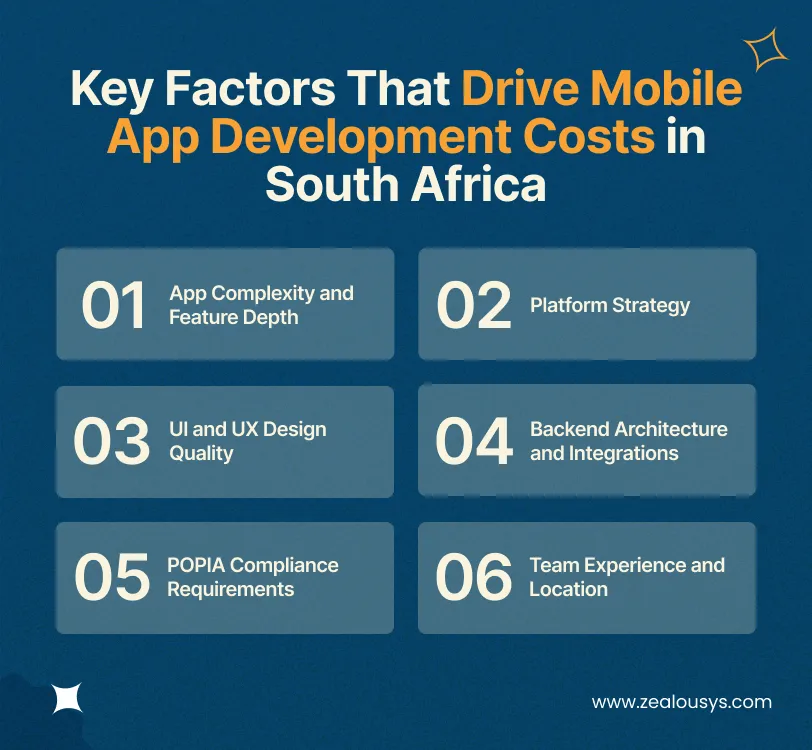
Understanding what actually moves the price is more useful than a single headline number. The following factors explain why two apps that look similar in scope can have very different price tags.
The biggest cost variable is what the app actually does. Login and content display take days to build. Real-time data synchronization, offline-first architecture, or computer vision features can each add weeks of development. The number of user roles, the complexity of business rules, and the number of screens all multiply development time.
Building native iOS and Android apps separately is the most expensive approach because it requires two distinct codebases, two sets of tests, and platform-specific expertise in Swift and Kotlin. Cross-platform frameworks such as Flutter and React Native reduce this cost significantly by sharing a single codebase across both platforms. For most South African projects, Flutter has emerged as the most popular cross-platform choice in 2026 due to its performance, design flexibility, and strong community support.
| Platform Approach | Estimated Cost Range | Best For |
|---|---|---|
| Native iOS only | ZAR 150,000 to 600,000 | Swift, best performance |
| Native Android only | ZAR 120,000 to 500,000 | Kotlin, largest SA user base |
| Both Native (iOS + Android) | ZAR 250,000 to 1,100,000 | Best UX, highest cost |
| Flutter (cross-platform) | ZAR 100,000 to 500,000 | One codebase, fast delivery |
| React Native (cross-platform) | ZAR 100,000 to 480,000 | Strong JS ecosystem |
| Role | Junior (ZAR/hr) | Mid-level (ZAR/hr) | Senior (ZAR/hr) |
|---|---|---|---|
| iOS / Android Developer | ZAR 300 to 450 | ZAR 500 to 750 | ZAR 800 to 1,200 |
| Flutter / React Native Dev | ZAR 280 to 420 | ZAR 480 to 700 | ZAR 750 to 1,100 |
| Backend / API Developer | ZAR 300 to 500 | ZAR 550 to 800 | ZAR 850 to 1,200 |
| UI/UX Designer | ZAR 250 to 400 | ZAR 450 to 650 | ZAR 700 to 1,000 |
| QA / Test Engineer | ZAR 200 to 350 | ZAR 380 to 550 | ZAR 600 to 850 |
| Project Manager | ZAR 350 to 500 | ZAR 550 to 750 | ZAR 800 to 1,100 |
The Protection of Personal Information Act is South Africa’s primary data privacy law. Unlike a bolt-on addition, POPIA compliance must be designed into the app architecture from the beginning. Apps built without compliance in mind often require expensive rework to meet requirements, and the legal exposure from non-compliance far exceeds the cost of building it right the first time.
| POPIA Compliance Item | Estimated Cost |
|---|---|
| Consent and opt-in screens | ZAR 8,000 to 20,000 |
| Data encryption at rest and in transit | ZAR 15,000 to 40,000 |
| User data deletion (right to erasure) | ZAR 10,000 to 25,000 |
| Privacy policy and terms integration | ZAR 5,000 to 12,000 |
| POPIA legal review and audit | ZAR 20,000 to 60,000 |
| Ongoing compliance maintenance per year | ZAR 15,000 to 40,000 |
For most medium-complexity apps, building POPIA compliance into the initial project adds ZAR 40,000 to ZAR 100,000 to the total cost. For enterprise healthcare or fintech apps, this figure can be significantly higher, particularly when combined with ISO 27001 or PCI DSS requirements.
The launch cost is only part of the total investment. Most businesses underestimate the ongoing costs required to keep an app running, updated, and competitive.
| Ongoing Cost Item | Typical Cost | Notes |
|---|---|---|
| App Store fees (Apple) | ZAR 1,680 per year | One-time registration plus annual |
| Google Play Store | ZAR 470 once-off | No annual fee |
| Cloud hosting (AWS / Azure) | ZAR 2,000 to 15,000/month | Scales with user traffic |
| Third-party APIs and services | ZAR 1,000 to 8,000/month | Payment, maps, SMS, email |
| App maintenance and updates | 15 to 20% of build cost/year | Bug fixes, OS updates |
| QA and regression testing | ZAR 20,000 to 80,000/year | Critical after major updates |
| Marketing and ASO | ZAR 15,000 to 100,000+ | App store optimization |
A realistic rule of thumb is to budget an additional 15 to 20 percent of your initial build cost per year for maintenance, updates, and hosting. An app built for ZAR 400,000 will therefore cost roughly ZAR 60,000 to ZAR 80,000 per year to maintain properly. This figure rises if you plan to release major new features regularly.
The most reliable way to control cost is to define your minimum viable product precisely before development starts. Write user stories for every feature and challenge each one with the question: is this needed to prove the core value of the app? Features that do not meet that bar should be saved for a future phase. A tightly scoped MVP costs less, launches faster, and gives you real market data before you commit to a larger investment.
Unless your technical requirements specifically demand native development, choosing Flutter or React Native for cross-platform delivery will reduce your build cost by 25 to 40 percent compared to building separate native apps. Most business apps do not require native-only capabilities, and the user experience from mature cross-platform frameworks is now excellent.
Rather than commissioning a full project at a fixed price with poorly defined scope, experienced product teams often prefer agile delivery with defined sprint budgets. Each two-week sprint has agreed deliverables and a capped cost. This structure gives you the flexibility to adjust scope based on real progress, reduces the risk of scope creep, and lets you pause or redirect the project if business priorities change.
Retrofitting compliance into an existing app is significantly more expensive than building it correctly from the start. Every privacy and security requirement should be part of the initial technical design, not an afterthought. Your development brief should explicitly state POPIA compliance as a project requirement from day one.
Factor your annual app maintenance budget into your business case before you approve the initial build. An app with no budget for updates will decay quickly as operating systems change and user expectations evolve. Maintenance contracts with South African agencies typically range from ZAR 15,000 to ZAR 50,000 per month depending on scope and response time requirements.
Ask each vendor for a detailed scope document, a feature list with individual estimates, and a team composition breakdown showing who will work on your project and at what rate. Comparing proposals at this level of detail reveals differences in assumptions that a headline price comparison would miss entirely.
A basic MVP costs between ZAR 80,000 and ZAR 250,000. A medium-complexity business app costs ZAR 250,000 to ZAR 900,000. An enterprise or AI-powered app starts at ZAR 900,000 and can exceed ZAR 2,000,000. Developer hourly rates range from ZAR 300 for junior developers to ZAR 1,200 for senior specialists.
Both Flutter and React Native are cross-platform frameworks that cost significantly less than building separate native iOS and Android apps. Flutter has a slight edge for apps requiring complex custom UIs, while React Native is preferred when your team already has strong JavaScript experience. In practice, the cost difference between the two frameworks is smaller than the difference between either and native development.
Yes. Any app that collects, processes, or stores personal data from South African residents must comply with POPIA. Building POPIA compliance into a medium-complexity app typically adds ZAR 40,000 to ZAR 100,000 to the project cost. The exact amount depends on how much personal data the app handles and which industries it serves. Healthcare and fintech apps face the highest compliance requirements.
A simple MVP takes four to ten weeks. A medium-complexity app takes three to six months. An enterprise app takes six to eighteen months. Timeline depends on team size, the clarity of requirements at the start, and how quickly decisions are made during development.
Local South African development companies offer time zone alignment, in-person meetings, knowledge of the local market and regulatory environment, and accountability under South African law. Offshore teams in countries like India or Eastern Europe can offer lower hourly rates but require more structured communication and may lack specific knowledge of POPIA, local payment gateways, or South African user expectations. For apps targeting South African users with compliance requirements, local or nearshore development typically delivers better outcomes.
The lowest-cost path to a working app is a cross-platform MVP using React Native or Flutter, scoped to a single core use case, built Android-first given local market share, and delivered by a well-structured team with clear sprint-based milestones. Using no-code or low-code tools is cheaper still for simple use cases, but these platforms have significant limitations for custom functionality, payment processing, and POPIA compliance.
Ongoing mobile app maintenance in South Africa typically costs 15 to 20 percent of the original build cost per year. For an app built at ZAR 400,000, expect ZAR 60,000 to ZAR 80,000 annually for bug fixes, OS compatibility updates, security patches, and minor feature improvements. Hosting and third-party API costs are additional and depend on your user volume.
The most accurate way to get a reliable quote is to produce a one-page product brief that describes your target users, the core problem the app solves, the three to five essential features, the platforms you need to support, and any compliance requirements. Share this with three vendors and ask each for a detailed feature-by-feature estimate, a proposed team structure, and a timeline. Compare the scope of work assumed in each proposal rather than just the headline price.
The cost to develop a mobile app in South Africa in 2026 depends on many factors, including app complexity, platform choice, backend integrations, and compliance with regulations like POPIA. A simple MVP costs far less than a complex enterprise solution, but both require clear planning and the right mobile app development company.
For startup founders, SME owners, or entrepreneurs testing a new idea, building a focused MVP is the most cost-effective way to enter the market. Product managers, CTOs, and procurement teams can control budgets by comparing South Africa mobile app development rates, asking to hire mobile app developers for fixed-price or hourly projects, and prioritizing features that deliver the most value.
Investors and consultants assessing projects should also factor in mobile app maintenance costs in South Africa, as ongoing updates, hosting, and security remain part of every app’s lifecycle. Whether you choose native or cross-platform development, the key is to balance cost, quality, and long-term scalability with the help of a trusted app developer in Johannesburg or a reliable app developer in Cape Town.
By understanding app development pricing in South Africa in 2026 and working with an experienced team, businesses can launch apps that meet user needs, stay compliant, and grow sustainably. The best way to start is with a clear cost estimate, a simple MVP, and a dependable mobile app development company that can help you scale as demand increases.
Our team is always eager to know what you are looking for. Drop them a Hi!

Raj Kewlani is a Project Manager and Mobile & Open Source Development Lead at Zealous System, specializing in agile-driven digital solutions. He focuses on delivering high-quality mobile apps and open-source projects that align with business goals.


Comments