Your AI pilot probably worked. The demo answered questions correctly, the steering committee liked what it saw, and the budget got approved. Then the project hit the part nobody demoed, and months later it still isn’t part of anyone’s daily work. That stretch between demo and daily use is where forward deployed engineering does its job.
The obstacles in that stretch are rarely about the model. In 2024, Gartner predicted that at least 30% of generative AI projects would be abandoned after proof of concept by the end of 2025, citing poor data quality, inadequate risk controls, escalating costs, and unclear business value. None of those reasons is “the AI wasn’t smart enough.”
Forward deployed engineering closes that gap by changing who does the work and where. Instead of building a pilot and handing it over, engineers work inside your environment, with your data and your users, and stay accountable until the system runs in production. For background on the role itself, here’s what a forward deployed engineer does day to day.
If you’re working out how to move AI from pilot to production, start with where pilots actually get stuck. Then use the checklist further down to see how close your own project is.
A pilot answers one question: can this work? Production asks a harder one: can this work every day, for every user, on real data, inside the systems the business already runs? Most AI pilot-to-production challenges come from the distance between those two questions.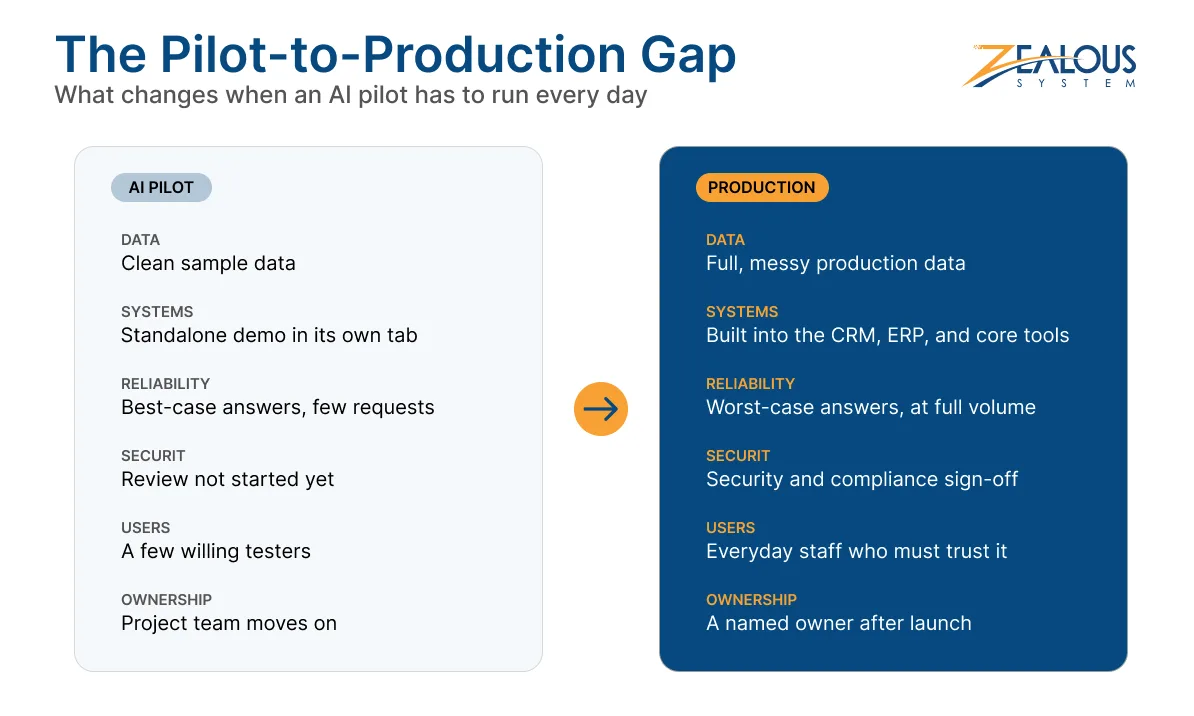
Pilots often run on a clean extract, a few thousand records someone prepared by hand. Production data looks nothing like that. It carries years of history: records entered by different teams under different rules, fields repurposed along the way, and key details buried in PDFs, emails, and scanned forms.
A model that looked accurate on the sample often slips once it meets the full, unfiltered dataset. And fixing the data is rarely a quick job.
An AI tool that lives in its own browser tab rarely stays in use for long. People work in the CRM, the ERP, the claims platform, the warehouse system, or the MES on the factory floor. If the AI output doesn’t show up there, adoption depends on people remembering to switch windows. Most don’t.
Connecting to older systems also brings undocumented APIs, overnight batch jobs, access approvals, and change boards. Pilot teams rarely scope this work, because the demo didn’t need it.
A demo is judged on its best answers. Production is judged on its worst ones.
Once real users arrive, you need to know how the system behaves on edge cases, how often it’s wrong, and what happens when it is. Cost and latency matter too. A response time and cost per request that looked fine for 20 test users can look very different at thousands of requests a day.
In fintech and healthcare especially, a pilot can run for months before anyone asks where customer or patient data goes when it’s sent to a model. When the security review finally starts, it can force architecture changes: data residency rules, stricter access controls, audit logs, or a move to a private LLM for enterprise applications.
Finding those requirements after the build is one of the most expensive ways to lose time.
Even a well-built system fails if people quietly go back to their spreadsheets. Experienced staff are right to be skeptical of outputs they can’t check.
If the AI can’t show why it made a recommendation, or nobody asked users how they actually work, usage will fade soon after the launch announcement.
This is the problem that ties the others together. In the common build-and-handoff model, a vendor or innovation team builds the pilot, presents it, and moves on to the next project.
Integration, data cleanup, monitoring, and training then fall to teams who didn’t build the system and weren’t budgeted for it. Nobody owns the path to production, so the pilot sits in limbo: never officially cancelled, never actually live.
The forward deployed engineering model changes who is responsible for that path. Engineers work inside the client’s environment, next to the people who will use the system. Their work is measured by one outcome: whether the system runs in daily operations.
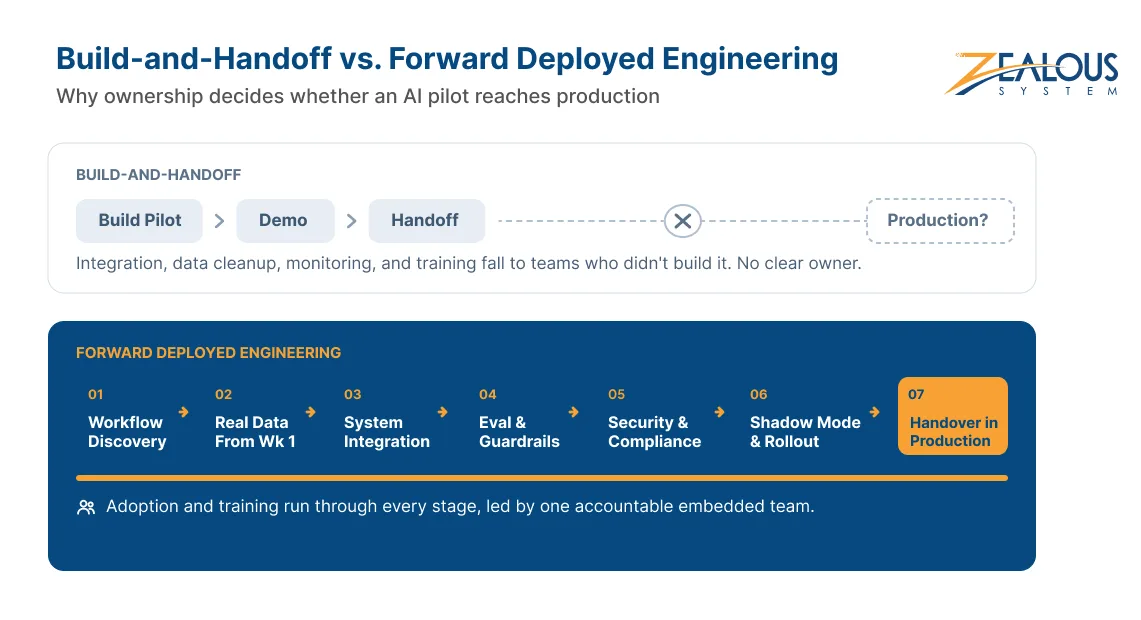
Here’s how that plays out across the problems above.
The first weeks go into understanding how the work actually happens. That means shadowing the people who do the job, tracing each handoff, and spotting where information arrives late or incomplete. What the team learns frequently reshapes the original request.
A logistics team asking for AI to predict delivery delays may find that carrier status updates arrive hours late, and no model can predict around missing data. Discovery is also where success metrics get defined, so “done” means something measurable, such as hours saved per case or fewer manual reviews. Those same numbers become the ROI case for leadership.
Forward deployed engineers build against production data, with production access controls, from the start. Data gaps show up early, while there’s still time to plan around them.
When the data needs more than cleanup, such as consolidating records scattered across old systems, that work gets scoped into the project. Sometimes it calls for dedicated data migration services before the AI work can go further.
The team wires AI output into the places decisions already happen: a field in the CRM, a flag in the ticketing queue, a suggestion on the ERP screen. SaaS teams face a version of this inside their own product, and this guide on how to integrate generative AI into your existing product covers that side in detail.
Much of this is the unglamorous side of AI integration services: authentication, data mapping, error handling, and retries when an older system times out. In the forward deployed engineering model, the same engineers who build the AI also own these connections, so nothing falls between teams.
Before launch, the team builds test sets from real cases, including the awkward ones. They agree on accuracy thresholds with the business, decide which outputs need human review, and define what the system does when its confidence is low.
For generative AI, this also covers prompt injection, invented references, and answers that drift outside the approved scope.
Because the engineers work inside your environment, security and compliance teams join from the first week. In healthcare, that can mean designing around patient privacy rules before you integrate AI with existing EHR/EMR systems. In fintech, it often means an audit trail for every automated decision.
The architecture is designed around those rules from day one, so a late review doesn’t send the team back to rebuild.
The AI first runs alongside the existing process, with no single switch-over date. Its outputs are compared against the decisions people actually made, without touching live operations.
Once the results hold up, automation starts with low-risk cases and expands in stages. The business gets evidence before anything important depends on the system.
Forward deployed engineers see how users react as it happens. If people ignore a recommendation because it arrives too late in their workflow, the team moves it earlier. If they don’t trust a score, the team surfaces the reasoning behind it.
Training happens throughout the build, so adoption doesn’t hinge on a single onboarding session after launch.
The engagement ends with a named internal owner, documentation, monitoring dashboards, and runbooks for common failures. Some companies keep a smaller forward deployed engineering team for ongoing improvement, while others hand everything to their internal engineers.
Either way, the system has someone responsible for it after launch, which is exactly what the handoff model was missing.
There’s no honest single number. A 2024 Gartner survey of organizations in the U.S., Germany, and the U.K. found that only 48% of AI projects make it into production, and moving from AI prototype to production takes 8 months on average.
Your own AI pilot-to-production timeline could be much shorter or much longer. These are the factors that decide it:
| Factor | Why It Adds Time | What Shortens It |
|---|---|---|
| Data Readiness | Cleaning, merging, and getting access to real data often takes longer than building the AI | Auditing data sources in the first two weeks |
| Integration Depth | Every connected system brings its own APIs, approvals, and failure modes | Starting with one or two high-value integrations |
| Compliance Requirements | Regulated data can trigger architecture changes, reviews, and sign-offs | Bringing security and compliance into discovery |
| Evaluation Standards | High-stakes decisions need more testing and stricter review rules | Agreeing on accuracy thresholds before the build |
| Scope | Several use cases in parallel multiply every factor above | Proving one use case in production before adding more |
| User Adoption | Resistance leads to rework and delays full rollout | Involving end users from the first prototype |
Whatever the duration, most projects move through the same sequence:
A single, narrow use case with clean data and one integration can move through these stages quickly. A multi-workstream program takes far longer. The retail project later in this article, for example, scaled four AI workstreams across the business over 18 months.
Building an agent in a sandbox is the easier part of AI agent development. Letting it act on live systems is where the stakes rise. A chatbot that gets something wrong gives a bad answer. An agent that gets something wrong can update a record, send an email, or trigger a refund.
Gartner expects over 40% of agentic AI projects to be canceled by the end of 2027 due to escalating costs, unclear business value, or inadequate risk controls. Many of those risks only appear once an agent leaves the demo environment.
Before an agent goes live, settle these:
This is where embedded engineers are especially useful. Permissions, business rules, and approval chains are specific to each company, and they only become clear from inside its systems. If you’re still deciding where agents belong in your operations, this overview of agentic AI workflows covers the use cases where they tend to pay off.
Use this before any go-live decision. Not every project needs the same depth on each item. A customer-facing agent in a regulated industry needs far more than an internal summarization tool. But if you can’t answer one of these questions, start there. A system counts as production-ready AI only when every row has a clear answer.
| Area | Question to Answer Before Launch |
|---|---|
| Business Case | Is there a measurable success metric, agreed with the business owner? |
| Data | Has the system been tested on full production data, with access permissions reviewed? |
| Integration | Does the output appear inside the tools people already use, and are integration failures handled? |
| Evaluation | Has it been tested against real cases, including edge cases, with an agreed accuracy threshold? |
| Human Oversight | Is it clear which outputs or actions need human review? |
| Security and Compliance | Have security, privacy, and regulatory reviews been signed off? |
| Monitoring | Are accuracy, latency, cost, and usage tracked after launch? |
| Failure Handling | Is there a fallback and escalation path when the system is wrong or unavailable? |
| Adoption | Have end users tested it, and is training planned? |
| Ownership | Is a named person responsible for maintenance and improvement? |
Forward deployed engineering isn’t the right answer for every AI project. It earns its cost when the gap between pilot and production is wide.
It’s a strong fit when:
It’s probably more than you need when:
A forward deployed engineering team is usually small. A typical setup includes a lead engineer with architecture experience, engineers who handle data and integration work, and an ML or LLM specialist for evaluation. On your side, they need a business owner who can make decisions quickly, because slow decisions can stall an embedded team as easily as technical problems can.
A U.S. omnichannel retailer with more than 180 stores and a growing e-commerce business came to Zealous System with four connected problems. Inventory was planned on spreadsheets and instinct. Marketing spend kept rising while returns shrank. Store staffing depended on each manager’s judgment. And customer service was overloaded with repetitive queries.
The way the project ran mirrors the forward deployed engineering approach described above.
The team mapped operations across all 180 stores, the e-commerce platform, and the marketing and service workflows. The goal was to find where data lived, where it broke down, and where the biggest losses occurred. Each problem became its own workstream, with success metrics and data dependencies defined before development began.
Data quality turned out to be far worse than expected, with duplicate customer records and missing sales data across dozens of stores. Cleaning and unifying it became a major part of the project. The result was a single platform holding five years of sales, customer, and behavioral data.
Experienced buyers were hesitant to trust AI demand forecasts, which is a reasonable reaction from people whose jobs depend on getting stock right. Adoption improved once the system’s reasoning was made transparent. The team also kept refining the balance between automation and human control, so staff could step in whenever needed.
Every solution went through A/B tests and pilots in a subset of stores and customers, measured against real business metrics. Pilots that hit their targets were scaled across the business over the 18-month program. The labor scheduling tool was built into the retailer’s existing software rather than launched as a separate app.
Forecast accuracy rose from 61% to 79%, and marketing ROI improved by 31% on the same budget. The full retail AI demand forecasting case study covers the technology stack and each workstream in detail. If you’re weighing a similar project, this guide to AI demand forecasting software explains how these systems are built.
Any team that owns the full path: data, integration, evaluation, security, rollout, and adoption. That can be an internal team with production AI experience, an external partner that embeds engineers in your environment, or a mix of both. What matters is that one team stays accountable until the system runs in daily use.
AI consulting often focuses on strategy, use case selection, and roadmaps. Forward deployed engineering produces working software inside your systems and stays until people use it. Many companies need both: AI consulting services to pick the right use cases, and forward deployed engineering to ship them.
Parts of it can usually be reused, such as the use case definition, prompts, evaluation examples, and sometimes the model choice. What typically needs rebuilding is everything around the model: data pipelines, integrations, access controls, and monitoring. A short technical audit will show which parts will hold up in production.
No. Mid-market companies can benefit just as much, because they often have complex workflows but smaller internal AI teams. The engagement can be sized down to a small team focused on one high-value use case.
A proof of concept tests whether an idea is technically possible, usually on sample data. A pilot tests it with real users in a limited setting, such as one team or a few locations. Production means the system runs as part of daily operations, with full data, integrations, monitoring, security controls, and a named owner. Moving from AI POC to production means closing every gap between those stages.
A working demo proves an idea. Getting AI into production takes different work: real data, real integrations, security sign-off, users who trust the output, and someone who owns the system after launch. Forward deployed engineering puts all of that in one team’s hands, inside your environment, from the first week.
For companies evaluating forward deployed engineering services, this is the kind of work we do at Zealous System: turning stalled pilots into working systems. As an AI software development company, we build the parts a pilot usually leaves out: production data pipelines, system integrations, evaluation, and staged rollouts. If your pilot has stalled, a close look at where it’s stuck is usually the fastest way to find the path forward.
Our team is always eager to know what you are looking for. Drop them a Hi!

Ruchir Shah is Technology Head at Zealous System with hands-on expertise in AI/ML, Microsoft Azure, .NET, Node.js, Python, React, and Angular. He leads enterprise software development, champions digital transformation, and mentors developers building the future of intelligent apps.


Comments