The headline number in a legacy modernization cost estimate usually covers the build. The data cleanup, the weeks of running two systems side by side and the old servers still billing after go-live often sit outside it. Those costs reach the buyer’s budget after the contract is signed, when there’s little room left to negotiate.
A complete estimate prices every activity needed to move from the old system to a stable new one, including the work after go-live. Before you compare a single number, check that each proposal covers these 10 areas:
1. Discovery and system assessment
2. Architecture and target design
3. Code conversion or rebuild
4. Data migration
5. Integrations and APIs
6. Testing and security
7. Infrastructure, cloud and licensing
8. Cutover and parallel run
9. Training, documentation and knowledge transfer
10. Post-launch support and legacy decommissioning
Doing nothing isn’t free either. The U.S. federal government spends over $100 billion a year on IT, and agencies have typically reported putting about 80 percent of it into operating and maintaining existing systems, according to the Government Accountability Office. Private companies rarely publish figures like this, but teams running decades-old .NET Framework, Java EE, VB6 or COBOL applications will know the pattern well. Modernizing is how they break it, provided the contract accounts for the full cost from the start.
Most vendor quotes are detailed on the build and thin on everything around it. That imbalance is where budgets break. Your job is to make the thin parts visible before you sign, and the simplest way is to hand every vendor the same list and ask them to price each row or explain why it doesn’t apply.
The table below works as a legacy modernization RFP checklist. Attach it to your RFP and you’ll get quotes you can actually compare.
| Cost line item | What it should cover | Evidence to request | Red flag in the quote |
|---|---|---|---|
| Discovery and assessment | Code discovery and inventory, dependency map, business-rule extraction, scope boundaries | Assessment deliverables and timeline | Fixed price issued without anyone reviewing the system |
| Architecture and target design | Target stack and the reasoning behind the chosen approach | Architecture document with decision rationale | Approach picked before discovery |
| Code conversion or rebuild | Modules, features and code changes in scope | Module-by-module scope list | “Modernize application” as a single line |
| Data migration | Cleansing, mapping, trial runs, reconciliation, rollback | Migration plan with sign-off criteria | One undetailed migration line |
| Integrations and APIs | Every connected system and who tests each interface | Integration inventory | Integrations marked “client-owned” with no interfaces named |
| Testing and security | Regression, performance and security testing, UAT support | Test strategy and coverage targets | No testing effort or owner named |
| Infrastructure, cloud and licensing | Environments, third-party licenses, running costs during transition | Environment list and license schedule | Hosting and licenses excluded |
| Cutover and parallel run | Deployment, parallel-run window, backups, rollback plan | Cutover runbook with parallel-run duration | No transition plan at all |
| Training and knowledge transfer | User training, documentation, handover to your team | Deliverables list and session count | Client responsibilities left vague |
| Support and decommissioning | Hypercare, warranty, SLAs, archiving and retiring the old system | Support terms and decommissioning plan | Project ends at go-live |
Three of these rows are the ones most often priced too thinly, or left out altogether.
Discovery is often the first line cut from a quote, because it adds time before the build starts. Yet it is the only reliable way to price a system nobody fully understands anymore. Legacy applications carry years of business rules that live in code, not in documentation.
When Zealous System re-engineered the reporting module of a legacy e-learning system for a New Zealand university, one of the biggest challenges had little to do with writing new code. It was working out how data flowed through the old system and what each field meant for reporting. That took a multi-week site visit, a scope document and client-approved wireframes before development began. A quote that skips this step is guessing.
Data migration is where many legacy system migration cost estimates fall apart. Vendors often price the transfer and ignore the cleanup. Ask for trial migrations, reconciliation reports and a clear sign-off point, because “data moved” and “data correct” are two different milestones.
If your data sits across several databases or formats, it’s worth reviewing how specialist data migration services scope the work before you accept a single-line estimate.
Very few quotes mention switching the old system off. Until it’s retired, you keep paying for its servers, licenses and the people who know how to keep it running. Regulated industries such as BFSI and healthcare also need archived records kept accessible for years, which means storage, access controls and retrieval have a cost of their own.
Not every missing cost is a trap. Some exclusions are perfectly fair, and treating them all as gaps will only slow down negotiations. The useful skill is telling the three types apart.
| Type | What it means | Example | How procurement should handle it |
|---|---|---|---|
| Legitimate exclusion | Genuinely outside the vendor’s scope | Your internal SSO or network setup | Budget for it internally |
| Allowance | A real cost whose size isn’t known yet | Data cleansing before the data is profiled | Ask for an estimated range and the trigger that will confirm it |
| Gap | A cost the vendor should have priced | Regression testing | Request a revised quote |
With that lens in place, these are the legacy modernization hidden costs that most often slip through, along with the contract terms that keep each one under control.
Old systems hide rules nobody remembers writing: a discount applied on the third Tuesday, a field that triggers a compliance report. Each one found mid-project becomes a change request.
Contract fix: Fund discovery as its own phase, then re-baseline the price for the build once findings are in.
Duplicates, broken references and fields reused for different purposes over the years are normal in legacy databases. Legacy data migration cost depends heavily on how much of this exists, and nobody knows until the data is profiled.
Contract fix: Price a data-quality assessment as a separate line, and treat cleansing as an allowance with an agreed rate.
During cutover, you run the old and new systems side by side. That means two sets of infrastructure, two sets of licenses and often double data entry for your staff. The same overlap shows up when teams add AI on top of older platforms, a pattern covered in detail in this piece on AI legacy system integration.
Contract fix: Define the parallel-run window in weeks, list what runs during it and assign each cost to a party.
Your subject matter experts will spend hours in workshops, reviews and user acceptance testing. That time rarely appears in a vendor quote, yet it pulls people away from their day jobs.
Contract fix: Ask the vendor to estimate client-side hours by role in the statement of work, so you can plan for them.
Scope will move. The question is what each change costs when it does. Without agreed rates, every change becomes a fresh negotiation that you have little power to win mid-project.
Contract fix: Fix change-control rates and the approval process upfront, including who can sign off and at what value.
Proprietary conversion tools, undocumented frameworks and vendor-hosted environments can make it expensive to switch partners later. That exit cost is real even if you never pay it.
Contract fix: Secure ownership of source code, documentation and tooling outputs, and agree on exit and handover terms before signing.
The pricing model decides who carries the risk of the unknown, and it shapes your final legacy modernization cost as much as the scope does. In the fixed price vs time and materials modernization debate, both sides have a point, and neither works well alone for most legacy projects.
| Model | Best for | Risk sits with | Budget predictability | Watch-outs |
|---|---|---|---|---|
| Fixed price | Well-documented systems with stable scope | Vendor, who prices it in as a premium | High | Padded quotes and disputes over every change |
| Time and materials | Unclear scope or shifting requirements | Client | Low | Needs strong governance and spending caps |
| Phased hybrid | Most legacy projects | Shared | Medium to high | Requires clear gates between phases |
A fixed price on an unexplored legacy system forces the vendor to guess, and guesses get padded. Pure time and materials, on the other hand, leaves finance without a number to plan around.
A phased hybrid solves both problems. Start with a fixed-price discovery phase. Then price the build module by module, either as fixed price or capped time and materials, using what discovery revealed. Each phase ends with a gate where you can review, re-scope or stop.
A 2026 BCG analysis of AI-based IT modernization notes that budgets on large programs sometimes expand two to four times. Phase gates are how you catch that drift early, while it’s still a conversation rather than a crisis.
AI-assisted legacy modernization now shows up in a growing share of vendor proposals. Some of those claims hold up well. Others are a sales layer on top of the same old process.
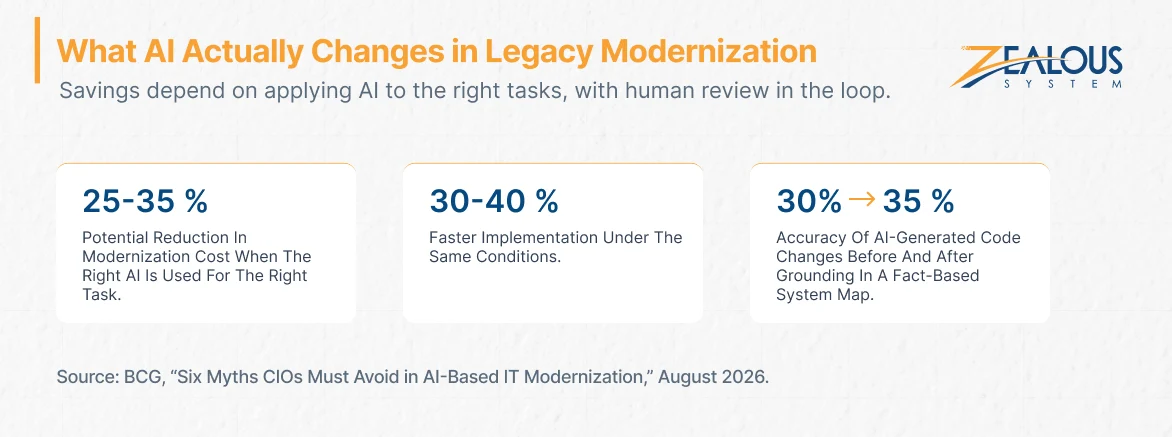
The same BCG analysis found that the right AI applied to the right task can reduce modernization costs by 25 to 35 percent and speed up implementation by 30 to 40 percent. The important words are “right task.” BCG also points out that coding is rarely the main bottleneck in modernization, so a vendor promising savings only from faster code generation is pulling the wrong lever.
AI earns its keep in the slow, manual parts of the work:
These are the activities that used to make discovery slow and expensive. Done well, AI makes a proper assessment affordable, which in turn makes the rest of your legacy modernization cost estimate more accurate.
AI doesn’t make architecture decisions, run user acceptance testing or manage the people whose daily work is changing. It also needs grounding. In one case BCG describes, AI-generated code changes were accurate only about 30 percent of the time until the tool was fed a fact-based map of the system. After that, accuracy rose to 85 percent.
AI legacy code modernization cost goes down only when the vendor has a disciplined process around the AI. If you want a sense of what that looks like in practice, this overview of how Zealous System uses AI in software development and maintenance walks through where AI sits in the workflow and where people stay in control.
Before you credit any AI savings in your evaluation, ask:
1. Which phases are AI-assisted, and which are fully manual?
2. How is AI-generated code reviewed, tested and approved?
3. Is the saving reflected in the price, or kept as vendor margin?
4. Where do your code and data go when AI tools process them, and who can access them?
A confident vendor will answer all four without hesitation. Vague answers usually mean the AI story is marketing rather than method.
Once the quotes are in, the temptation is to line up the totals and start negotiating with the cheapest. Resist it for now. A fair comparison takes three steps.
Map every proposal against the checklist table, row by row. Flag anything marked “TBD,” “excluded” or “client responsibility,” then ask each vendor to price or justify those items. Only then can you compare one vendor’s legacy application modernization cost with another’s.
It also helps to understand how the vendor arrived at its numbers. Asking about their method for estimating software development projects, whether bottom-up, analogy-based or something else, tells you how much confidence to place in the figure.
Upfront price is only part of the legacy modernization total cost of ownership. Compare each proposal over three to five years, including hosting, licenses, support and the cost of changes you already expect.
The cheapest approach upfront can easily become the most expensive one over five years. A simple rehost moves the old system to new infrastructure but carries its technical debt along with it. McKinsey research found that CIOs estimate tech debt amounts to 20 to 40 percent of the value of their entire technology estate. That debt keeps charging interest after go-live. A sound application modernization strategy weighs the upfront saving against what you’ll keep paying later.
A scorecard keeps the decision honest when stakeholders have different priorities. Use the modernization vendor evaluation criteria below as a starting point. The weights are suggestions, so adjust them to match what matters most for your project.
| Criterion | What a strong proposal shows | Evidence required | Suggested weight |
|---|---|---|---|
| Scope completeness | Clear deliverables, assumptions and exclusions | Assumptions and exclusions register | 20% |
| Cost transparency | Itemized costs with variable items identified | Line-item breakdown | 15% |
| Discovery and technical approach | An approach justified by your existing system | Assessment plan and architecture rationale | 15% |
| Data migration and testing | Defined responsibilities and test coverage | Migration plan and test strategy | 15% |
| Delivery risk and change control | Milestones, rollback plan and change rates | Project plan and change-control terms | 15% |
| Security and compliance | Requirements mapped to acceptance gates | Security plan and relevant certifications | 10% |
| Support and exit terms | Warranty, SLAs, knowledge transfer and code ownership | Support terms and IP clauses | 10% |
Score each criterion from 1 to 5, multiply by the weight and add up the results. A vendor who scores well on scope and transparency but sits slightly higher on price is usually the safer buy.
Watch for these warning signs during evaluation:
Most overruns are baked in at contract stage. These steps take a little longer upfront and save far more later.
1. Commission discovery first: When the system is poorly documented, a discovery phase costs a fraction of the build and removes most of the guesswork.
2. Require an assumptions register: Every assumption behind the price should be written down, so you know exactly what changes the number.
3. Define acceptance criteria per milestone: “Module complete” should mean tested, reconciled and signed off, not just delivered.
4. Agree on change control: Rates, approval authority and turnaround times belong in the contract, not in a later email thread.
5. Size contingency from real risks: Instead of adding a flat percentage, list the known risks, attach a cost range to each and build contingency from those ranges. Finance will trust a number it can trace.
6. Tie payments to accepted milestones: Paying on acceptance, rather than on effort or calendar dates, keeps both sides focused on outcomes.
There’s a trade-off to keep in mind. A lean, low quote can be perfectly reasonable for a well-understood system with good documentation. When uncertainty is high, though, an assessment-first engagement usually costs less in the end, even if the first number looks higher.
Some organizations can modernize with internal teams and a few contractors. Others need outside help. These four signals usually point to the second group:
If any of these sound familiar, the choice of partner will affect your legacy modernization cost as much as the quoted price. Look for a team that insists on discovery, prices every row of the checklist and shows you how it handles cutover and handover. This guide on choosing a software development partner covers the wider selection process, and this overview of legacy application modernization explains the approaches you’re likely to see in proposals.
For an Australian environmental services organization, Zealous System’s legacy system modernization started with client briefings and requirement analysis before any code changed. The team then re-engineered core modules, automated the billing cycle and deployed only after testing and client approval.
There’s no reliable single figure, because legacy system modernization cost depends on codebase size, data quality, the number of integrations, compliance needs and how much downtime you can accept. Two systems of similar size can differ widely in cost. The most reliable way to get a realistic number is a short discovery phase, followed by a line-item estimate built on what it finds.
When deciding what to include in a modernization RFP, cover all 10 cost areas: discovery, architecture, code conversion, data migration, integrations, testing, infrastructure, cutover, training and post-launch support with decommissioning. Ask vendors to price each one separately and to list their assumptions and exclusions.
The most common are undocumented business logic, poor data quality, the parallel-run period, internal staff time, change requests and vendor lock-in. Each can be controlled through specific contract terms, such as funded discovery, data-quality allowances and fixed change-control rates.
Neither works well alone for most legacy projects. A phased hybrid is usually the safest choice: a fixed-price discovery phase, then fixed price or capped time and materials per module, based on what discovery uncovers.
Yes, when it’s applied to the right tasks. BCG research puts the potential saving at 25 to 35 percent in those conditions. In practice, the gains come mostly from code analysis, documentation, testing and data mapping. Savings depend on human review and a well-grounded process, so ask vendors to show exactly where AI is used and how its output is checked.
Base contingency on identified risks rather than a fixed percentage. List each known risk, such as poor data quality or unclear integrations, estimate a cost range for it and build your contingency from those ranges. This gives finance a figure it can trace and defend.
A legacy modernization cost estimate is only worth comparing when it covers the same scope as the others. Treat your legacy modernization budget as a sum of every row in the checklist, insist on discovery when the system is poorly understood, and compare vendors on total cost of ownership rather than the headline number.
If you’re holding proposals that don’t line up, or you need a starting estimate for a system nobody fully understands, Zealous System can review your quotes against this checklist or scope your system from the ground up with AI-assisted discovery. Either way, you’ll leave with a line-item estimate you can take to finance and a clear view of what full application modernization services would involve for your system. Book a call to talk through your system and the quotes you already have.
Our team is always eager to know what you are looking for. Drop them a Hi!

Nandini Pare is a CAPM® Certified Business Analyst at Zealous System, specializing in business analysis, Agile delivery, and helping organizations build technology solutions that solve real business challenges.


Comments