
An invoice lands in a shared inbox at a Durban freight company. Someone opens it, checks it against a purchase order, keys the figures into Sage, spots a R400 discrepancy, and emails the supplier. Eleven minutes, four hundred times a month.
That work has not disappeared. What has changed is that software can now read the invoice, run the check, make the entry, and pass only the exceptions to a person. That is what AI agents for business automation in South Africa do in practice, and it is a long way from handing the team a ChatGPT subscription.
This guide covers which operations repay the investment first, what POPIA requires once an agent starts handling personal information, and what the work costs in Rands.
An AI agent is software that completes a multi-step task across your systems. It reads messy input, decides what to do next, uses tools to act, and stops to ask a person when it hits something outside its remit.
The difference from automation you already run sits in how each handles the unexpected. A rule-based script or an RPA bot follows a fixed path and fails when reality stops matching the script. An agent opens a PDF that arrived in an unfamiliar layout, works out that it is a credit note rather than an invoice, and routes it correctly.
Three capabilities decide whether an agent is useful for operations work.
The agent needs permission to read from and write to the tools your team already uses, whether that means Sage, SAP, Salesforce or a database sitting on a server in your building.
Operational work arrives as email threads, scanned documents, photographs of delivery notes and WhatsApp messages, not as clean rows in a table.
Every agent needs a rule for when it stops and hands over. An agent without one will eventually make a decision nobody authorised.
Our comparison of agentic AI vs traditional automation sets out the cost, risk and ROI differences in full.
South Africa already leads the continent on AI use. Microsoft’s Global AI Diffusion report put local adoption at 23.1% of the working-age population in the first quarter of 2026, ranking the country 46th out of 147 economies and ahead of every other African market.
Almost all of that is individuals using chat tools, not companies automating operations. The gap between those two things is where the local opportunity sits, and five conditions make the case sharper here than the global version of this argument does.
For three winters, slow turnaround times had a ready explanation. That explanation has run out.
Eskom passed a full year without a single second of load shedding on 16 May 2026, a milestone last reached in September 2018. By early August, the country had gone 441 consecutive days without a cut, and Eskom met demand 100% of the time between 1 April and 30 July 2026. Targeted load reduction still affects some areas, so this is not a national all-clear. But if your claims backlog ran three days long in 2023 and still runs three days long today, the grid is no longer the reason. The process is.
Adding headcount is the traditional answer to rising volume. It is also the most expensive one, and dollar-priced software seats have grown harder to justify with every exchange rate move.
Skilled claims assessors, finance staff and operations managers have been hard to hire for years. Agents do not fix recruitment. They reduce how much routine work sits on the people you already managed to keep.
POPIA data requests, B-BBEE reporting, FICA verification, and SARS submissions all consume senior time and follow predictable patterns, which makes them unusually suitable for this kind of automation.
Service in South Africa runs on WhatsApp, across several languages, well outside office hours. A team that responds quickly in English at 10 am and slowly in isiZulu at 7 pm has a coverage problem rather than a headcount problem.
Business process automation in South Africa usually goes wrong at the selection stage rather than the build. The best first candidate is rarely the most interesting process. It is the one with high volume, clear rules, and a mistake that becomes visible within a day.
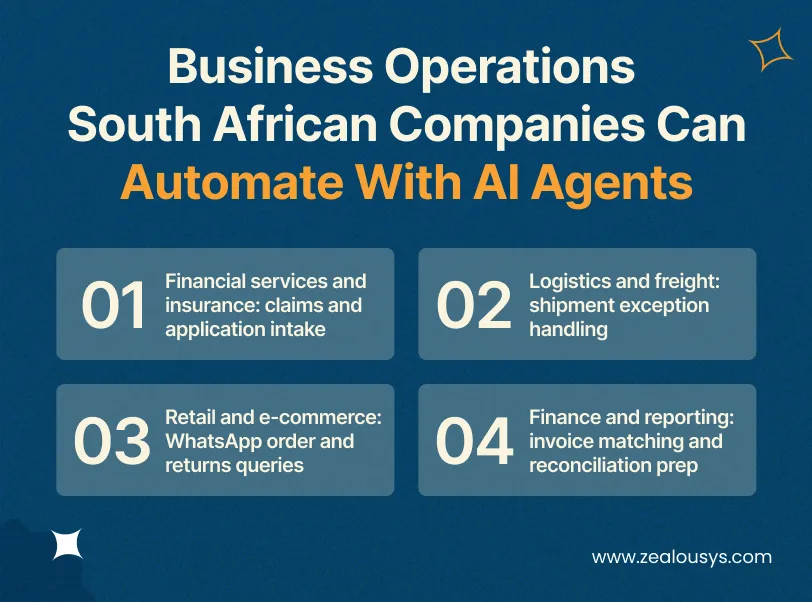
Claims, credit applications, and onboarding files arrive as documents, and most of the delay sits in assembling them rather than assessing them.
An agent handles intake. It extracts data from the ID document, payslip, bank statement, and claim form, checks each against your policy rules, assembles a complete case, and puts it in front of an assessor instead of a folder of attachments. Turnaround improves because the waiting stops, not because anyone works faster. Firms handling large document volumes will find more detail in our guide to AI document processing for South African law firms and financial services.
For logistics companies in South Africa, exception handling consumes hours, and none of it is complicated work. Delayed consignments, missing proof of delivery, customs paperwork queries, and the constant chasing that follows all run on the same pattern.
An agent monitors shipment status, drafts the customer update, requests the missing POD from the driver, and escalates only the consignments that need a commercial decision. Overnight coverage matters here. An agent working the queue at 2 am clears the backlog before the day shift walks in.
Order status, returns, stock availability, and failed payments across Yoco, PayFast, or Ozow make up the bulk of inbound contact, and volume spikes when you can least afford to hire.
A WhatsApp AI agent connected to your order system answers those directly and passes anything unusual to a person with the full conversation already attached. Handling several languages properly is a build decision rather than an afterthought. We used retrieval-augmented generation to solve exactly this in a multilingual AI chatbot for the travel industry, where one query had to work across languages without maintaining a separate script for each.
Invoice matching, supplier queries, reconciliation preparation, and pulling evidence together for compliance reports look the same whether you run a mine services business or a medical practice.
These usually make the strongest starting point. The rules are documented, the volume is steady, and an error surfaces immediately rather than at year-end.
The fundamentals sit in our guide to POPIA compliance in South Africa. What follows applies specifically to agents.
Most companies walk into section 15 without noticing. In May 2026, the Information Regulator of South Africa issued an enforcement notice against Central Johannesburg TVET College, finding, among other failures, that further processing of employee personal information was not compatible with the purpose for which it had been collected.
Feeding your existing customer records into an agent is further processing. That data was gathered to service an account, not to drive an autonomous system, and the gap between those two purposes is the compliance risk almost nobody budgets for.
If personal information leaves South Africa to reach a model, section 72 comes into play. The AWS Cape Town region and Azure South Africa North both give you a local option, and genuinely sensitive workloads can run on a private deployment instead.
Logging what the agent read is not sufficient. You need a record of what it did, on what basis, and who had the ability to stop it. When the Regulator asks, “the model decided” is not an answer.
The same notice cited failure to register the Information Officer and failure to report a security compromise under section 22. Enforcement has followed a ladder in practice: an enforcement notice first, then a fine for ignoring it. Penalties issued to date have run from R100,000 to R5 million against a statutory ceiling of R10 million.
Budgets for AI agents for business automation in South Africa are driven by scope, and the ranges in our breakdown of AI agent development cost apply here. Three local line items are worth adding.
POPIA compliance designed in from the start adds roughly R40,000 to R100,000 to a medium-complexity system, and considerably more for fintech and healthcare. Retrofitting it later costs more again. Cloud hosting runs R2,000 to R20,000 a month depending on volume, before model inference. Maintenance sits at 15% to 20% of the build cost every year. Our guide to custom software development cost in South Africa covers the wider budget picture.
The honest version of this sum uses your figures, not a vendor’s. Count the hours your team spends on the process each month and multiply by your fully loaded cost per hour, including benefits and overhead. That figure is the ceiling on what automation can return.
As an illustration, an agent absorbing 60% of a 300-hour monthly process at a loaded rate of R200 an hour returns around R36,000 a month, or roughly R432,000 a year, against build and running costs. Substitute your own rate, because the answer moves sharply with it.
Then test two things before you trust the result. Are those hours measured or estimated? And does faster turnaround earn anything real, through quicker collection, fewer abandoned orders or lower penalty exposure? Low-volume or highly variable processes rarely pay back, and discovery is a cheaper place to learn that than delivery.
Most companies looking at this already run systems they cannot afford to disrupt. That is the real test when choosing an AI agent development company in South Africa: does the work start with your process, or with their technology?
If you are weighing this up internally, the useful conversation is which of your processes would actually repay the effort. That is worth having before a scope document exists.
Software that completes a multi-step task across your systems. It reads unstructured input such as emails and PDFs, decides what to do, acts through connected tools, and escalates when it reaches its limits. A chatbot answers questions. An agent completes work.
Cost tracks how many systems the agent touches and how much personal information it handles. POPIA compliance adds roughly R40,000 to R100,000 on a medium-complexity build, hosting runs R2,000 to R20,000 a month, and maintenance sits at 15% to 20% annually.
Not automatically. It depends entirely on how the agent is built. The common failure is section 15: using personal information collected for one purpose to drive an agent doing something else. Data residency, audit logging, and a documented lawful basis need to be designed in.
Yes. Agents connect through APIs where they exist, and through database or file-level access for older systems without one. Legacy platforms take longer to scope than modern ones, so establish the integration effort during discovery rather than assuming it.
A fair question here, and it deserves a straight answer. Agents typically absorb backlog and repetitive volume rather than headcount, moving people onto exceptions and customer work. What happens next depends on what a business does with the freed capacity. Anyone promising no effect on roles is selling something.
AI agents for business automation in South Africa earn their place when they take on high-volume, rule-bound work that people should not be spending their week on. The technical decisions matter less than picking the right first process and settling your POPIA position before the build rather than after it.
Zealous System provides custom AI agent development services for businesses across South Africa, working inside the systems they already run. If you would like a view on which of your operations would actually repay automation, our team is happy to look at it with you.
Our team is always eager to know what you are looking for. Drop them a Hi!

Pranjal Mehta is the Managing Director of Zealous System, a leading software solutions provider. Having 10+ years of experience and clientele across the globe, he is always curious to stay ahead in the market by inculcating latest technologies and trends in Zealous.


Comments