An enterprise RAG system typically costs $25K to $50K for a proof of concept, $75K to $200K for a production system serving one department, and $200K to $600K+ for a complex, organization-wide deployment. Running it adds anywhere from a few hundred dollars to $40K+ per month, depending on users, query volume, and where the model runs.
Those ranges are wide for a reason. Two companies can ask for the same thing, “an assistant that answers questions from our documents,” and end up with budgets nearly ten times apart. Most of that gap traces back to three things: messy data, the number of systems that need to connect, and how tightly you control access. The LLM itself is rarely the deciding factor.
If you’re preparing a budget for leadership, the sections below cover every line item behind those numbers. That includes build components, cost drivers, monthly run costs, hidden costs, and the choice between building, buying, or partnering.
Here is how enterprise RAG pricing usually breaks down by scope. Treat these as planning ranges, not quotes. Your final number depends on the factors covered later in this guide.
| Scope | What’s Typically Included | Build Cost | Timeline | Monthly Run Cost |
|---|---|---|---|---|
| Proof of Concept | 1-2 data sources, one use case, API-based LLM, basic chat UI, limited test users | $25K-$50K | 4-8 weeks | $500-$2K |
| Production RAG System | 3-10 sources, hybrid search, reranking, SSO and role-based access, evaluation suite, 2-3 integrations | $75K-$200K | 2-5 months | $2K-$10K |
| Complex Enterprise Deployment | Many sources, document-level permissions, compliance controls, multi-department rollout, possible self-hosted LLM | $200K-$600K+ | 5-12+ months | $10K-$40K+ |
Indicative ranges for 2026, based on typical enterprise RAG engagements. Costs vary by region, team model, and data complexity.
A PoC answers one question: can RAG give accurate answers on your data? It usually runs on a clean subset of documents, uses a hosted model through an API, and skips most security work. It is cheap because it avoids the hard parts on purpose.
This is where most enterprise budgets land. The system now has to handle real users, real permissions, and real documents, including the badly scanned PDFs and outdated wikis nobody wanted to touch during the PoC. Evaluation, monitoring, and access control turn a demo into something your security team will approve.
Costs climb fast once the system spans departments. Each new data source brings its own format, owner, and permission model. Add regulatory requirements, on-premises hosting, or agent-style workflows that take actions, and you are funding a platform rather than a single tool.
A RAG system looks simple from the outside: a question goes in, an answer comes out. Behind that is a pipeline of separate pieces, each with its own engineering effort.
| Component | What It Covers | Share of Build Budget |
|---|---|---|
| Data Ingestion and Preparation | Source connectors, document parsing, cleaning, chunking, metadata tagging | 20-30% |
| Embeddings and Vector Database | Embedding model selection, indexing, vector database setup and tuning | 10-15% |
| Retrieval and Reranking | Hybrid search, reranking, query rewriting, context assembly | 10-15% |
| LLM Integration | Prompt design, model selection, response formatting, citations | 5-10% |
| Enterprise Integrations | Connections to CRM, ERP, ticketing, Slack, Teams, intranet | 10-15% |
| Security and Access Controls | SSO, RBAC, document-level permissions, PII handling, audit logs | 10-15% |
| Testing and Evaluation | Test datasets, accuracy metrics, hallucination checks, guardrails | 5-10% |
| Deployment and Infrastructure | Cloud or on-prem setup, CI/CD, scaling, observability | 5-10% |
Two things stand out. First, the LLM itself is one of the smallest line items in the build. Second, data preparation is almost always the largest.
This is the work that decides whether your answers are right or confidently wrong. Parsing tables inside PDFs, splitting documents into useful chunks, removing duplicates, and tagging content with metadata all take careful engineering. One example is a RAG-enabled multilingual AI chatbot for the travel industry. Unstructured PDFs were dragging down search quality. Once the content was re-chunked and enriched with metadata, retrieval speed improved by 40%.
The risk of skipping this step is well documented. Gartner predicts that through 2026, organizations will abandon 60% of AI projects that aren’t supported by AI-ready data. If your content lives across file shares, legacy systems, and old databases, budget for consolidation and basic data governance first. Specialist data migration services are often cheaper than fixing bad retrieval later.
Basic vector search finds text that sounds similar to the question. Enterprise users ask about product codes, policy numbers, and acronyms, where exact matches matter. Hybrid search (keyword plus vector) and a reranking step fix most of these misses, but each adds tuning time.
An enterprise RAG system must never show an intern the board minutes. That means mirroring permissions from SharePoint, Google Drive, Confluence, or your DMS at the document level, not just the app level. This piece is often underestimated because it looks like a checkbox until you try to sync it in real time.
Without measurement, answer quality becomes a matter of opinion. A proper evaluation set, typically a few hundred real questions with verified answers, tells you whether a change to chunking or prompts made things better or worse. Skip it, and every update is a guess.
Every enterprise RAG implementation cost estimate comes down to the same handful of variables. Here they are, with how much each one tends to move the budget.
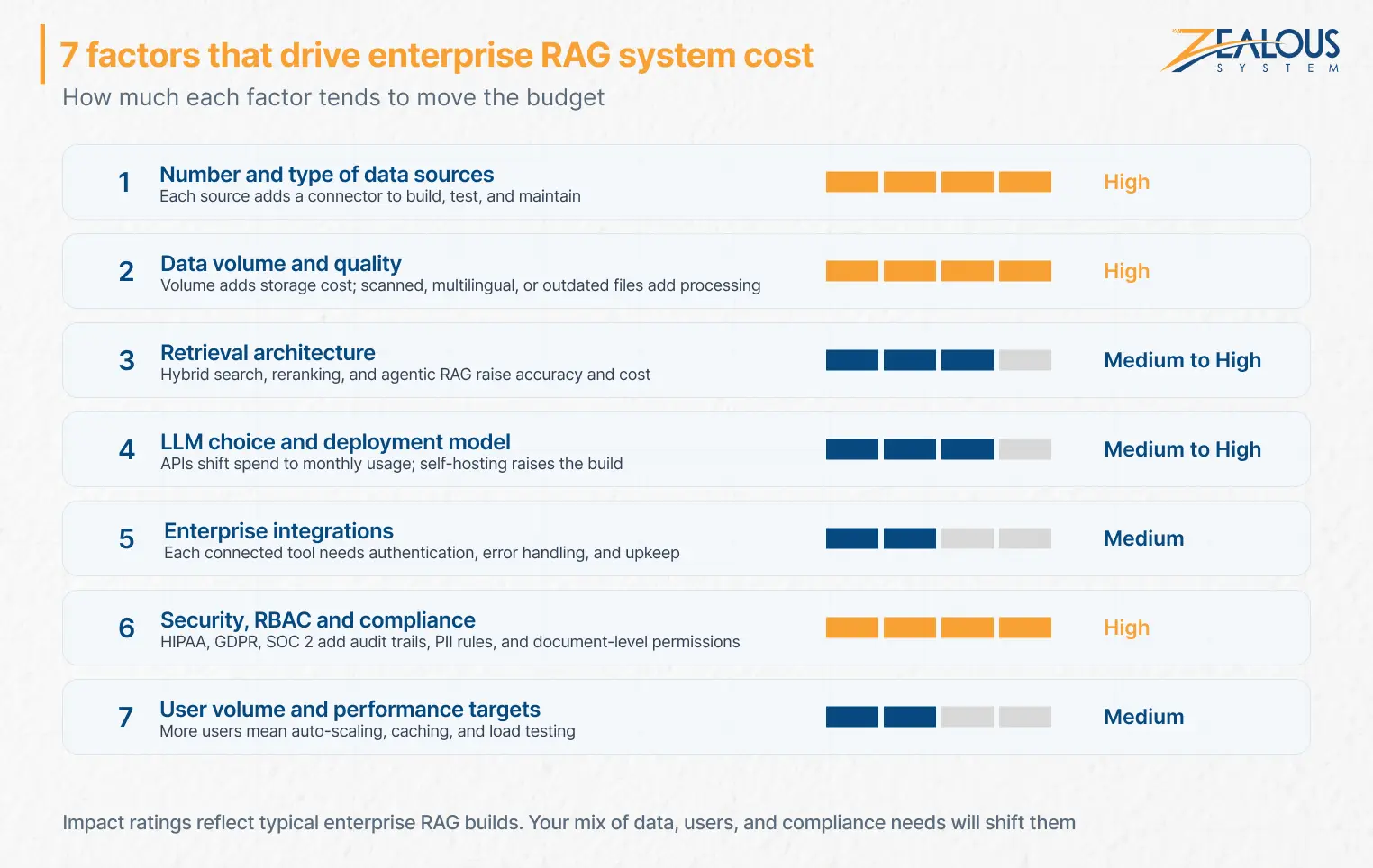
Cost impact: High
One clean knowledge base is easy. Ten sources, each with different formats, owners, and update schedules, means ten connectors to build, test, and maintain. Sources with APIs are cheaper to connect than legacy systems that need custom extraction.
Cost impact: High
Volume affects indexing and storage costs, but quality affects everything else. Scanned documents need OCR. Multilingual content needs language-aware processing. Contradictory or outdated documents need a cleanup plan, or the system will retrieve them with full confidence.
Cost impact: Medium to High
A simple vector search pipeline is the cheapest option. Hybrid search, reranking, query decomposition, and knowledge graphs each raise accuracy and cost. Agentic RAG, where the system plans multi-step lookups or takes actions, sits at the top of the range. If that’s where you’re heading, the cost of agentic AI workflows follows a different curve worth understanding early.
Cost impact: Medium to High
Calling a hosted model through an API keeps build costs low and moves LLM inference spending into monthly usage. Self-hosting an open-source model inside your VPC or data center raises the build cost (GPU infrastructure, model serving, and MLOps) but gives you full data control and predictable costs at high volume. Regulated industries often have no choice but to self-host or use a private cloud deployment.
Cost impact: Medium
Most teams don’t want another tab. They want answers inside Teams, Slack, the CRM, or the support desk. Each integration needs authentication, error handling, and maintenance when the other system updates its API. Experienced AI integration services can shorten this work considerably, since many connectors follow familiar patterns.
Cost impact: High
Regulations like HIPAA and GDPR, audit frameworks like SOC 2, and industry-specific rules add requirements for data residency, audit trails, PII redaction, and retention. Document-level permission sync is one of the most complex parts of any enterprise RAG build, and it gets harder as the number of sources grows.
Cost impact: Medium
Fifty pilot users and 5,000 daily users are different systems. Higher concurrency needs auto-scaling, caching, and load testing. In the travel chatbot project mentioned earlier, the first load tests failed beyond 300 users. Moving to auto-scaling containers with Redis caching brought sub-second responses for 500+ users. That kind of work rarely shows up in early estimates.
The build is a one-time cost. Running the system is not, and this is where many budgets go wrong. A $150K build is not a $150K project.
| Monthly Cost Item | What Drives It |
|---|---|
| LLM/API Usage | Queries per day, tokens per query, model tier |
| Embedding Generation | New and updated documents that need re-embedding |
| Vector Database | Index size, query volume, managed vs self-hosted |
| Cloud Infrastructure | Compute, storage, networking, GPU (if self-hosted) |
| Data Synchronization | Connectors pulling changes from source systems |
| Monitoring and Evaluation | Logging, observability, scheduled accuracy checks |
| Maintenance | Bug fixes, dependency updates, prompt and retrieval tuning |
Take a company with 1,000 active users, each asking about 10 questions per working day. That’s roughly 220,000 queries a month. Assume each query sends around 4,000 tokens of retrieved context and instructions, and gets back about 500 tokens. That adds up to roughly 880 million input tokens and 110 million output tokens a month.
Depending on the model tier, that token bill alone can range from a few hundred dollars on a small, efficient model to several thousand dollars on a frontier model. Add vector database hosting, cloud compute, and monitoring, and a production enterprise RAG system for this company typically lands in the $2K to $10K monthly range.
Per-query costs look tiny in a demo. Gartner points out that a negligible per-token cost can become a total cost of ownership problem. Multiply it across thousands of users and hundreds of use cases, and the numbers change fast. Set a cost-per-query target before launch and track it the same way you track uptime.
API pricing scales with use, which is ideal for unpredictable or moderate volume. Self-hosting has a high fixed cost but a flatter curve. The breakeven point depends on your query volume and how fully you can use the GPUs you’re paying for. At moderate volumes, APIs with private-endpoint options usually remain the cheaper route. Self-hosting starts to pay off when traffic is high, steady, and predictable, or when data rules leave no other option.
These costs rarely appear in the first proposal, yet they’re often why projects stall. According to Gartner, organizations abandoned at least half of generative AI projects after proof of concept by the end of 2025. The reasons: poor data quality, inadequate risk controls, escalating costs, and unclear business value. Most of the items below map directly to those causes.
Old policies, duplicate files, and conflicting versions don’t disappear when you index them. Someone has to decide which document is the source of truth, and that takes time from business teams, not just engineers.
Permissions change daily as people join, leave, and switch teams. Keeping the RAG index aligned with source-system permissions needs an automated sync that keeps pace with those changes.
Every time documents change, their embeddings need updating. Large or frequently changing knowledge bases need scheduled pipelines, which add compute and maintenance costs.
Building a reliable test set means subject-matter experts writing questions and verifying answers. The work is slow and easy to postpone, which is why it rarely makes the original budget.
You need visibility into what users ask, what the system retrieves, and where it fails. Logging, tracing, and dashboards cost money to build and to store data for.
Internal security and legal reviews can add weeks to an enterprise RAG system rollout. Penetration testing, vendor risk assessments, and data protection impact assessments all carry a cost.
Model providers retire versions and change pricing. Each change means retesting prompts and re-running evaluations to confirm quality didn’t slip.
User questions shift over time. Expect regular tuning of chunking, prompts, and ranking after launch, especially in the first six months. Budgeting for application maintenance from the start avoids an awkward funding gap later.
The build vs buy RAG question often shapes your enterprise RAG development cost more than any technical choice. Here’s how the three paths compare.
| Option | Upfront Cost | 3-Year TCO | Control | Time to Production | Best For |
|---|---|---|---|---|---|
| Build In-House | High (hiring ML, data, and platform engineers) | High (salaries plus infrastructure) | Full | Longest | Companies with a mature AI team and long-term roadmap |
| Buy a Platform | Low to medium | Rises with seats and usage | Limited to medium | Fastest | Standard use cases with clean, common data sources |
| Development Partner | Medium to high | Medium (infrastructure plus optional support) | Full, on your infrastructure | Medium | Custom workflows, compliance needs, faster delivery |
If you already have ML engineers, a data platform team, and RAG is central to your product or operations, building keeps the knowledge inside. The catch is hiring time. Assembling an experienced team often takes longer than the build itself.
Off-the-shelf enterprise search and assistant tools work well when your content sits in mainstream systems and your use case is general Q&A. Watch the licensing model. Per-seat pricing that looks reasonable for a pilot can become your biggest line item at full rollout.
Outsourced RAG development services fit when you need custom retrieval logic, unusual data sources, strict compliance, or on-prem deployment. They also make sense if you’d rather not hire a permanent AI team. You keep ownership of the code and infrastructure while moving faster than building a team from scratch.
Many companies end up with a hybrid: a partner builds and stabilizes the system, then hands it over to an internal team. The same trade-offs apply to chatbots in general, as covered in this guide on AI chatbot development: build vs buy vs integrate.
For most enterprise knowledge use cases, yes. RAG and fine-tuning solve different problems, though, so the comparison only goes so far.
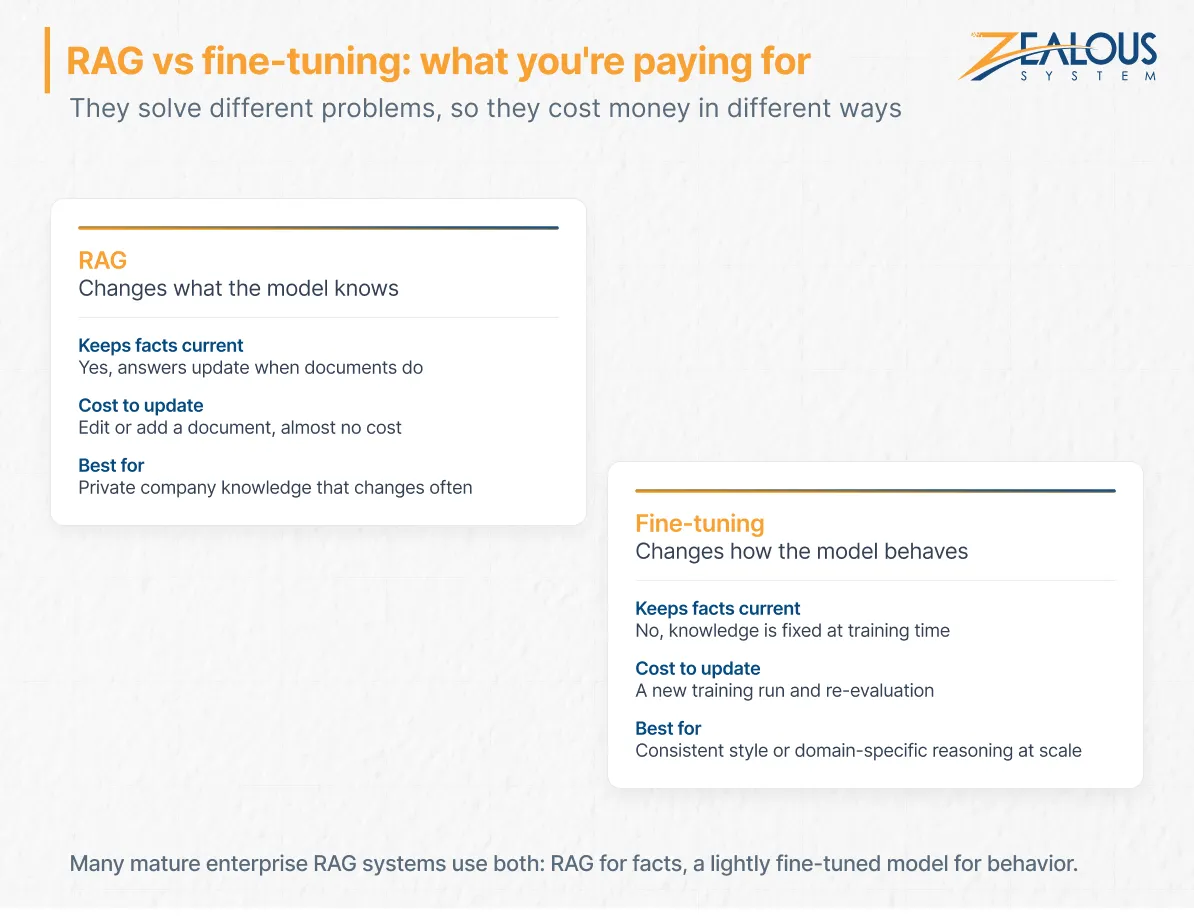
RAG gives a model access to your current, private information at the moment it answers. When a policy changes, you update the document and the answers change with it. Fine-tuning changes how a model behaves: its tone, format, or skill at a specialized task. It doesn’t keep facts current, and each update means retraining.
That makes RAG the better choice for knowledge that changes often. Fine-tuning earns its cost when you need consistent output style or domain-specific reasoning at scale. Many mature enterprise RAG systems use both: RAG for facts, a lightly fine-tuned model for behavior. If that second path is on your roadmap, this guide on how to fine-tune an LLM covers the process and its costs.
Cutting costs in the wrong place usually means paying twice. These moves lower spend while protecting answer quality.
Pick a use case where wrong answers are costly and good answers save measurable time, such as support agents searching product manuals. A narrow win builds the case for funding the next phase.
Launch inside one or two tools people already use. Every additional connector adds build time and ongoing maintenance.
Better chunking and cleaner sources often improve accuracy more than a larger model or a more complex pipeline. They also lower the overall cost to build a RAG system.
Reranking and hybrid search are worth it for technical or code-heavy content. For straightforward FAQ-style documents, simple vector search may be enough.
Route simple questions to smaller, cheaper models and reserve frontier models for complex reasoning. Caching frequent answers cuts repeat token spend.
Agree on what “accurate enough” means before development starts. It stops endless tuning cycles and gives you a clear launch threshold.
Most enterprise RAG systems don’t need a custom-trained model. Prove that prompting and retrieval can’t meet the bar before paying for training.
If you decide to bring in outside help, the partner you choose has a direct effect on both cost and outcome. A low quote that skips evaluation or permission handling usually costs more by the end. Look for these signals.
Ask for examples of connecting AI systems to legacy software, ERPs, and document management systems. Connectors are where many projects slip.
They should explain how they’ll mirror document-level permissions and handle PII, without you having to prompt them.
A credible partner breaks the estimate into phases with defined deliverables. Be cautious of a single number with no assumptions attached.
Ask how they measure accuracy, detect hallucinations, and decide when a system is ready to launch. “We test it” isn’t an answer.
Cloud, private cloud, on-premises, or hybrid. The right partner works with your infrastructure rules instead of forcing their default stack.
RAG systems need tuning after launch. Confirm what monitoring, maintenance, and retraining support looks like after go-live.
At Zealous System, we hold our own RAG projects to these same standards. Our multilingual AI chatbot using RAG for a Croatian tourism brand is one example. It pulls real-time data, handles three languages with regional slang, and reaches 95% multilingual response accuracy. Its architecture also held up through peak tourist season. As a generative AI development company, we scope RAG projects in phases so you can validate value with a focused PoC before committing to a full rollout.
Most enterprise RAG systems cost $25K to $50K for a proof of concept, $75K to $200K for a production deployment, and $200K to $600K+ for a complex, multi-department rollout. Data complexity, integrations, and security requirements drive most of the difference.
Monthly costs typically range from $500 to $2K for a PoC, $2K to $10K for a production system, and $10K to $40K+ for large deployments. LLM usage, vector database hosting, cloud infrastructure, and maintenance make up most of the bill.
For one well-scoped use case with clean data, most teams spend $25K to $50K on a proof of concept. Moving that same use case to production, with security, evaluation, and integrations, usually brings the total into the $75K to $200K range.
Usually, yes, for company knowledge that changes often. Updating a document in a RAG system costs almost nothing, while refreshing a fine-tuned model means another training run.
A proof of concept takes 4 to 8 weeks. A production system usually takes 2 to 5 months, while a complex enterprise deployment can take 5 to 12 months or more.
An enterprise RAG system can cost $40K or $400K, and both figures can be right. Where you land depends on your data, your integrations, your security rules, and how many people will use it. The smartest budgets account for monthly run costs and hidden work from day one, not after the PoC succeeds.
If you’re building the business case for an enterprise RAG system, start with a scoped estimate based on your actual data sources and users. Our team at Zealous System can review your use case and outline a phased plan with realistic costs. Book a call when you’re ready to put real numbers behind your RAG budget.
Our team is always eager to know what you are looking for. Drop them a Hi!

Nandini Pare is a CAPM® Certified Business Analyst at Zealous System, specializing in business analysis, Agile delivery, and helping organizations build technology solutions that solve real business challenges.


Comments