
Quick Overview:
Most teams arrive at fine-tuning the same way. You shipped something on top of GPT or Claude, it demoed beautifully, then real users got hold of it. Now the model misreads your terminology, ignores your output format on every fifth request, and your inference bill grows faster than your usage. Or legal has said, plainly, that customer data cannot go to a third-party API.
You are not alone there. Stanford’s 2026 AI Index found 88% of organisations now use AI in at least one business function, while deeper autonomous deployment stays rare. Adoption is easy. Making a model work reliably on your own data is where the effort sits.
Fine-tuning is a second round of training on top of a pre-trained large language model. You feed it examples showing exactly how you want it to respond, its weights shift, and it produces your format, tone, and domain reasoning by default rather than because you asked nicely in a prompt. That is worth doing in some situations and a waste of money in others. This guide covers how to fine-tune an LLM in practice: which situations justify it, what it costs, and whether to build it internally.
Fine-tuning solves a narrow set of problems very well. Recognising whether you have one of them saves months.
Your prompt runs past a page, you have added few-shot examples until the context window strains, and accuracy sits stubbornly at 85%, with the failing 15% being the cases that matter commercially. Output drift is the other signal: you need clean JSON or a fixed report structure every time, and the model complies most of the time. Most is not good enough for an automated pipeline.
A frontier model answering millions of routine queries is expensive per call and slower than you want. Fine-tuning a smaller open-weight model for your task often matches its accuracy at a fraction of the running cost. This is the argument that convinces finance teams: you are not buying better AI, you are buying the same performance on cheaper infrastructure.
Insurance policy wording, clinical abbreviations, freight terminology, internal product codes: general models trip on all of them. If your reviewers keep correcting the same category of mistake, that pattern is what fine-tuning encodes, and it is what turns a general model into a domain-specific LLM.
These three get compared as competitors. They are closer to different tools for different failure modes.
The cheapest option and the right starting point for almost everything. Days rather than weeks, no infrastructure, changes take effect immediately. Its limit is consistency: instructions guide the model but do not bind it.
RAG fetches relevant documents at query time and passes them to the model as context. It fixes knowledge gaps, keeps answers current as documents change, and lets you cite sources, which matters in regulated work, as in this multilingual AI chatbot built with RAG for a travel client. What it does not fix is behaviour: feeding the right document to a model that writes in the wrong tone changes nothing about the tone.
Fine-tuning changes default behaviour: how the model structures answers, which vocabulary it treats as normal, how it reasons through a task it sees repeatedly. It also moves that behaviour onto a smaller, cheaper model.
| Prompt Engineering | RAG | Fine-Tuning | |
|---|---|---|---|
| Fixes | Simple task guidance | Missing or changing knowledge | Behaviour, format, domain reasoning |
| Setup Time | Hours to days | 3 to 8 weeks | 6 to 12 weeks |
| Typical Cost | Negligible | Moderate, plus per-query retrieval | $10,000 to $180,000+ |
| Updating It | Edit the prompt | Update the document store | Retrain the model |
| Cuts Inference Cost | No | No | Yes, when paired with a smaller model |
In production, fine-tuning and retrieval get stacked. Fine-tune so the model follows your format and reasons in your domain, then use retrieval for current facts at query time. Fine-tuning handles how; retrieval handles what.
LLM fine-tuning for business pays off in high-volume, repetitive, format-sensitive work.
High volume, consistent structure, and historical labelled data already sitting in your helpdesk. Classification against your own taxonomy is where general models underperform most visibly, because your categories are yours alone.
Analyst review queues are expensive, and the work inside them is repetitive. A model trained on your historical decisions learns your risk thresholds rather than a generic notion of suspicious activity. Our AI fraud alert triage agent for a UK-based NBFC cut manual review workload by 62%.
Clinical shorthand, abbreviation handling, and strict output structure are what fine-tuning encodes well. The same principles apply in AI medical documentation automation, where format consistency matters as much as accuracy.
Clause extraction against your own playbook rather than a general legal standard. Closely related to AI document processing for law firms and financial services, where the value comes from consistency across thousands of documents.
If an AI feature is core to what customers pay for, running it on the same public API as your competitors gives you no defensible position. A model trained on proprietary data is one of the few durable advantages available, a recurring theme in AI integration in SaaS projects.
The LLM fine-tuning process a real project actually follows, with the decision that matters at each stage.
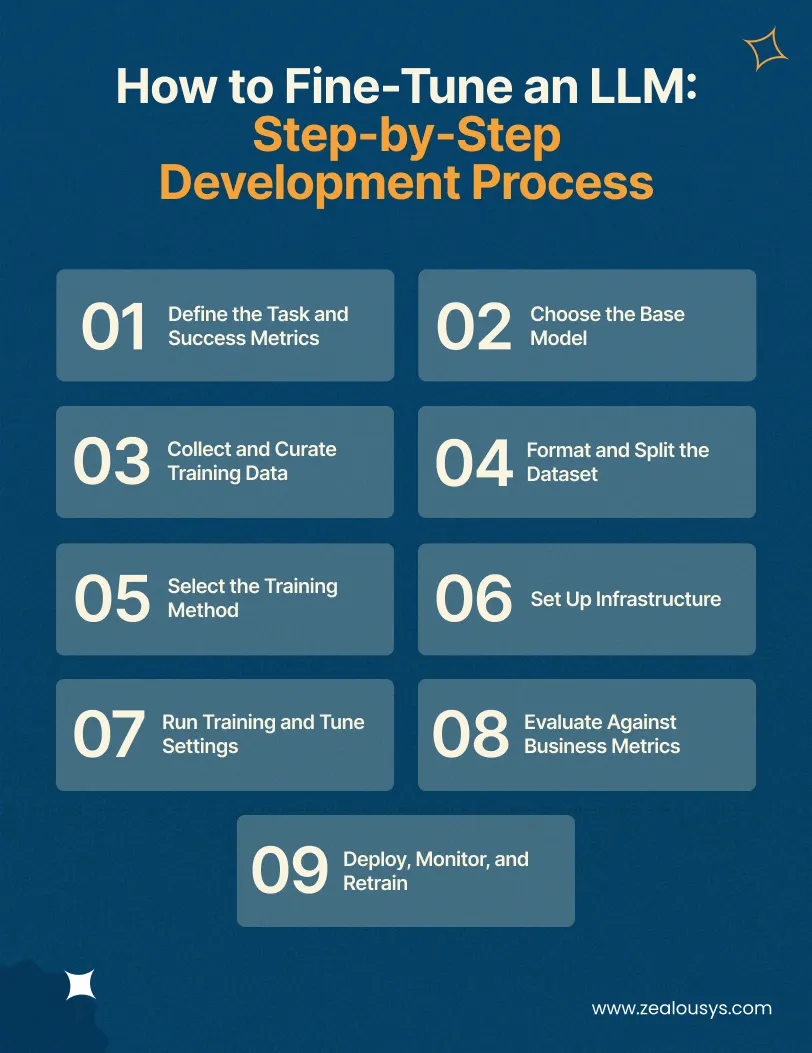
Write down the number that has to move before anyone touches a model. “Reduce misrouted tickets from 22% to under 8%” is a target; “improve accuracy” is not. This step belongs to the business, not engineering, and without it there is no way to know when to stop spending. 1 to 2 weeks, alongside model selection.
Two decisions: open or proprietary, and how large. Open source LLM options for business, such as Llama, Mistral, and Qwen, ship with open weights you can self-host, which matters enormously when data residency is a constraint. Our Llama 4 vs GPT-4o comparison covers the trade-offs.
Check the licence first. “Open weights” does not always mean unrestricted commercial use. The Llama Community License allows broad commercial use but requires a separate agreement with Meta above 700 million monthly active users, and bars using outputs to train competing models. Other families ship under Apache 2.0, and some variants are research-only. Finding out after launch means rebuilding.
On size: start with the smallest model that plausibly hits your target. A well-fine-tuned 7B to 13B model regularly beats a poorly-fine-tuned 70B on a narrow task, at a fraction of the daily running cost.
The largest and least glamorous part of the project. You need examples of the input your model will see in production, paired with the output you want. “Production” is load-bearing: training on clean, ideal examples produces a model that fails on the messy reality of real user input. 2 to 6 weeks.
One consistent schema across every example, then a split into training, validation, and test sets. Build the held-out test set before training starts, so nobody is tempted to grade on data the model has already seen. It is how you prove the project worked.
Full fine-tuning, LoRA, QLoRA, instruction tuning, or preference tuning. This choice drives your GPU budget more than any other, and the next section covers the trade-offs.
Managed platform or your own GPUs. Managed starts faster and runs without an MLOps function. Self-hosted costs less at volume and keeps data inside your boundary, usually the deciding factor rather than price. Most teams build on the Hugging Face stack, where the PEFT library handles LoRA and QLoRA without custom infrastructure work.
Learning rate matters most, epoch count second, and 1 to 3 passes is usually right. Watch validation metrics rather than training loss: when loss keeps falling while validation flattens, the model is memorising, and you should stop. Budget for several runs, because nobody gets the settings right first time. 1 to 3 weeks of experiments, then 1 to 3 weeks of evaluation.
Run the held-out test set and calculate the metric from Step 1. Add human review of a sample, because automated scores miss tone, safety, and the subtle wrongness that damages trust. Public benchmark scores are not evidence. Only performance on your data counts.
Quantise the model to cut memory and latency, deploy it behind your serving layer, and instrument it for drift, because real-world inputs shift and accuracy decays quietly. Plan on revisiting the model every 3 to 6 months. Fine-tuning is not a one-time purchase, and budgeting it as one is how projects quietly degrade in year two. 2 to 4 weeks to integrate and deploy, then ongoing.
The method you pick sets your compute bill.
Updates every parameter. Highest performance ceiling, highest cost by a wide margin, and it needs a large clean dataset to justify itself. Reserve it for cases where efficient methods have measurably fallen short.
LoRA freezes the base model and trains a small set of adapter weights alongside it. The original paper by Hu et al. reported cutting trainable parameters by up to 10,000 times and GPU memory by three times against full fine-tuning of GPT-3, while matching or beating its quality. A job needing a multi-GPU cluster for a week becomes a single GPU for a day. QLoRA adds 4-bit quantisation, cutting memory further and putting larger models within reach of modest hardware. These two are the default starting point for most commercial projects.
Trains the model on instruction-and-response pairs so it follows directions and produces your required structure reliably. This is the fix for most “the model keeps ignoring my format” problems.
Direct Preference Optimization (DPO) and RLHF train against ranked human judgements about which of two outputs is better. Useful when quality is a matter of tone, taste, or safety rather than a checkable right answer. DPO has largely replaced classic RLHF commercially: it drops the separate reward model and reinforcement learning loop, making it simpler and cheaper.
| Method | Relative Cost | Training Time | Best For |
|---|---|---|---|
| LoRA / QLoRA | Low | Hours to days | Most business tasks, first attempt |
| Instruction Tuning | Low to Moderate | Days | Format and instruction compliance |
| Preference Tuning (DPO) | Moderate | Days | Tone, judgement, safety alignment |
| Full Fine-Tuning | High | Days to weeks | Large datasets, deep domain adaptation |
Less than most people expect, at a higher quality bar than they assume.
Narrow classification and format-following tasks show real gains from 500 to 1,000 clean examples. Broader behaviour changes across varied inputs want 5,000 to 10,000. Deep domain adaptation runs higher.
A thousand carefully reviewed examples outperform ten thousand scraped ones. Duplicates make the model over-weight whatever they contain, and inconsistent labelling teaches contradictions, which produce inconsistent output. If two annotators disagree on how an example should be labelled, the model cannot resolve that disagreement either. Fix the guidelines before scaling the labelling.
Where real examples are scarce, a larger model can generate additional examples for a domain expert to review. This works well for rare categories and edge cases, and badly when nobody checks the output, because errors compound quietly across the dataset.
Data preparation is also where most of your budget goes, which brings us to the numbers.
LLM fine-tuning cost varies by model size, data readiness, and how much integration work surrounds the model. These ranges reflect what commercial projects typically run.
| Project Type | Typical Cost | Typical Timeline |
|---|---|---|
| Small LoRA / QLoRA Pilot | $10,000 to $20,000 | 3 to 6 weeks |
| Business-Focused Fine-Tuning | $20,000 to $80,000 | 6 to 12 weeks |
| Enterprise LLM Fine-Tuning with Integrations | $80,000 to $180,000+ | 3 to 5 months |
| Large-Model or Complex Production System | $180,000+ | 4 to 6+ months |
Not on GPUs. Compute is usually the smallest line on a LoRA project. The budget goes to data: sourcing, cleaning, labelling, and reviewing the labels.
Evaluation is the second most underestimated cost. Building a proper test set and running human review takes expert time, and it is the first work cut when schedules slip. Cut it and you cannot prove the model works, which tends to be exactly what your board asks about.
Integration is third. A model that performs well in a notebook still needs serving infrastructure, API surfaces, monitoring, and connections to the systems that will use it. The same dynamic shows up in AI agent development costs, where integration routinely outweighs the model work.
| Phase | Typical Timeline |
|---|---|
| Discovery and Model Selection | 1 to 2 weeks |
| Data Audit and Preparation | 2 to 6 weeks |
| Fine-Tuning Experiments | 1 to 3 weeks |
| Evaluation and Iteration | 1 to 3 weeks |
| Integration and Deployment | 2 to 4 weeks |
| Production Monitoring | Ongoing |
Data readiness moves this timeline more than anything else. Teams with clean labelled history finish near the low end. Teams starting from scattered records spend most of their schedule in the second row.
Inference hosting, monitoring, and periodic retraining. Self-hosting a smaller fine-tuned model usually costs less per query than API calls to a frontier model, and the crossover arrives sooner at higher volumes. Work out where that breakeven falls before you commit, because it is often the entire financial case for the project.
Five failure modes account for most of the wasted budget we see.
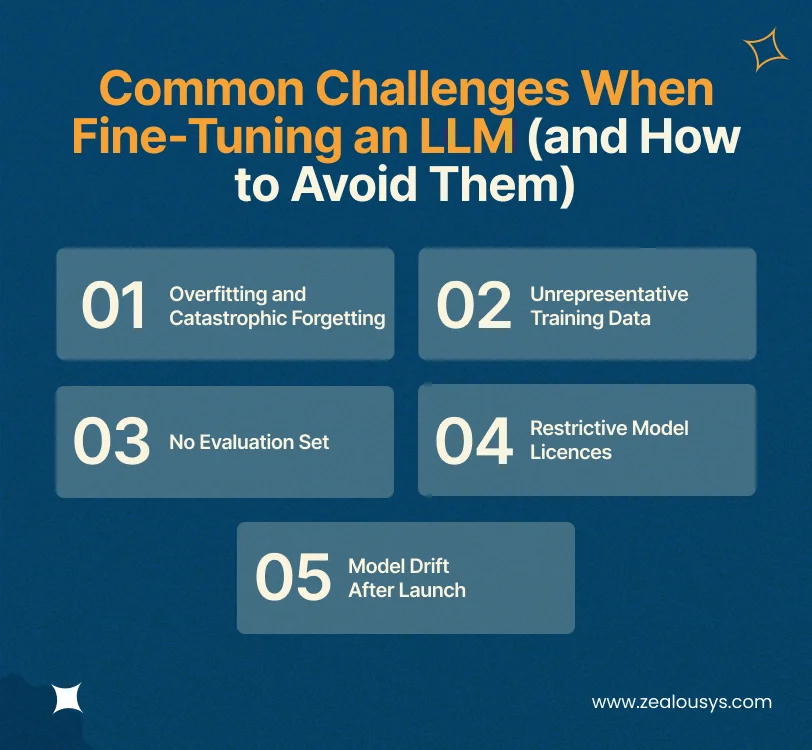
The model memorises training examples and performs worse on anything new. Worse, it can improve at your task while quietly losing general capability. Guard against it with early stopping, a low learning rate, and a validation set you actually watch. Test general capability after training, not just task accuracy.
The most common cause of a project being written off. If your examples are cleaner or narrower than production inputs, the model fails on contact with real users. Sample your training set against live traffic before you train.
Without a held-out test set defined up front, you cannot demonstrate improvement or compare two model versions. Teams that skip this end up arguing about vibes in a review meeting.
The risk is a licence that blocks commercial use, or attaches conditions above a usage threshold, discovered only after deployment. Legal review belongs in week one, alongside model selection.
Accuracy decays as real-world inputs shift. Without monitoring, the first sign is a customer complaint. Instrument on day one and set a retraining cadence before you need it.
Yes, and for regulated industries this is usually the whole reason to fine-tune rather than call an API. What matters is where training and inference happen.
Open-weight models can be trained and served inside your own VPC, on-premise, or air-gapped, so nothing leaves your infrastructure at any point in the pipeline. This is what makes fine-tuning viable for healthcare, financial services, and government work.
Models can memorise and reproduce their training data. Researchers showed this in Extracting Training Data from Large Language Models, recovering hundreds of verbatim sequences including names, phone numbers, and email addresses. So personal information needs redaction before training, not filtering at the output layer. Output filters catch what they are told to look for; removing the data at source removes the risk category.
The controls are the ones you already apply to any sensitive data system: residency, access control, audit logging, encryption, and a defensible retention policy for training datasets. The training pipeline is data processing, and your compliance framework should treat it as such.
For governance structure, the NIST AI Risk Management Framework is the reference most auditors and enterprise procurement teams recognise. Our guide on making software GDPR compliant covers the underlying data principles.
Ask before signing anything. When you fine-tune an open-weight model, the weights and adapters can be yours outright, hosted wherever you choose, portable to another vendor. Some arrangements are less clean. Get the answer in writing, because the trained model is an asset and you should know whether you own it.
An honest comparison, including where building internally is the better call.
A working capability needs an ML engineer, a data engineer, a domain expert to review labels, and MLOps support. In the US, UK, or Australia, that team costs more per year than most single fine-tuning projects cost in total. The maths favours building internally only if you plan to run this repeatedly.
You already have ML engineers on staff. The model is core intellectual property rather than a supporting feature. You expect many cycles across multiple products. Under those conditions, the capability compounds, and outsourcing wastes the investment.
You need a working system in one quarter, not one year. This is one project rather than a permanent capability. Your engineering team is committed to the product roadmap. Or you need regulated deployment experience that would take a year to develop internally. The same reasoning runs across most AI builds, covered in build vs buy vs integrate for AI chatbot development.
Useful whether you talk to us or anyone else.
1. What success metric will you commit to, and how will you measure it?
2. Who builds the evaluation set, and when?
3. Will you recommend against fine-tuning if RAG solves this more cheaply?
4. Where does training happen, and does our data leave our infrastructure?
5. Do we own the resulting model weights?
6. What is the retraining plan and what does it cost annually?
7. How many training runs are included before scope changes?
8. What happens if the target metric is not reached?
A vendor who answers the third question honestly is usually worth more than one who says yes to everything.
We handle custom LLM development end-to-end for companies in healthcare, finance, logistics, and B2B SaaS, and a fair share of our engagements start with us telling a client that retrieval will solve their problem for a quarter of the price.
Where fine-tuning is the right answer, our LLM fine-tuning services cover the full path: data audit and preparation, base model and licence review, LoRA and QLoRA training, evaluation against metrics you define, and deployment inside your own environment where compliance requires it. You own the resulting model. Our AI consulting team runs the assessment, and our generative AI development and machine learning development practices deliver the build.
For a recent example of that work, see our AI-based chatbots for law firms.
$10,000 to $20,000 for a LoRA or QLoRA pilot, $20,000 to $80,000 for a business-focused project, and $80,000 to $180,000+ for an enterprise build with integrations. Data preparation, not compute, usually takes the largest share.
Narrow classification and formatting tasks can improve with 500 to 1,000 clean examples; broader behaviour changes typically need 5,000 to 10,000. Consistency matters more than raw volume.
A pilot takes 3 to 6 weeks; a production deployment with integrations takes 3 to 5 months. Data readiness decides where you land.
Use RAG when the model is missing information or your knowledge base changes often, and fine-tune when it behaves incorrectly: wrong format, wrong tone, or weak domain reasoning. Many production systems use both.
Sometimes. It makes sense with a high-volume repetitive task, several hundred to a few thousand usable examples, and a measurable target. At low volumes, prompt engineering and retrieval serve you better for less.
Yes. With open weights, you control the whole pipeline: training and inference both run inside your own infrastructure, so no data reaches a third-party API. Redact personal information before training regardless.
With open-weight base models, the weights and adapters can be yours outright and portable between hosting providers, subject to the base licence. Confirm ownership in writing before the engagement starts.
An ML engineer, a data engineer, a domain expert to review labels, and MLOps support. Most companies running a single project find it cheaper to bring in a partner than hire that group.
Our team is always eager to know what you are looking for. Drop them a Hi!

Ruchir Shah is Technology Head at Zealous System with hands-on expertise in AI/ML, Microsoft Azure, .NET, Node.js, Python, React, and Angular. He leads enterprise software development, champions digital transformation, and mentors developers building the future of intelligent apps.


Comments